
A dry lease fails in two places: the paper and the practice. The paper problem shows up in a review or an enforcement inquiry. The practice problem shows up on the ramp, when nobody in the chain can say who decided the flight would go. This checklist works both sides, in order, with the pass signal, the fail signal, and what to do when an item fails.

Who this checklist is for
A dry lease agreement is a contract where the lessor provides the aircraft and nothing more, while the lessee supplies the crew and holds operational control of every flight. This checklist is for the owner, the lessee, the pilot or chief pilot who will fly the aircraft, the operations person who will schedule it, and the counsel reviewing the draft before anyone signs.
Work the sections in order. Sections 1 through 3 decide whether the deal is legally what it claims to be. Sections 4 and 5 decide who pays and who proves it later. Each item checks the written term and the actual conduct, because the FAA treats the aircraft owner as the operator unless a properly structured dry lease is in place and followed.
1. Confirm the deal is truly a dry lease
The core test is simple. Title the document whatever you like. What matters is what each party provides and does.
Read what the lessor actually provides. Pass: aircraft only, or aircraft plus separately identified items such as insurance, hangar or a maintenance program, with no crew. Fail: the lessor supplies pilots, or supplies ‘a pilot’ as an accommodation. On a fail, either remove the crew from the lessor’s column or accept that you’re negotiating a wet lease and price it that way. A bundled rate that includes insurance, maintenance and hangarage is common in short-term, non-exclusive leases and does not by itself make the lease wet. Crew is the line. For the side-by-side view of dry and wet structures, including how the 12,500 pound truth-in-leasing threshold applies, see ‘Wet vs Dry Lease: Cost, Control and Risk.’
Look for companion agreements. Pass: any management, pilot-services or scheduling agreement is separate, disclosed, and leaves flight decisions with the lessee. Fail: a ‘dry’ lease sits beside a pilot-provision agreement with the same counterparty. On a fail, put every agreement on one page side by side and map who decides what. Substance beats form.
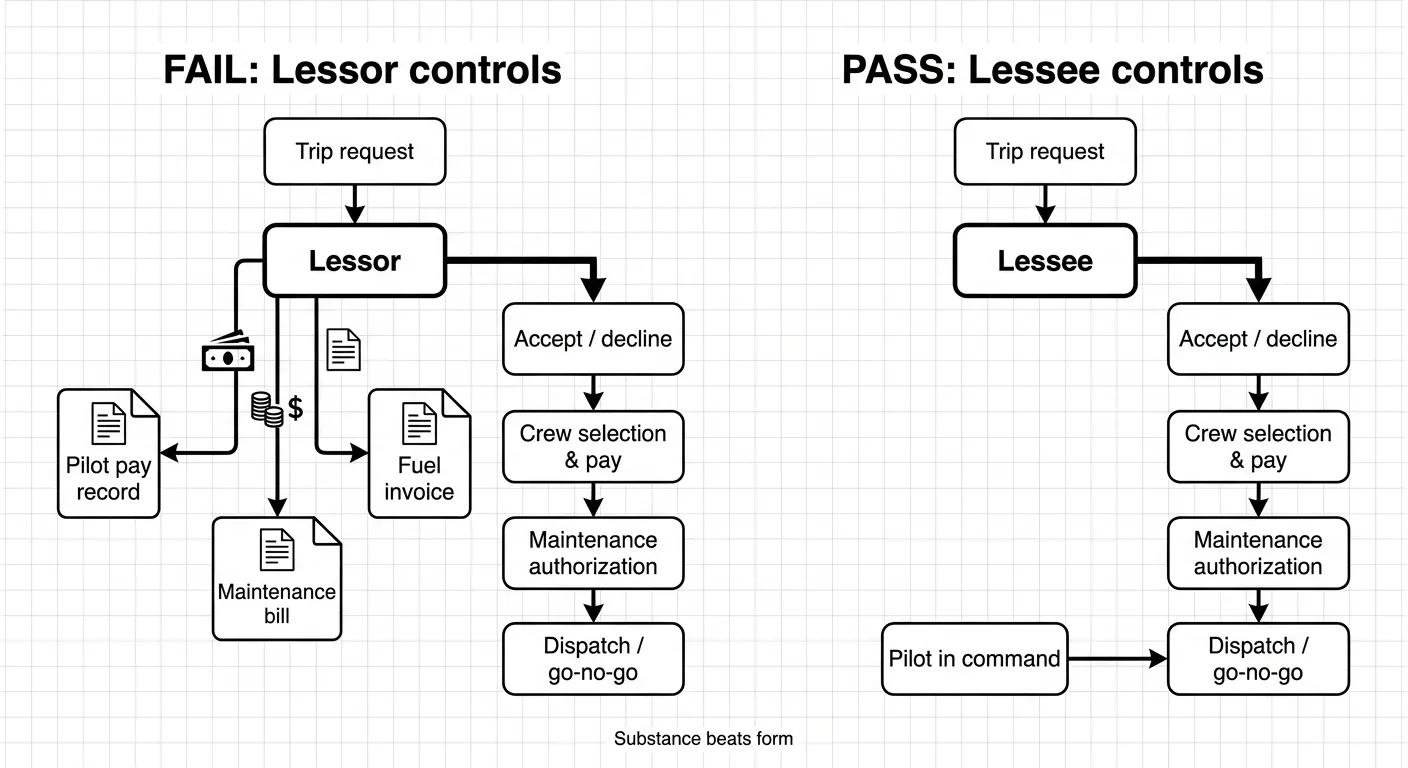
Compare the paperwork with the money trail. Pass: the lessee’s name is on the fuel invoices, the trip sheets, the dispatch account and the pilot pay records. Fail: the lessor pays the crew and rebills it, or passenger requests arrive in the lessor’s inbox. On a fail, stop and fix the flow of requests and payments before the first flight, not after.
2. Verify who has operational control
Operational control is the authority to initiate, conduct and terminate a flight. The FAA reads it from conduct across a list of factors: who assigns the crew and the aircraft, who accepts the trip request, who initiates and terminates the flight, who sets fuel and weather requirements, who approves loading, who directs and pays for maintenance, who confirms the aircraft is airworthy for that trip, and who pays the operating costs.
Two examples, side by side. Fail: the owner supplies the pilot, puts the trips on the schedule, or pays the maintenance bills directly. That is the owner operating the aircraft with a lease stapled to it. Pass: the lessee independently selects and pays the crew, accepts or rejects each flight request, and authorizes the maintenance needed to release the aircraft for its own trips.
Flight acceptance and go/no-go authority. Pass: the lessee accepts or declines each trip and the pilot in command, employed or contracted by the lessee, makes the dispatch, fuel and weather call. Fail: the lessor or a manager decides whether the flight happens or which aircraft fills it. On a fail, rewrite the request path in writing and document it per trip.
Crew selection, qualification and payment. Pass: the lessee selects, qualifies and pays the crew. The lessor may hold a reasonable approval right over pilot minimums for insurance purposes and nothing more. Fail: the lessor’s employees fly the trips. Credential tracking sits with the party holding control. At WingLeader, before any trip goes on the schedule, the assigned crew’s credentials, currency and training records are checked. A trip with a crew member out of currency does not get scheduled until it’s fixed.
Maintenance direction and operating expenses. Pass: the lessee authorizes the line maintenance needed to release the aircraft for its flights and pays the operating costs the lease assigns to it. Fail: the lessor approves every maintenance action and pays every bill while the lessee claims control. On a fail, split routine and non-routine authority with dollar thresholds. The full treatment of control failures is in ‘who has operational control in a dry lease.’
3. Check the truth-in-leasing clause and FAA filing steps
According to the FAA, truth in leasing applies by regulation to aircraft weighing more than 12,500 pounds. For a U.S.-registered large civil aircraft leased after January 2, 1973, the sequence is fixed. Sign the written lease with the concluding clause, deliver a copy to the FAA within 24 hours of execution, notify the FSDO at least 48 hours before the first flight, and carry a copy aboard.
Confirm the clause content. Pass: the concluding clause identifies the Federal Aviation Regulations under which the aircraft has been maintained and inspected during the preceding 12 months, states compliance for the intended operation, and carries the printed name, address and signature of the person responsible for operational control. Fail: the lease says only ‘the aircraft is airworthy.’ On a fail, send it back to counsel.
**LII’s 14 CFR § 91.23 reports that a copy of the executed lease must be mailed within 24 hours of execution to the FAA Aircraft Registration Branch. The responsible Flight Standards District Office must be notified before the first flight under the lease, usually well in advance. Pass: proof of mailing, a dated FSDO notice and a signed onboard copy all live in one file. Fail: the first flight departs while the paperwork is ‘in process.’ On a fail, the flight waits.
Verify the onboard copy and the named signature. Pass: a copy of the lease is carried aboard and a named individual, not an entity, has signed the clause. Fail: the lease names only a company or an owner in the abstract. On a fail, name a real person and get the signature before the first flight.
4. Match maintenance, inspections, and airworthiness responsibilities
Under a genuine dry lease, the lessee must be able to prove continuing airworthiness for the flights it conducts. ‘Lessee is responsible for all maintenance’ is the clause that produces the most end-of-term argument. It says nothing about who decides a repair is necessary, who approves the spend, or who carries the downtime.
Allocate every task by trigger. Pass: routine inspections, mandatory inspections, airworthiness directives, service bulletins, repairs, alterations, damage and component replacement each have a named decision maker, an approval threshold, a deadline, a cost rule and a record requirement. Fail: one sentence covering ‘all maintenance.’ On a fail, build the matrix below into an exhibit.
Separate pre-existing from in-term. Pass: open discrepancies, deferred items and overdue intervals at delivery stay with the lessor unless priced into the rate. Fail: the lessee inherits a squawk list it never saw. Under 14 CFR 91.403, the owner or operator is generally responsible for keeping an aircraft airworthy and complying with applicable maintenance rules.
Fix the authoritative meter and the downtime rule. Pass: the lease names the meter of record for hours and cycles, sets a reporting frequency, states whether positioning, ferry and training flights count, and says how many consecutive out-of-service days trigger rent abatement or a term extension. Fail: the operator’s tracking and the lessor’s records disagree at redelivery by 40 hours, and nobody wrote down who pays rent while the aircraft sits. On a fail, reconcile before delivery and report monthly.
| Task | Who decides it is necessary | Approval and downtime rule | Who pays | Record that closes it |
|---|---|---|---|---|
| Scheduled and mandatory inspections | Program intervals, tracked by the lessee | Scheduled ahead. Downtime inside the program allowance does not abate rent | Lessee for in-term intervals, lessor for any interval overdue at delivery | Signed inspection entry and work package |
| Airworthiness directives | The AD, not the parties | Lessee schedules, lessor consents to the compliance method within a stated number of business days | Lessor for ADs due before delivery, lessee for in-term ADs | AD compliance record with method and date |
| Non-mandatory service bulletins | Lessor elects | Lessor’s call, timed so it doesn’t take the aircraft off the lessee’s schedule | Lessor | Logbook entry plus written owner approval |
| Unscheduled repairs and AOG | Maintenance provider evaluates, lessee authorizes | Lessee authorizes up to a stated dollar threshold, lessor consents above it with a same-day response duty while AOG | Lessee below the threshold, per the lease above it | Release to service |
| Alterations and modifications | The party requesting the change | Lessor consents in writing before work starts | The party requesting the change | Approved data and Form 337 where required |
| Damage and incident repair | Lessee reports, technical evaluation decides | Aircraft stays on the ground until evaluated. Lessor consents to the repair data | Insurance first, then deductible and balance per the indemnity | Repair data approval and records |
| Components and life-limited parts | The tracking system limits | Lessee tracks, lessor consents to swaps | Per lease, from reserves where reserves are held | Traceability and back-to-birth records |
If your operation runs one to five aircraft and nobody is minding this matrix between trips, see how back-office support handles the tracking and the paperwork.
5. Audit records, inspection rights, and redelivery condition
This section is the evidence file. Before signing, verify the delivery records package. During the term, verify the lessor’s access is limited to inspection. At the end, verify the return standard is measurable.
Delivery package and component time schedule. Pass: airframe, engine, APU and propeller logs, AD and SB status, repair and alteration records, weight and balance, equipment list, database currency, parts traceability and a component time schedule, all indexed and jointly signed. Fail: ‘as is,’ no index, records held by a third party. On a fail, treat the gap as an airworthiness and financing defect and do not accept delivery.
Inspection rights that do not become control. Pass: the lessor may inspect at reasonable times with advance notice, at defined locations, at its own cost, with a separate path for an urgent safety concern. Fail: the lessor can ground, crew or dispatch the aircraft under an inspection clause. On a fail, narrow the clause. Broad lessor rights aren’t automatically safer. They create conduct evidence that contradicts a dry lease.
Objective redelivery standard. Pass: required configuration, damage limits, inspection status, remaining life on engines, APU and landing gear, deferred-defect treatment, records delivery, return location, a cure period and a dispute mechanism. Fail: ‘good operating condition and normal wear and tear.’ On a fail, write the schedule. Undefined return language is where six-figure component arguments start.
Who pays what, line by line. A dry lease only has to exclude crew. Everything else is allocated by contract. Audit the rate sheet against this table and write the answers into an exhibit.
| Line item | Who usually carries it | Where it goes wrong |
|---|---|---|
| Base rent | Lessee pays the lessor for the aircraft | Rent quoted as an all-in number with no breakdown |
| Fuel and landing fees | Lessee, on the lessee’s own accounts | Lessor’s fuel card used, which becomes control evidence |
| Crew | Lessee, always | Lessor pays the pilot and rebills it |
| Insurance | Either party. Often the lessor procures and includes it in the rate | Lessee is not a named insured on the policy it relies on |
| Maintenance reserves | Lessee funds, lessor holds | No rule on refunds, credits or who owns parts removed |
| Hangar | Either party. Often bundled in a short-term rate | Bundled and also billed as a pass-through |
Warning: records held by a manager, a maintenance provider or a prior operator with no guaranteed lessee access are the single most expensive item on this list. Missing or inaccessible records are an airworthiness defect and a financing defect at the same time, not an administrative inconvenience. They block redelivery, financing, sale and, in a records review, the ability to show continuing airworthiness. On a dry lease, WingLeader keeps the lease paperwork, the records and the procedures, and acts as the point of contact between lessor and lessee so who holds operational control is documented for every flight. WingLeader does not draft the lease and does not give legal advice.

Red flags that stop the job
Any one of these means pause the signature or the first flight and bring in aviation counsel or a technical reviewer.
- No written lease, or no concluding truth-in-leasing clause in large print where the regulation applies to the aircraft.
- Nobody can name the individual with operational control, or two parties each believe the other has it.
- The lessor provides the crew, the schedule or the flight acceptance, in the document or in practice. Enforcement of illegal charters is an active FAA priority, particularly in Florida.
- The FAA copy, the FSDO notice or the onboard copy is missing and a flight is on the schedule.
- Records are inaccessible, incomplete, or held by a third party with no written access right.
- Maintenance authority and maintenance payment sit with different parties with no threshold or approval process.
- Insurance does not match reality: the named insured is the wrong entity, the approved-pilot warranty does not cover the crew actually flying, the permitted use describes an operation nobody runs, or nobody has read the hull deductible. A claim can be denied on any one of those. The deductible lands on whoever the indemnity names.
- No lienholder consent where financing documents require it.
- Redelivery described only as ‘airworthy’ with no component schedule.
What to do with the results
Sort the outcome into three buckets. If every item passes, sign, file on the dated log, put the onboard copy in the aircraft and calendar the first utilization report. If items in sections 4 or 5 fail, revise. Those are drafting and exhibit problems. They’re cheaper to fix now than to argue at redelivery. If anything in sections 1 through 3 fails, or any red flag appears, stop and escalate to aviation counsel before the first flight. Those failures go to whether the arrangement is a lawful dry lease at all.
For the background this checklist assumes, read “Aviation Dry Lease: The Complete Guide.” Rent, reserves and the all-in operating budget belong in ‘dry lease aircraft cost.’
If the checklist turned up more open items than your operation can carry between trips, talk through what back-office support would cover for your aircraft.
Frequently Asked Questions
If it’s a dry lease, why are some leases still charging me for insurance, maintenance, and hangar?
Because a dry lease only has to exclude crew. Ask for the rate broken out line by line. For what those items run in a full budget see ‘dry lease aircraft cost.’
Can the lessor provide pilots or scheduling support without converting a dry lease into a wet lease?
The lessor cannot supply the crew. A third-party vendor can handle scheduling, dispatch, trip logistics and credential tracking for the lessee without touching operational control, as long as the lessee accepts the trips and the pilot in command makes the go or no-go call. The test is who decides, not who types the itinerary.
What happens if the aircraft fails the pre-delivery inspection?
Do not accept delivery. A failed pre-delivery inspection, an overdue interval, a life-limited part near expiry, missing parts traceability or an unapproved modification all belong to the lessor’s side of the ledger until they’re corrected or priced into the rate. Put the findings in writing, set a correction deadline, and make acceptance conditional on a re-inspection signed by both parties.
What happens if the aircraft is unavailable for weeks because of maintenance?
That depends entirely on language most leases omit. Negotiate a maintenance downtime allowance. For example rent abatement after a stated number of consecutive out-of-service days, plus a term extension option, a substitute aircraft provision if the lessor has one, and a termination right if downtime exceeds a hard limit such as 60 days. Without those terms, rent usually keeps running.
Can I end a dry lease early, and what will the penalty be?
Only if the lease gives you a right to. Look for three mechanisms: a stated early-termination fee or remaining-rent obligation, a default and cure structure with a typical 10 to 30 day cure period, and the redelivery obligations that survive termination. A lease with no early exit and a vague return standard is the combination that produces the largest surprise bill.
How should engine, APU, and life-limited-part obligations be written into a dry lease?
Tie each one to a measurable number at delivery and a required number at return: hours and cycles remaining to overhaul or retirement, program enrollment status, and who owns parts removed during the term. State who pays when a component reaches its limit mid-term and whether maintenance reserves are held, refundable, or credited against the work. Back-to-birth traceability for life-limited parts should be a delivery condition, not a redelivery surprise.