
According to Flying Magazine, a new private jet runs anywhere from $1.1 million to $90 million before it ever leaves the ramp. That number gets all the attention. It also gets budgeted for last most of the time. The money that decides whether ownership works is the recurring money: crew, hangar, insurance, maintenance reserves, management, fuel, and the depreciation nobody writes a check for but everybody pays. Owners of professionally crewed jets commonly land somewhere between $500,000 and $1 million or more per year. The spread inside that range comes down to aircraft class and how often the airplane flies.
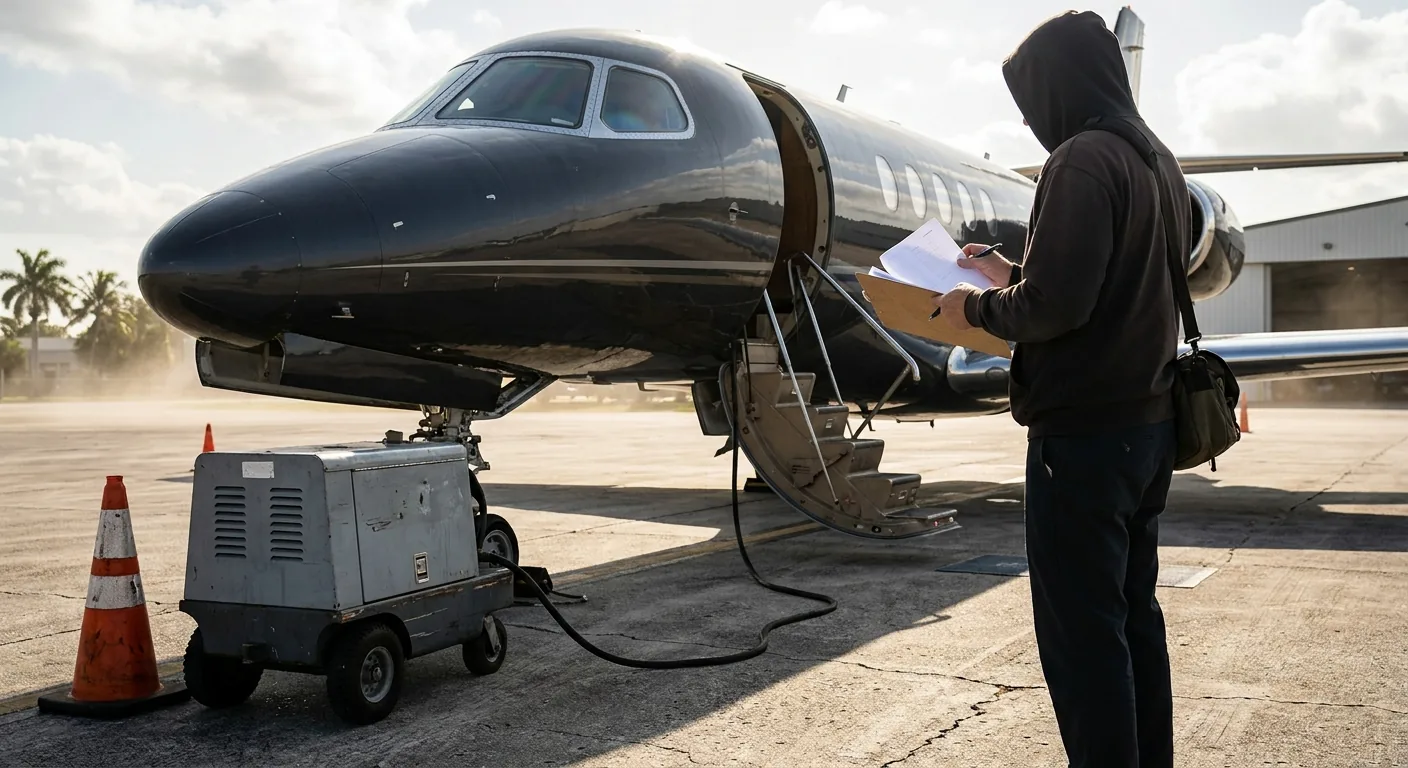
What private jet ownership cost really includes
Private jet ownership cost is the total of four things: the purchase price, the fixed annual costs that run whether the airplane flies or sits, the variable costs that accrue by flight hour, and the depreciation you carry until resale. Published figures disagree because they mix those four, so one article says $200,000 a year and the next says $1.5 million for the same class of airplane.
- Acquisition. Purchase price plus the cash to close: pre-purchase inspection, escrow, title and lien searches, legal work, sales and use tax, registration, delivery.
- Fixed annual cost. Crew, recurrent training, hangar, insurance, management or back office support, subscriptions, calendar-driven inspections.
- Variable cost. Fuel, maintenance reserves, engine and APU program contributions, fees, handling, repositioning legs.
- Depreciation. What the airplane loses between the day you buy it and the day you sell it.
Three situations send people looking for these numbers. The first is a first-time buyer who needs a realistic annual budget before signing anything. The second is a charter or fractional user whose hours have grown enough that whole ownership looks cheaper on paper. The third is an existing owner checking whether the airplane they have still matches the mission they actually fly.
How to decide which ownership path fits your flying
Start with the access model, then pick the airplane. Choosing a Citation Latitude before you have decided whether you should own anything at all is how people end up with a $14 million asset flying 70 hours a year.
Four mission questions come first:
- Mission length and passenger count. Two passengers on 600 mile legs is a light jet or turboprop mission. Six passengers on transcontinental legs is super midsize or heavy. Buying range you fly twice a year is the most expensive mistake on this list.
- Schedule predictability. Firm, repeating routes favor ownership, because you can staff crew and schedule maintenance around known gaps. Short-notice travel favors programs that guarantee a callout time, as long as you read what that guarantee covers.
- Peak-day exposure. If your travel clusters around holidays, major sporting events, or the Florida season, check the peak-day list in any card or fractional contract before you compare hourly rates. Peak days are where guaranteed availability turns into a surcharge or a substitute aircraft.
- Crew model. Owner-flown, two salaried pilots, or contract crew through a manager. After aircraft class, this choice moves the annual budget more than anything else.
Then run your hours up the ladder, using your own trip history rather than a brochure:
- Around 100 hours a year. On-demand charter or a jet card almost always wins. Fixed cost spread over 100 hours makes the owned hour expensive no matter what the airplane burns.
- Around 200 hours. The traditional crossover point, and still the place where fractional or charter often makes more sense once depreciation and financing sit in the model.
- Around 300 hours. Ownership usually pulls ahead on cost for a given class, assuming the airplane fits the mission and the schedule holds.
- Around 500 hours. One airplane and one crew pairing stop covering the calendar. Plan for supplemental lift, a second crew set, and maintenance downtime that now has to happen while you still need to fly.
Published break-even ranges cluster between 200 and 300 hours a year. No single threshold fits every mission. It moves with depreciation on your specific airplane, whether you financed it, what management or back office fees you pay, and the cost of the time somebody in your organization spends running the operation. Most published break-even numbers count fuel and direct operating cost only, which pulls the crossover earlier than your own books will.
Here’s where people get stuck: more flying does not automatically make ownership cheaper. Fuel, reserves, engine exposure, crew duty limitations, and downtime all scale up with you.
How much a private jet costs by aircraft class
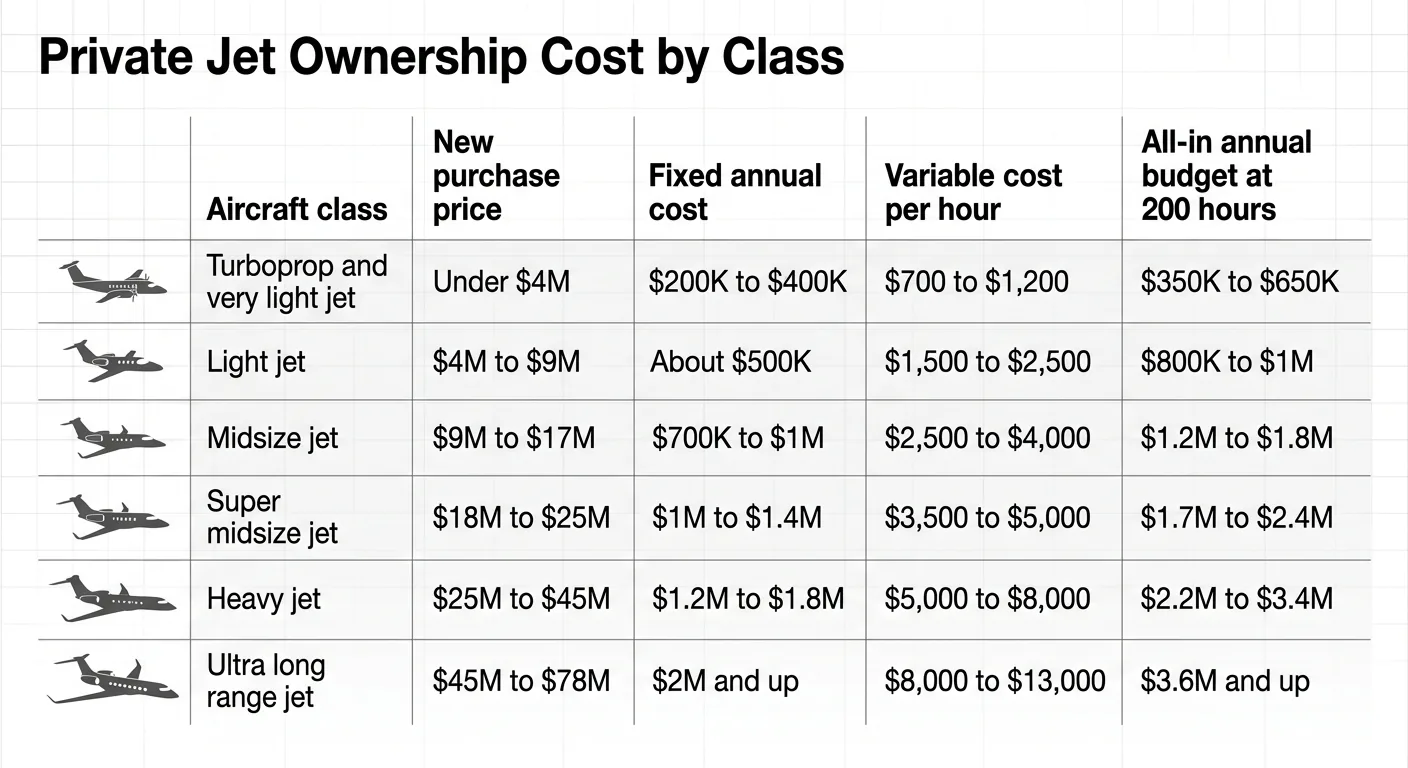
Aircraft class sets both numbers that matter: what you pay once and what you pay every year after. Classes differ in crew requirement, inspection intervals, hangar footprint, and insurance exposure. One generic ownership figure never survives contact with a real airplane.
Approximate 2026 figures. The last two columns assume about 200 flight hours a year with a professional two pilot crew.
| Aircraft class | New purchase price | Fixed annual cost | Variable cost per hour | All-in annual budget at 200 hours |
|---|---|---|---|---|
| Turboprop and very light jet | Under $4M | $200K to $400K | $700 to $1,200 | $350K to $650K |
| Light jet | $4M to $9M | About $500K | $1,500 to $2,500 | $800K to $1M |
| Midsize jet | $9M to $17M | $700K to $1M | $2,500 to $4,000 | $1.2M to $1.8M |
| Super midsize jet | $18M to $25M | $1M to $1.4M | $3,500 to $5,000 | $1.7M to $2.4M |
| Heavy jet | $25M to $45M | $1.2M to $1.8M | $5,000 to $8,000 | $2.2M to $3.4M |
| Ultra long range jet | $45M to $78M | $2M and up | $8,000 to $13,000 | $3.6M and up |
Hourly cost separates the classes as sharply as purchase price does. AOPA reports that an Airbus ACJ320 was reported to cost $7,964.69 per hour to operate. A pre-owned airplane at the bottom of a band is cheaper to buy and rarely cheaper to run, because engine program enrollment, parts lead times, and avionics mandates follow the airframe rather than the price. An airplane on a current engine program also resells faster and holds value better than an identical one off program.
The month by month maintenance math behind these bands, including reserves and inspection timing, is in “private jet maintenance cost per month.” If you are weighing a share instead of a whole airplane, the share price, monthly fee, and occupied hour math sit in “fractional private jet ownership cost.”
Fixed annual costs you pay even when the jet does not fly
A crewed light jet that flies 25 hours in a year costs nearly as much to own as one that flies 250. Crew salaries, hangar rent, insurance premiums, recurrent training, tracking subscriptions, and calendar-driven inspections are billed on a schedule, not on a flight log.
What keeps running on a grounded airplane:
- Crew. Salaries and benefits for two pilots, plus recurrent training slots that are booked and paid whether or not the airplane moved that quarter.
- Hangar. Rent continues. In constrained markets the lease carries a minimum term that outlasts your interest in the airplane.
- Insurance. Hull and liability premiums track insured value, pilot experience, and operating area, not hours flown. A rule of thumb is 1 percent to 3 percent of insured value annually.
- Management or back office. The fee for services bills month to month regardless of activity.
- Calendar maintenance. Annual and phase inspections, airworthiness directives, service bulletins, and pitot static and transponder certifications all come due on dates.
- Engine and APU programs. Many carry monthly minimums, so you pay for hours you did not fly.
- Subscriptions and administration. Maintenance tracking, charts, weather, flight planning, trip support, and the accounting work behind all of it.
A crewed light jet that flies 60 hours still owes most of the $500,000 fixed band in the table above. That works out north of $8,000 per hour on an airplane whose published variable rate is a fraction of that. Low utilization does not lower the ownership bill. It raises the cost of every hour you do fly.
Variable costs that rise with every hour in the air
Variable costs exist only because you flew: fuel, maintenance reserves, landing and ramp fees, handling, catering, deicing, international permits and overflight charges, crew hotels and per diem, repositioning legs that burn fuel with nobody in the back.
Maintenance reserves behave differently from everything else on that list. A reserve is money you accrue per hour against an event that has not happened yet: an engine overhaul, a landing gear event, a major inspection. Common guidance is 5 percent to 10 percent of aircraft value annually, or roughly $300 to $800 per flight hour on a midsize jet and $1,000 or more per hour on a heavy. Skip the accrual and the overhaul still arrives, as a six figure surprise instead of a planned draw. When those events land on the calendar is the subject of “private jet maintenance cost per month.”
For an anchor at the entry end of the market, AOPA reported a Cirrus Vision SF50 at $661.53 per hour to operate in 2015. Hourly numbers age. Fuel price alone can move a budget by six figures in a busy year.
Short legs punish the hourly math. Home base to Tampa, Tampa to Tallahassee, then home is about 2.4 hours of flight time with three landings, three handling and ramp events, and catering on two legs, so the ground charges on that day can rival the fuel bill. Repositioning is the line owners underestimate most. It never appears on a published hourly rate.
If you want a quick picture of where your own hours land, the WingLeader operating cost calculator estimates annual variable cost by jet category, flight hours, and fuel price.
Hidden costs that change the true ownership total
The costs that wreck budgets are rarely exotic. They sit outside the operating cost spreadsheet: inspection findings, taxes, financing interest, depreciation, and the paperwork exposure that comes with how the airplane is used.
At acquisition. A pre-purchase inspection on a used jet is where deferred maintenance, corrosion, incomplete records, open airworthiness directives, and overdue service bulletins surface. Budget for the inspection itself, for the downtime while it runs, and for the discrepancy list that follows. Add title and lien searches, escrow fees, aviation counsel, sales and use tax in the state of delivery or base, registration, ferry costs. A low purchase price often means the previous owner deferred something. Deferred maintenance transfers with the logbooks.
Older airframes. Cheap airplanes get expensive through downtime, not through invoices. Parts lead times on out of production types can ground an aircraft for weeks, avionics that cannot meet current mandates force an upgrade you did not plan, and thin resale demand steepens the depreciation curve exactly when you want to exit.
International and short trips. A Caribbean or Mexico leg adds an overflight permit, eAPIS and customs filings, a customs user fee and decal, and international handling at rates that bear no resemblance to a domestic FBO invoice. Then there is the crew: two nights of hotels, per diem, and a rental car for two pilots is a four figure line on a trip that billed three hours of flight time.
Financing and depreciation over five years. Most published operating cost estimates assume a cash purchase and leave interest out entirely. Take a $10 million midsize jet financed with 20 percent down on a 15 year amortization in the high single digits: interest adds roughly $2.5 million over those first five years. You still carry all of the depreciation. A five year hold commonly takes 25 to 40 percent off the purchase price, which is $2.5 million to $4 million on that airplane. None of it shows up on a monthly statement. Pay cash instead and you trade the interest for the return you gave up on the $10 million. Model both lines against your own tax position with an adviser before you compare any hourly rates.
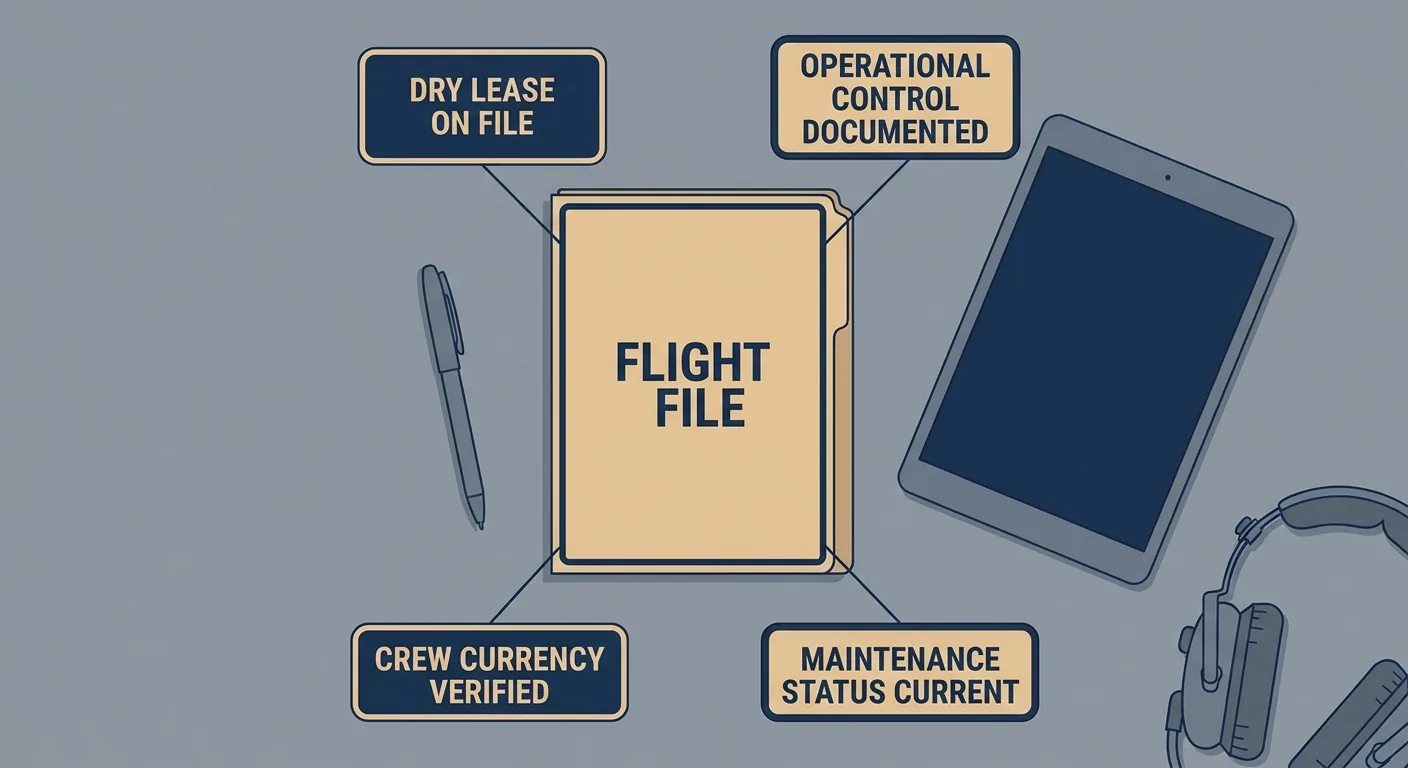
Operational control. If the airplane is used by more than one entity, a related company, a second owner, or anyone paying for a flight, the structure matters. The FAA treats the aircraft owner as the operator unless a properly structured dry lease is in place. WingLeader notes that enforcement of illegal charters is an active FAA priority, particularly in Florida. On a dry lease arrangement, WingLeader keeps the lease paperwork, the records and the procedures, and acts as the point of contact between lessor and lessee so who holds operational control is documented for every flight. WingLeader does not draft the lease and does not give legal advice (that is your aviation attorney’s job).
How ownership compares with fractional, jet cards, and charter
The four access models differ less on hourly rate than on what the rate buys and what it leaves out.
- Whole ownership. You get the asset, the crew, and the calendar, with the airplane available on your notice and configured the way you want it. Nothing is excluded, which is the problem: every fixed cost, the depreciation, and the administration sit with you. Use the hour ladder above against your own trip history before anything else.
- Fractional. You get a share, guaranteed access to an aircraft in your category, and a stated callout time, in exchange for an upfront share price, a monthly management fee, and an occupied hourly rate. Excluded: your specific tail number, peak days at the standard rate, and any certainty about what the share is worth at exit. The share price, monthly fee, occupied hour charges, and buy-back terms are worked through in “fractional private jet ownership cost.”
- Jet card. You get hours at a locked rate from a deposit, with no asset and no exit risk. Excluded: peak days, short-notice trips inside the callout window, and in many programs the unused balance at the end of the term. Read the peak-day calendar before you compare rates.
- On-demand charter. You get the trip you booked and nothing past it, which keeps it the cheapest model well below 200 hours a year. Excluded: guaranteed availability, aircraft consistency, and any control over crew or schedule.
Occupied hour rates and card rates usually sit on top of fuel surcharges, federal excise tax, segment fees, deicing, catering, and international charges, so compare all-in trip totals rather than headline rates.
Owners also run this in the other direction and place the airplane on someone else’s certificate for charter. It does reduce the net annual cost when the airplane would otherwise sit, but it adds airframe hours, downtime, scheduling conflicts with your own trips, and operational control questions. Treat the revenue as an offset rather than a plan.
What management fees, crew, and hangarage can add to the budget
These three lines carry most of the fixed cost on a professionally operated jet. They move more with crew model and location than with aircraft type.
- Crew, fully loaded. A qualified private jet crew can cost upwards of $215,000 annually depending on the size of the aircraft. Treat that as the salary baseline. Add benefits and payroll taxes, recurrent training with travel and lodging, and contract relief pilots for vacation, sick time, and duty-day coverage when your two pilots cannot legally finish a trip. A two pilot operation on a midsize or larger jet commonly lands in the $300,000 to $500,000 range fully loaded. Owner-flown operations skip most of it, which is why owner-flown budgets quoted online run so much lower than crewed ones.
- Management fee. Third party aircraft management fees are commonly reported at $60,000 to $150,000 annually for crew coordination, scheduling, maintenance oversight, and compliance. Mid to large jets on full service agreements quote several times that. The fee buys services. Fuel, maintenance, engine programs, insurance premiums, crew salaries, taxes, catering, and extraordinary repairs are pass-throughs that bill at cost, sometimes with a markup. Ask which line is which, then ask for a monthly statement that separates direct trip cost from fixed operating expense with use allocated by flight.
- Hangar, by location. Regional field hangar costs are commonly reported at $30,000 to $100,000 per year. Constrained major markets can exceed $240,000 annually. Enclosed heated space in those hubs runs roughly $5,000 to $10,000 per month. An outdoor tie-down at a smaller field can be as little as $2,400 a year, a fair option for some turboprops and a bad one for a jet sitting in Florida sun and salt air. Basing 40 minutes outside a major market instead of on the primary business field can swing six figures a year. The price of that choice is repositioning legs and crew drive time.
WingLeader works the back office side of that list for operators running one to five aircraft under Part 91: technology, dispatchers, flight following, scheduling, crew coordination, trip logistics, compliance documentation, and expense tracking, with pilot credentials, currency, training records, and availability tracked under crew coordination and verification. Pricing is a monthly retainer per aircraft based on flight hours. Owners who want a turnkey management company that takes the aircraft off their hands entirely are pointed toward firms like Clay Lacy, Solairus, or Jet Aviation.
When to hire a pro before you buy or operate
Name the problem first, because four different professionals solve four different ones.
- Aviation consultant. The pre-purchase decision: operating cost modeled against your real trip history, aircraft types compared against your mission, management company bids read side by side.
- Management company or back office provider. The operation after closing: crew hiring and scheduling, dispatch, maintenance planning, insurance procurement, compliance records, trip logistics.
- Aviation attorney. The structure: entity setup, the purchase agreement, dry lease documents, operational control.
- Aviation tax adviser. Depreciation treatment, state sales and use tax, federal excise tax exposure, and personal use disallowance, all of which have to be set up before closing.
Hire outside help when the decision is irreversible or the exposure is regulatory. In practice that is four triggers:
- Due diligence before an offer. An independent consultant models operating cost against your real trip history and tells you when the airplane you want is the wrong tool for the mission you fly. This is the cheapest hour in the whole transaction.
- Records review at the pre-purchase inspection. Use an inspection facility that is not the seller’s shop, read the complete records, verify airworthiness directive and service bulletin status, check engine and APU program enrollment and transferability, and get an aircraft-specific maintenance forecast for the next 24 months.
- Maintenance oversight after closing. Somebody has to track due lists, approve work, chase parts, and keep records audit ready between trips. A pilot doing that at 10 p.m. after a long duty day is how items get missed.
- Crew planning. Credential tracking, currency, training records, and duty limits are where small operations quietly fall out of compliance. At WingLeader, before any trip goes on the schedule, the assigned crew’s credentials, currency and training records are checked. A trip with a crew member out of currency does not get scheduled until it is fixed.
Before you sign a management agreement, get written answers on five points: termination rights and the notice period on both sides, who owns the aircraft records and how quickly they come back to you, who approves maintenance above a set dollar threshold, how pass-through expenses are marked up, and whether your own use outranks charter bookings on the calendar. If the aircraft will be placed on a Part 135 certificate, confirm the operator’s named personnel and safety program, since Part 135 certificate holders are required to designate key operational and maintenance personnel.
Most owners of one to three airplanes do not need a full management company. They need somebody minding the office between trips so the pilot flying the airplane is not also chasing insurance certificates, maintenance due lists, and dry lease paperwork at 10 p.m.
Before you talk to anyone, gather four numbers: the aircraft category you are considering, the annual hours your actual trip history supports, your home base and what hangar space costs there, and your crew model. Run them through the private jet ownership cost calculator and request the line-item breakdown of fuel, engine program, parts program, and maintenance costs.
Frequently Asked Questions
How much does it actually cost to own a private jet?
There is no single number, which is why published figures disagree so sharply. Use the class table above for the annual band that matches your airplane at about 200 hours a year with a professional crew. An owner-flown light aircraft sits far below any of those bands, because the largest fixed line (two salaried pilots) disappears. Before you trust a figure from anywhere, check the aircraft class, the crew model, the annual hours, and what the number excludes.
Does the 200 to 300 hour break-even include depreciation, financing, and management fees?
Usually not. Add financing interest, depreciation on a five year hold, management or back office fees, and the staff time the operation consumes, and the crossover often moves past 300 hours on an expensive airplane. Model it at 100, 200, 300, and 500 hours using your own purchase and financing assumptions.
How much cash is required beyond the aircraft purchase price?
Budget 2 percent to 5 percent of purchase price for closing costs on a used aircraft, covering pre-purchase inspection, discrepancy corrections, escrow, title and lien searches, legal fees, registration, ferry flights. Then add state sales or use tax, which in many states applies at the point of delivery or base and can be the single largest closing item. Any avionics mandate work or interior refurbishment is on top of that.
Can you write off 100% of a private jet?
Only when the aircraft is used entirely for qualified business purposes and the ownership structure supports it. Bonus depreciation rules, passive activity limits, and personal use disallowance under IRS rules all affect the answer. Personal entertainment use triggers a specific disallowance calculation. Have an aviation tax adviser model it before closing, because the structure has to exist at acquisition, not at tax time.
What percentage of a private jet’s value should be budgeted for maintenance?
The common guideline is 5 percent to 10 percent of aircraft value annually, blending routine invoices with reserve accruals for engines, APU, landing gear, and major inspections. That percentage hides enormous timing variation, since an overhaul year and a quiet year look nothing alike. The month by month view is covered in “private jet maintenance cost per month.”
Is a 1/16 fractional jet share worth it if I fly approximately 50 hours per year?
A 1/16 share typically entitles you to about 50 occupied hours annually, so the hours match. Whether the economics work depends on the monthly management fee, the occupied hourly rate, and the share’s resale value at the end of the term. That comparison is worked through in “fractional private jet ownership cost.”
Can charter revenue offset the cost of owning a private jet?
Sometimes, but gross revenue is not net profit. Reported owner and operator splits run roughly 70/30 to 85/15. Your share still has to cover repositioning, crew, fuel, incremental maintenance, insurance endorsements, handling, and broker commissions. Charter also adds airframe hours, downtime, and regulatory exposure, so run the net number before assuming it reduces your annual cost.
Should a privately owned jet operate under Part 91 or be placed on a Part 135 charter certificate?
Part 91 fits owners flying their own aircraft for their own purposes, with fewer operational restrictions and no air carrier certificate required. Part 135 applies when anyone pays for transportation. It brings named management personnel, a drug and alcohol program, stricter duty and rest rules, and more maintenance requirements. Flying people for compensation under Part 91 is where illegal charter enforcement actions start.
How do I verify a private jet management company’s FAA certificate, SMS compliance, ARGUS rating, and IS-BAO status?
Ask for the air carrier certificate number and verify it with the FAA directly, then request the current ARGUS or Wyvern rating letter and the IS-BAO registration certificate with its expiration date. Ratings lapse, so check the date rather than the logo on the website. For a Part 91 operation, ask whether a documented safety management system and formalized procedures exist, and ask to see a sample of the records they keep.
At what annual flight hours does hiring an aircraft management company make financial sense?
The trigger is rarely hours. It is whether anyone is handling scheduling, dispatch, crew credential tracking, maintenance records, and compliance paperwork between trips. A single aircraft flying 120 hours a year with a pilot doing the office work after hours often needs support more than a 300 hour operation with a dedicated administrator. Compare the fee against what the missed item would cost: a lapsed currency, an overdue inspection, or an undocumented operational control question.