
The hourly rate on a fractional invoice is the smallest number in the deal. The share price, the monthly management fee, the taxi billing and the resale haircut sit around it, and together they decide whether owning a slice of an aircraft beats prepaying for hours on a card. Buyers who compare only the hourly figures routinely pick the wrong option. Usually it’s the one the salesperson hoped for.
A jet card is usually the cheaper choice for roughly 25 to 100 hours a year, and for any flying you can’t predict with confidence. A fractional share starts to pay off only when you reliably use the full entitlement. In practice that means about 100 to 150 hours or more on trips that repeat. What decides it is effective cost per usable hour: everything you spend, minus what you get back at resale, divided by the hours you actually fly.
Key takeaway: Treat these thresholds as rules of thumb. Aircraft category, leg length, tax treatment, peak day exposure and resale value all move the break even point. A buyer who underuses a share can pay more per hour than a card holder at the same nominal rate.
A jet card buys prepaid hours with no asset behind them. A fractional share buys part of an airplane plus the right to use it. According to Business Jet Traveler, larger shares scale the same way, and a typical agreement pairs each one eighth share with 100 hours of flying a year.
| Criterion | Jet card | 1/16 fractional share |
|---|---|---|
| What you buy | Prepaid block of hours or a deposit | Ownership interest in one aircraft |
| Upfront capital | About $200,000 for 25 hours, about $400,000 for 50 | Share purchase price, set by aircraft type and age |
| Monthly fees | None | Management fee, owed whether you fly or not |
| Hourly rate basis | Occupied hours, often a fixed or capped rate | Occupied hours plus taxi time |
| Taxes and surcharges | Often include fuel and 7.5% FET, verify per quote | Usually billed separately |
| Term and exit | 12 to 24 months to use the hours | Commonly five years, buyback at market value less a fee |
| Availability guarantee | Category guarantee inside a callout window | Contract access, shorter notice, interchange rules |
| Resale risk | None, expiry risk instead | Full exposure to depreciation |
A 1/16 midsize share loses to a midsize card at 35 hours, roughly ties near 50, and only pulls ahead around 65. The math behind it is simple:
Effective cost per hour = (share acquisition + five years of fixed costs + variable costs − resale proceeds) ÷ usable occupied hours
Run a published 1/16 midsize illustration through that formula and compare it with a midsize card near $10,142 an hour including tax:
| Annual hours flown | 1/16 midsize effective cost per hour | Midsize jet card | Cheaper option |
|---|---|---|---|
| 35 | about $13,500 | about $10,142 | Card, by a wide margin |
| 50 | about $10,100 | about $10,142 | Roughly even |
| 65 | about $8,250 | about $10,142 | Fractional |
The cash flow explains the curve. One worked midsize example puts year one at about $820,000, covering the share, management fees running $5,000 to $10,000 a month and occupied hours near $4,500 each. Years two through five then run about $270,000 apiece. That’s roughly $1.9 million out the door over five years before any resale money comes back. And the fixed costs stay put whether you fly 35 hours or 65.
Here’s the contrarian part. One model of a 1/16 light jet share at a full 50 hours landed at $12,550 to $13,090 per hour over five years, after management and depreciation, against a light jet card around $7,324 plus 7.5% FET. Flying the whole share didn’t save that buyer. Worth pausing on.
Line item maintenance numbers live in “private jet maintenance cost per month,” and whole aircraft totals are in “Private Jet Ownership Cost: The Complete Guide.” Whole ownership enters the picture around 175 hours in an NBAA rule of thumb and is commonly favored above about 400.
The 50 hours on the contract are billable hours. Fewer of them end up as hours in the air. Minimums and taxi billing shrink them, especially on short legs, a bit like paying for a full parking hour when you only ran in for coffee.
Take a one way, 70 minute hop, flown ten times in a year:
Short regional flying favors the program with the lowest minimums, whatever the posted rate. Then look at what sits outside the headline number:
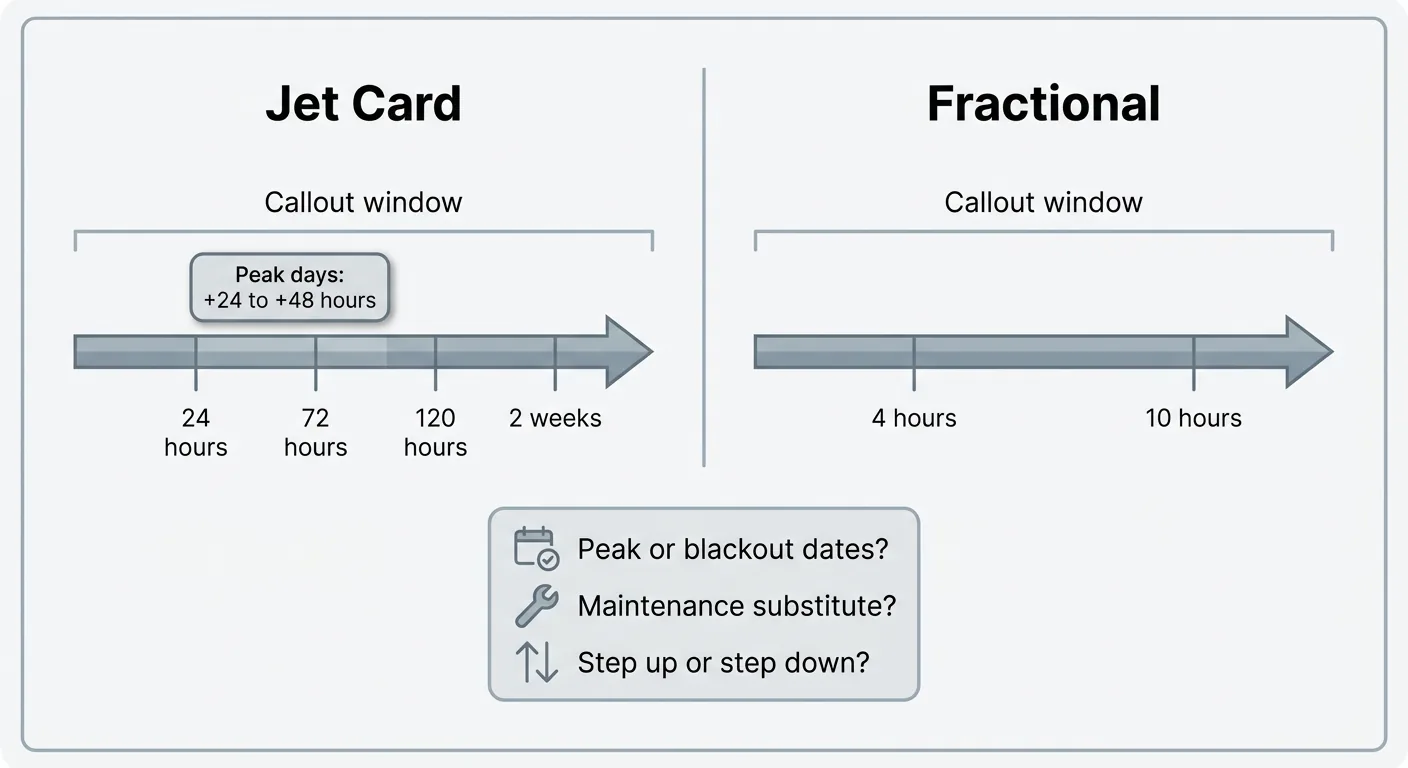
Card guarantees promise an aircraft category within a notice window. Fractional guarantees promise access to the program fleet on much shorter notice. Card callout windows commonly run 24 to 72 hours, with some programs stretching to 120 hours, peak periods adding 24 to 48 more, and a few demanding up to two weeks. Fractional programs can dispatch with 4 to 10 hours of notice.
The trap is the word “category.” A card guarantees a midsize jet, not the Citation XLS you asked for, and substitution rules decide what shows up. That can mean a different cabin, less baggage room or weaker short runway performance. Fractional owners face interchange provisions too, though usually within a narrower fleet.
So let go of the idea that a card guarantees any aircraft at any time. Holidays, blackout dates, geographic coverage and daily minimums all limit it. Before signing, it helps to get three answers in writing:
If your trips cluster around holidays, score peak access separately from ordinary days.
A fractional share commonly loses a large slice of its value over the contract, with one model assuming 40 to 60% cumulative depreciation over five to ten years. On exit, the provider buys the share back at fair market value and keeps a remarketing fee. Some material cites 5 to 7%, while others put the range at 5 to 12 percent. The provider controls both the appraisal and the timing.
Fractional aircraft also work hard, flying 1,000 to 1,200 hours a year against about 430 for a typical flight department airplane. More hours and cycles mean a weaker residual. The card’s risk is simpler. Hours left unused when the 12 to 24 month window closes may be forfeited.
Jet card
Fractional share
Then there’s opportunity cost. Money parked in a share or a prepaid balance earns nothing for the business, so the forgone return belongs in your five year model as a real line.
An experienced operator models the decision at three utilization levels before talking to a salesperson. Low year, expected year, busy year. Each one runs through the effective cost formula with resale and opportunity cost included. From there, a short list of terms goes in writing: tax treatment, fuel surcharge method, daily and per leg minimums, taxi billing, peak days, substitution rules and maintenance remedies. The program should sign off on each one.
Some readers already fly their own Part 91 aircraft, and the real friction is the office work around it. That’s where WingLeader fits, removing the friction in aircraft ownership for operators of 1 to 5 aircraft. After each trip, WingLeader tracks trip costs, passenger use and cost allocation by flight, produces post trip reports for the operator and passengers, and generates invoices when needed. With those numbers on file, a card quote or a share offer gets compared against real data. Start with the WingLeader cost calculator and see what your current hours actually cost.

Most cards give you 12 to 24 months to use your hours. Depending on the program, unused balances may be forfeited, rolled into a renewal, or refunded with a fee. Ask for the expiry, extension and refund terms in writing before funding the card.
Most programs supply an aircraft from the same fleet or a larger one at no extra hourly charge. If only a smaller jet is available, some contracts adjust the rate, and others simply offer a reschedule. Get the downgrade remedy written into the agreement.
Taxi time is often billed, and one major program adds 0.2 hour to every flight. Repositioning to reach the owner is usually absorbed by the program inside its service area. Trips outside that area or to international destinations can carry ferry or positioning charges, so read the definitions of billable time closely.
NetJets runs a fractional program under Part 91 Subpart K. Owners buy a share of a specific aircraft type, pay a monthly management fee, and are billed per occupied hour when they fly. The program schedules its whole fleet, so you often fly an equivalent aircraft instead of your own tail number. It also sells card products for buyers who don’t want an asset.
A fractional share is the closest thing, because you own an interest and receive a defined block of annual hours, such as about 50 hours for a 1/16 share. Unlike a vacation timeshare, the airplane isn’t reserved for fixed weeks. You book on demand within the program’s notice and peak day rules.
It can, if the aircraft has the range and the program covers your destinations. Expect international fees, permits and handling charges on top of the hourly rate, plus longer notice requirements. If most of your flying is transoceanic and your share is in a light or midsize jet, you’ll be buying supplemental lift, which erodes the share’s value.
Often, yes. The 175 hour mark is an NBAA rule of thumb for when whole ownership becomes an economic candidate. Companies with irregular demand, no in-house aviation staff or changing missions frequently stay fractional well past that point. Compare both options at 150, 250 and 400 hours before switching.