
The Private Aircraft Management Trap: Avoiding Regulatory Jeopardy and Hidden Costs
Managing a private aircraft looks straightforward until it isn’t. The regulatory framework governing Part 91 operations has real teeth, and the gaps between what owners assume is compliant and what actually holds up under FAA scrutiny can be significant. Cost-sharing arrangements, dry lease structures, and informal charter arrangements that seem reasonable on paper can create serious legal exposure if the underlying operational control doesn’t match the contract.
This article walks through the five most common pitfalls in private aircraft management – the ones that show up repeatedly in enforcement actions, insurance disputes, and cost overruns – and what a professionally structured operation looks like by comparison.
Pitfall #1: Misclassifying Operations Under Part 91 vs. Part 135
The regulatory line between private use and commercial charter is clear in the rulebook but easy to blur in practice, especially when cost-sharing or informal arrangements enter the picture. Part 91 governs non-commercial operations. You own the aircraft, you fly it for personal or business travel, and no one compensates you for the flight. Part 135 is for charter, where an aircraft is operated for compensation or hire under a carrier certificate with stricter maintenance, crew training, and operational control requirements. The problem arises when an operation looks like Part 91 on paper, but the actual use, agreements, or revenue structure resembles charter. Regulators call this “holding out” or operating without appropriate authority, and it triggers enforcement with real consequences.
Once the FAA identifies improper operations, the path forward involves certificate action, fines, and the requirement to bring the aircraft into full Part 135 compliance – including accelerated inspections, crew retraining, and operational control documentation. Insurance companies may also void coverage when they discover charter operations occurred outside the policy’s scope. This is one of the more expensive regulatory mistakes in private aviation, and it’s preventable with clear structure and transparent classification of every flight.
The ‘Sham Dry Lease’ Risk
Dry leasing is an arrangement where you lease an aircraft without crew to another party. It is perfectly legal under specific conditions. The lessee must have operational control, provide the crew, and genuinely manage the operation. The trap is when those conditions aren’t truly met. You sign a dry lease to help a colleague or business partner, but in practice, you’re still coordinating scheduling, your crew flies the trips, and maintenance responsibility remains unclear. On paper, it looks like a lease. In regulatory reality, it may be treated as an illegal charter – one of the faster ways to trigger an enforcement action because it suggests intent to sidestep Part 135 requirements while generating revenue.
Evaluating a lease structure comes down to operational control. Ask: Who decides when and where the aircraft flies? Who hires, pays, and supervises the crew? Who carries the maintenance responsibility and makes go or no-go decisions? If the answers point back to you even though the contract says otherwise, the lease won’t hold up under scrutiny. If the arrangement involves compensation or hire and you retain operational control, you need Part 135 authority, or you don’t do the flight. Trying to engineer compliance through creative paperwork without changing the underlying control structure is the trap that collapses under the first audit.
Charter Revenue Without Structure
Taking charter flights without Part 135 authority is an illegal charter, and the consequences are significant. The FAA can issue civil penalties, suspend or revoke certificates, and ground the aircraft pending compliance review. If an incident occurs during an illegal charter, your insurance policy will likely deny the claim because the operation wasn’t covered. That leaves personal liability for hull damage, third-party injury, and legal defense costs.
The straightforward path is transparent classification. If you want to generate charter revenue from your aircraft, work with a management company that holds a Part 135 certificate, will place your aircraft on that certificate, and will handle operational control, crew standards, and compliance documentation. You’ll share revenue with the operator, but you’ll do so legally and with appropriate insurance coverage.
Pitfall #2: Skipping Safety Audits and Certification Standards
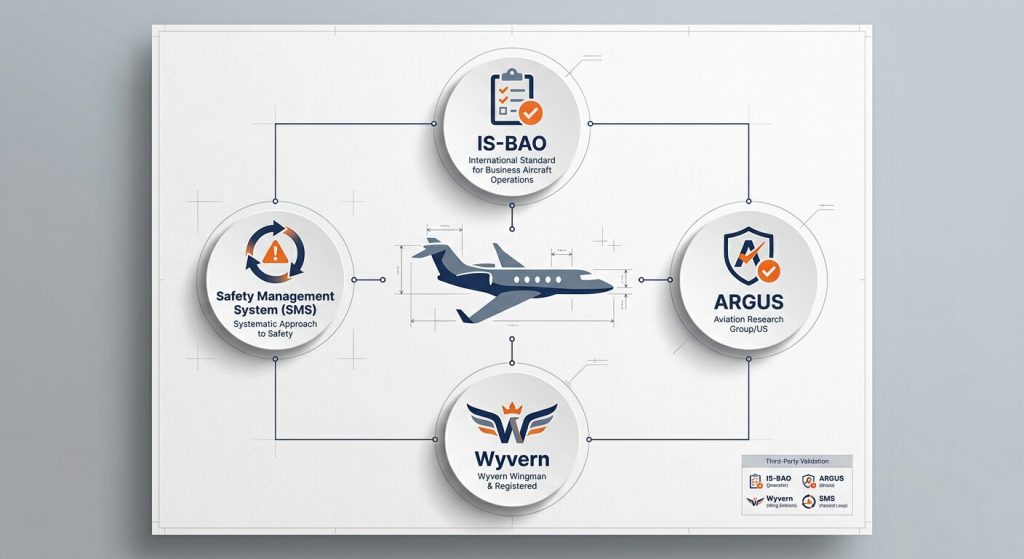
Regulatory minimums are a starting point, not a finish line. Professional aircraft management involves exceeding those minimums through third-party safety validation, structured safety management systems, and consistent crew training. The tools that matter here include IS-BAO certification from the International Business Aviation Council and independent auditing programs that rate operators on safety practices and compliance rigor. An internal Safety Management System formalizes hazard identification, risk mitigation, and documentation practices. Together, these standards demonstrate to insurers, regulators, and passengers that the operation is managed to a professional standard.
What Independent Safety Validation Adds to Your Operation
Operating without third-party safety validation isn’t automatically a compliance failure – many Part 91 operations run without it. But independent certification adds something that internal processes alone can’t: an outside set of eyes that confirms your standards hold up beyond your own review.
Insurance carriers do look at third-party audit history when evaluating risk. An operation with documented SMS procedures and a completed independent audit is easier to underwrite, and the terms tend to reflect that. This isn’t about coverage being denied outright – it’s about giving your underwriter confidence in the operation you’re running, which affects how they price the policy and what conditions they attach to it.
From a regulatory standpoint, documented safety procedures, crew training records, and maintenance tracking systems all make ramp checks and certificate reviews go more smoothly. When an FAA inspector asks for documentation, the question is whether you can produce it quickly and completely. Independent audits help you build and maintain that documentation as a matter of routine, not as a scramble before someone asks.
The deeper value of an SMS is less about the certification itself and more about the habit of documentation it creates. When a pilot makes a decision, when a maintenance item gets deferred, when a crew scheduling exception gets approved – having a process that captures those decisions means you can account for them later. That matters in incident reviews, insurance discussions, and any situation where you need to show that the operation was being managed with intention.
Third-party validation is one way to build and verify that structure. It’s worth considering not because the alternative is catastrophic, but because it makes the operation more defensible and easier to manage over time.
Crew Standards and Training
FAA minimums for pilot qualifications and currency are the legal floor, not a target. Most professional Part 91 operations set internal standards that go beyond what the regulations require, and for good reason – consistency and documentation matter when something goes wrong, and someone is reviewing how decisions were made.
For Part 135 charter operations, the training requirements are more prescriptive: simulator-based recurrent training, line checks by certified evaluators, and standardized operating procedures are standard practice and often contractually required by clients and insurers alike. Part 91 operations have more flexibility, but that flexibility comes with responsibility. The operator sets the standard.
Insurance carriers play a real role in shaping what that standard looks like in practice. They determine acceptable training intervals, and experienced underwriters understand the nuances – a pilot typed in two or more aircraft, for example, may alternate recurrents across types on a schedule the carrier approves. That’s a legitimate arrangement. The point isn’t to train on a rigid schedule regardless of circumstances. It’s to have a documented, defensible approach that reflects the complexity of the operation and holds up to review.
Where operators run into trouble is when there’s no defined standard at all – no written hiring minimums, no training policy, no documentation of what was done and why. That gap, more than any specific training choice, is what creates exposure in an incident review or an insurance dispute.
Pitfall #3: Hidden Costs and Lack of Transparency
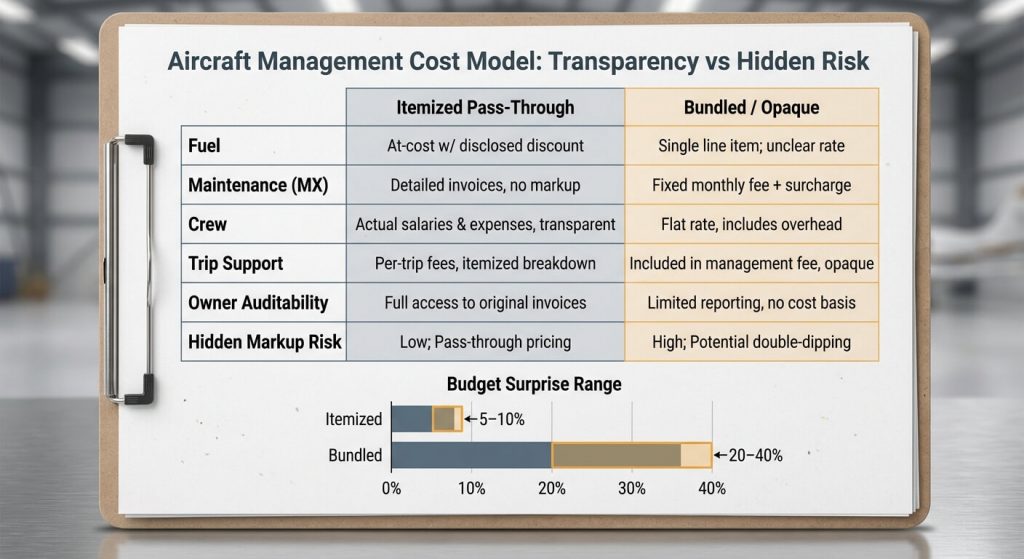
The biggest cost trap in aircraft management isn’t the headline management fee. It’s the variable expenses buried in monthly invoices that surface only after signing a multi-year contract. Fuel surcharges, crew deadhead positioning, unscheduled maintenance reserves, catering markups, and handling fee pass-throughs can add 20 to 40 percent to your expected operating budget if the contract doesn’t specify transparent cost structures and line-item accountability. Operators who quote “all-in” pricing without detailed breakdowns are obscuring this complexity, and you’ll discover it when your first quarterly statement arrives with charges you didn’t anticipate.
Transparent cost models separate pass-through expenses billed at actual cost from management fees and any service markups. The operator should provide itemized invoices showing fuel purchased, gallons, price per gallon, and the discount or markup applied – same for maintenance, crew costs, insurance, and hangar. Opaque models bundle everything into a single monthly charge or use vague categories like “trip support” that obscure what you’re actually paying for. The difference can be tens of thousands per year on a mid-size jet.
| Cost Model | Transparency | Owner Control | Hidden Risk |
|---|---|---|---|
| Transparent (itemized pass-through) | Full line-item detail; fuel, MX, crew, insurance billed at cost with discounts disclosed | Owner can audit vendor contracts and negotiate changes; sees savings from fleet buying power. | Low; owner knows true cost structure and can benchmark against alternatives |
| Opaque (bundled or “all-in”) | Single monthly charge or vague categories; limited invoice detail | Minimal; owner has no visibility into vendor selection or pricing | High; hidden markups, surprise charges, and inability to validate whether discounts are real or retained by manager |
The Illusion of ‘All-In’ Pricing
Bundled quotes sound appealing – one number, all costs covered, predictable budgeting. In practice, they can hide variable expenses that should be transparent and controllable. A professional management agreement should clearly break out fuel surcharges and contract fuel pricing (including whether the rate reflects the contracted discount or includes a markup), crew positioning and deadhead costs, maintenance reserves, and how unscheduled work is handled, catering and ground transport, international trip support and handling fees, and the insurance premium breakdown. If the contract doesn’t address these items with specific disclosure and line-item billing, you’re signing up for cost uncertainty.
Losing Leverage: No Fleet Buying Power
Solo operators managing one or two aircraft pay retail. Fuel, parts, maintenance labor, insurance, and hangar are all negotiated individually with minimal volume leverage. Professional management companies aggregate dozens or hundreds of aircraft, giving them the ability to negotiate fleet fuel contracts, MRO volume discounts, insurance pool pricing, and training center rates that can run meaningfully below what you’d pay on your own.
The question to ask is whether those discounts are passed through to you. Transparent operators disclose the contracted rate, the discount achieved, and bill you at net cost. Your agreement should specify that all vendor discounts negotiated on behalf of your aircraft flow through at cost, and you should receive statements showing the savings realized versus retail pricing.
WingLeader structures cost transparency into every agreement. When you’re managing a small Part 91 fleet, you need visibility into every expense category and confidence that vendor discounts flow to you, not to the manager’s bottom line.

Pitfall #4: Delegating Compliance Without Oversight
Hiring a management company does not transfer your legal responsibility as the aircraft owner or operator. Under FAA regulations, certain duties are non-delegable. You remain accountable for ensuring the aircraft is airworthy, operated legally, and maintained in compliance with all applicable airworthiness directives, inspection intervals, and certification requirements. Compliance is a partnership, not a handoff, and you need oversight systems that give you real-time visibility into regulatory status.
The professional standard is documented accountability. Your management agreement should specify exactly who is responsible for tracking ADs, managing maintenance intervals, ensuring crew currency, filing required reports, and maintaining operational control documentation. You should receive monthly compliance reports showing the status of every open item, upcoming inspections, crew training expirations, and regulatory filings. If your manager can’t produce that on demand, you don’t have the visibility you need.
A few signs that compliance oversight needs attention: your manager can’t produce a current status report on airworthiness directives and inspection due dates; maintenance records are scattered across email, vendor portals, and paper logbooks with no centralized tracking; crew training and currency records aren’t accessible to you on demand; you don’t receive advance notice of upcoming inspections, regulatory filings, or insurance renewals; or there’s no documented SMS or safety reporting system.
The Paper Trail Problem
Email and spreadsheet-based management creates compliance gaps that are invisible until they become problems. An AD is issued by the manufacturer, forwarded by email to the maintenance provider, logged in a spreadsheet. Months later, during a phase inspection, the mechanic discovers it was never complied with because it fell through the cracks in manual tracking. The aircraft is unairworthy until the corrective action is completed – a missed trip, emergency MRO costs, and potential FAA exposure if the gap surfaces during an audit.
The same pattern plays out with crew currency. A pilot’s instrument proficiency check expires with no automated alert because tracking is manual. The pilot flies an IFR trip, and a ramp check reveals the lapse. Centralized, digital compliance systems eliminate these gaps by automating alerts, linking maintenance and training records to regulatory calendars, and providing audit-ready documentation. Systems like CAMP, Traxxall, or integrated management software automate AD tracking, inspection scheduling, crew currency alerts, and document storage. If your current operation runs on email and spreadsheets, moving to a centralized platform is a straightforward improvement that removes a lot of risk.
Pitfall #5: Choosing a Manager Based on Low Cost Alone
The cheapest management fee often reflects the underlying operation. If one provider quotes significantly below market, it’s worth understanding why – whether they’re cutting corners on crew standards, skipping third-party audits, outsourcing maintenance oversight to the lowest bidder, or planning to make up the difference through hidden markups. The professional approach is to evaluate the total cost of ownership, compliance track record, safety culture, and service quality, then negotiate from a position of informed comparison rather than defaulting to the lowest number.
Aircraft management is a relationship business where the operator’s discipline, transparency, and operational rigor directly affect your financial exposure, regulatory risk, and asset value. The right questions to ask a prospective manager include: what is their current third-party audit status and can you see the full report; what do sample monthly owner reports look like; what are their crew hiring minimums and recurrent training programs; is maintenance handled in-house or outsourced and what are the vendor quality standards; and what do the management contract terms say about cost pass-throughs, charter revenue splits, and termination conditions.
Red Flags to Watch Before Signing an Agreement
Before committing to a management contract, a few things are worth examining closely. No third-party safety audit history suggests the operator is working below a professional standard. Vague or bundled cost terms in the contract make it impossible to control costs or verify that vendor discounts are being passed through. Unclear charter authority – especially if you’re planning to generate revenue – is a serious concern that needs to be resolved before signing. No documented SMS or safety reporting system means the infrastructure to manage risk systematically isn’t in place. Manual or email-based compliance tracking introduces avoidable gaps. And contract terms that lock you in with punitive termination fees limit your options if service quality degrades.
References matter too. Professional operators have satisfied clients who will discuss their experience directly.

The Path Forward: Professional Aircraft Management as Risk Mitigation
The pitfalls outlined here aren’t rare edge cases. They’re the everyday reality for aircraft owners who took on operational complexity without the right structure, assumed compliance was handled, or chose a manager based on cost rather than capability. The solution is a management partner who treats compliance, cost transparency, and safety culture as baseline standards rather than optional upgrades.
Professional aircraft management is fundamentally about risk mitigation. Operating a turbine aircraft legally and safely requires specialized infrastructure, third-party validation, and real-time oversight that most owners can’t build in-house without replicating the systems and costs of a full flight department. The value is regulatory confidence, predictable costs, and a solid paper trail if anything goes wrong.
When you’re managing a Part 91 aircraft and need professional back-office support without the overhead of a full-service management company, WingLeader provides the compliance infrastructure, cost transparency, and operational discipline that keeps you out of the traps outlined here. Your focus should be on flying, not tracking ADs in spreadsheets or wondering if your dry lease structure will survive FAA scrutiny.
Frequently Asked Questions
What are the main differences between full-service aircraft management and fractional ownership?
Full-service management means you own the aircraft outright and hire a company to handle all operational, compliance, and financial administration while you retain the asset and control usage. Fractional ownership is shared ownership where you buy a percentage of an aircraft managed by a fractional provider. You get guaranteed access hours, and the provider handles everything, but you don’t own the whole aircraft, and you’re subject to scheduling priority rules with other fractional owners. Full-service gives you complete control and asset ownership. Fractional gives you lower capital outlay and simplified access, but less control and shared availability.
How do private aircraft management companies ensure regulatory compliance?
Professional management companies maintain dedicated compliance staff who track airworthiness directives, manage inspection intervals, ensure crew currency, and monitor regulatory changes. They use centralized digital tracking systems that automate alerts for upcoming ADs, training expirations, and maintenance due dates. Many also participate in third-party safety audits, which require documented SMS, safety reporting processes, and regular audits of operational practices. Compliance is the result of systems, accountability, and independent validation – not any single person’s memory.
What are the key benefits of using a private jet management company?
The core benefits are regulatory compliance confidence, operational reliability, cost transparency through fleet buying power, and liability protection through professional systems and insurance. A good manager takes AD tracking, crew training, maintenance scheduling, and financial reporting off your plate, giving you real-time visibility without day-to-day burden. You also gain access to negotiated vendor discounts on fuel, maintenance, insurance, and hangar that solo operators typically can’t achieve.
How do companies handle maintenance and repairs for managed aircraft?
Most management companies either maintain in-house MRO capabilities or have preferred vendor networks with negotiated service standards and pricing. They schedule phase inspections, coordinate unscheduled repairs, track warranty claims, manage AOG events, and provide transparent invoices showing labor, parts, and any markups. Professional managers maintain digital maintenance logs that integrate with compliance tracking systems so every work order, AD compliance action, and modification is documented. You should receive advance notice of upcoming inspections and cost estimates before work begins.
What safety standards should I look for in an aircraft management company?
Look for current third-party audits and a documented SMS. Confirm that the company requires appropriate recurrent training for all crew, maintains standardized operating procedures, and conducts regular line checks. Ask to see their SMS manual and safety reporting process. The specific certifications and audit programs vary, but the underlying question is whether the operator has submitted to independent review and can show you the results.
What are the main differences between full-service aircraft management and charter-only management for a privately owned jet?
Full-service management covers all aspects: flight operations, crew employment, maintenance oversight, scheduling, compliance, financial reporting, insurance, and hangar (plus charter if you choose). Charter-only management means the company places your aircraft on its Part 135 certificate to generate charter revenue, handles charter sales and operational control for those flights, but you retain responsibility for crew hiring, maintenance coordination, and personal flight scheduling. Charter-only is lower cost but requires you to manage non-charter operations yourself. Full-service is turnkey and appropriate when you don’t want to run any part of the operation directly.
Which safety certifications should an aircraft management company have to meet industry standards?
Full-service management covers all aspects: flight operations, crew employment, maintenance oversight, scheduling, compliance, financial reporting, insurance, and hangar – plus charter if you choose. Charter-only management means the company places your aircraft on its Part 135 certificate to generate charter revenue, handles charter sales and operational control for those flights, but you retain responsibility for crew hiring, maintenance coordination, and personal flight scheduling. Charter-only is a lower-cost arrangement but requires you to manage non-charter operations yourself.
Which safety certifications should an aircraft management company have to meet industry standards?
IS-BAO registration from IBAC is a widely recognized benchmark for business aviation SMS and operational best practices. Independent auditing programs like those offered by ARGUS and Wyvern provide third-party assessment of safety culture, crew standards, maintenance practices, and operational discipline. These aren’t regulatory requirements – they’re evidence that the operator voluntarily exceeds FAA minimums and submits to external validation.
How do aircraft management contracts structure charter revenue sharing between the jet owner and the management company?
Charter revenue sharing varies, but typically the management company retains a percentage of gross charter revenue to cover sales, operational control, and administrative overhead, and the owner receives the balance after direct operating costs like fuel, crew positioning, catering, and landing fees are deducted. Some contracts guarantee the owner a minimum hourly rate or a fixed percentage regardless of what the operator charges the charter client. The key is transparency: you should see the charter rate charged, the direct costs incurred, and the net revenue split clearly itemized on monthly statements.