
Two proposals land on the same desk. One quotes a monthly fee that looks 40 percent lower than the other. Twelve months later, the cheap one has cost more, because the base fee never included crew travel, procurement charges, or the commission buried in a third-party invoice. Choosing a manager is a diligence exercise, not a price comparison. A provider worth hiring names the certificate holder, writes operational control into the agreement, and itemizes every dollar in the proposal. The one to avoid hands you a clean monthly number and gets vague when you ask what sits inside it.

What Actually Matters When You Compare Aircraft Management Companies
An aircraft management company runs the operating side of an aircraft the owner does not want to run: crew employment or sourcing, flight operations, scheduling and dispatch, maintenance administration, insurance placement, regulatory compliance and recordkeeping, and financial control over the budget and the invoices. Charter management is a narrower job. A company puts your aircraft on its Part 135 certificate and sells the time you do not use. It may never touch your crew, your maintenance program, or your books. The service-by-service breakdown belongs in “what is aircraft management.” For a buyer comparing providers, five criteria decide the outcome.
- Operational control. Who may initiate, conduct, delay, divert, or terminate a flight, and is that written down rather than implied by a brochure.
- Regulatory authority. Which legal entity holds the operating certificate, which aircraft are listed on it, and whether your intended use fits the operating model being proposed.
- Insurance structure. Who is named insured, who is additional insured, whose policy the aircraft sits on, and who controls a claim.
- Fee transparency. Whether the proposal itemizes fixed, variable, and pass-through charges, and whether any markup or rebate is disclosed.
- Owner access. Whether you can get the aircraft when you need it once charter activity, crew duty limits, and maintenance planning are in the picture.
If the aircraft sits on a foreign registry or will be based abroad, two more items join the list: the AOC that authorizes commercial flights and the CAMO or equivalent organization that manages continuing airworthiness, both tied to the registry you pick. Ask which registry, which AOC, and which CAMO a proposal assumes before you compare it with a US-registered option.
Scale is a sixth consideration, and a softer one. As Aviation Week notes, one industry recommendation is that owners consider management companies with five or more aircraft under management. Fleet size can buy fuel, insurance, and crew leverage. It also adds layers between you and the person who actually moves your trip. The test that matters is whether the company’s size matches your aircraft and your mission.
What to Ask About Regulatory Authority and Operational Control
Under Part 91 management the owner keeps operational control, the flying is personal or business use without compensation, and there is no charter revenue. Under Part 135 management the aircraft is added to a charter certificate held by a specific legal entity, that entity holds operational control of every charter flight and sells the hours you do not use, and the aircraft picks up heavier crew, maintenance, and inspection requirements in exchange. A company that says it “has a certificate” has answered nothing yet.
1. “Which entity will I contract with, and which entity holds the certificate?”
A good answer names both, admits when they are different companies, and explains in writing why. The proposal, the certificate, the insurance policy, the maintenance agreement, and the invoices should all name entities you can account for.
A weak answer uses one marketing brand for everything and gets vague when you ask which company signs the agreement.
2. “Will my aircraft be added to the Part 135 certificate, and under what arrangement?”
A good answer explains the exclusive use requirement plainly, and tells you what adding your aircraft involves in conformity work, downtime, and cost. According to the FAA, for certification, an applicant must own or lease at least one aircraft for 6 continuous months from the time of certification to satisfy that requirement.
A weak answer treats charter availability as automatic because the company “does charter.”
3. “If I stay Part 91 and lease the aircraft to a related entity, who documents operational control for each flight?”
A good answer points to paperwork: the lease on file, the procedures, a named point of contact, and a record that survives a ramp check. The FAA treats the aircraft owner as the operator unless a properly structured dry lease is in place, and enforcement of illegal charter is an active FAA priority, particularly in Florida. On a dry lease, WingLeader keeps the lease paperwork, the records, and the procedures and acts as the point of contact between lessor and lessee, without drafting the lease or giving legal advice.
A weak answer says the arrangement is “standard” and that everyone does it this way.
What to Ask About Fees, Markups, and Pass-Through Charges
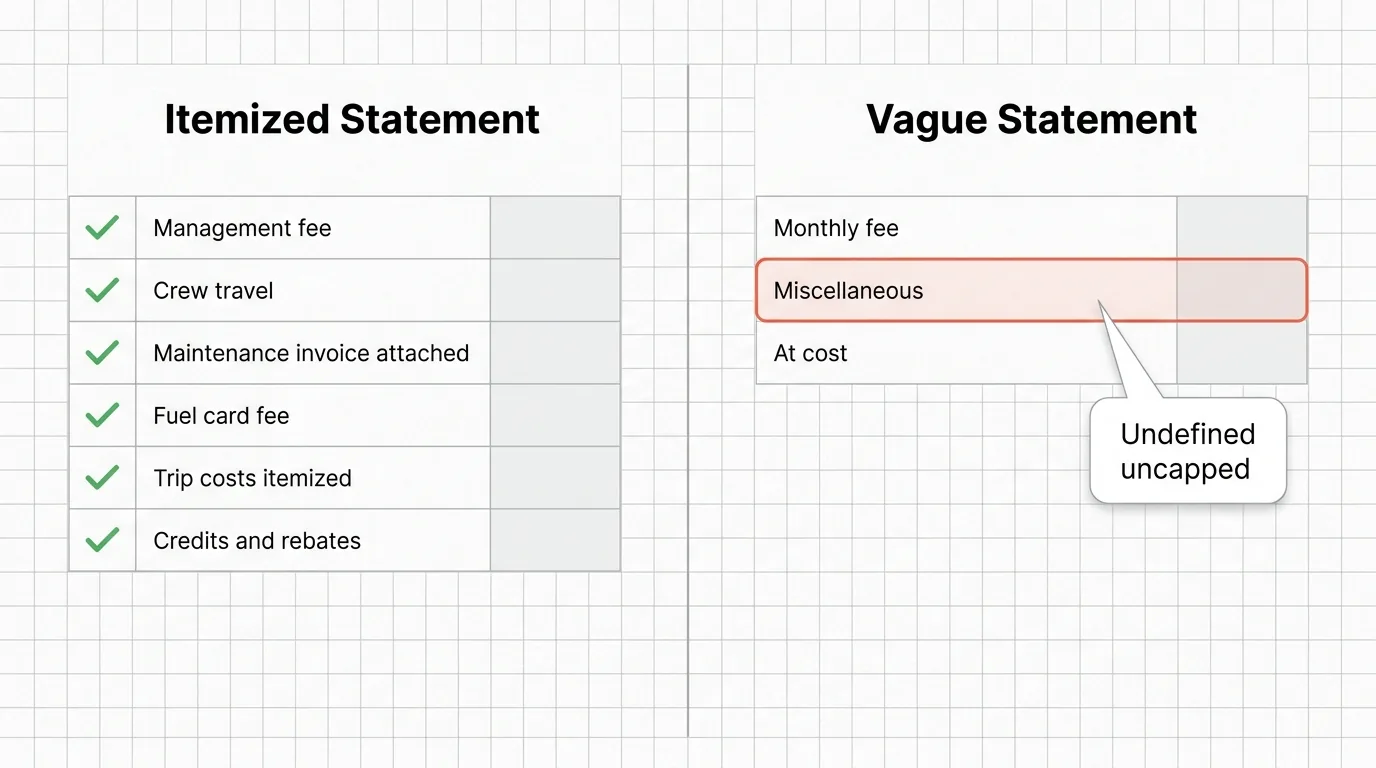
“At cost” is a phrase, not a contract term. Until the agreement defines it, it can exclude procurement labor, handling charges, card fees, affiliate invoices, and vendor rebates the manager keeps. Aviation Week reports that a final monthly bill may include handling fees, transaction charges, inflated foreign exchange rates, and commissions of 15 percent or more on outside procurement invoices.
4. “Show me a sample monthly statement for an aircraft like mine.”
A real statement, with the owner’s details removed, tells you more than any fee schedule. Look for whether each line traces back to a vendor invoice you could request.
| Statement line | How it should appear | What to verify |
|---|---|---|
| Management fee | Fixed, stated in the agreement | What it includes and what it excludes |
| Crew | Salary, benefits, travel, per diem shown separately | Whether crew travel carries a handling charge |
| Maintenance | Vendor invoice attached, labor and parts split | Procurement or coordination percentage |
| Fuel | Gallons, price, release, and any card fee | Whether volume rebates flow to you |
| Trip costs | FBO, handling, catering, ground, each itemized | Any per-trip administrative add-on |
| Programs and reserves | Engine, APU, parts program payments | Who holds reserve funds and who owns them |
| Credits and rebates | A visible line, even when zero | Whether rebates are retained or passed through |
5. “What is your markup on an outside maintenance invoice, in dollars?”
A good answer states the percentage in writing, says whether it applies to parts, labor, or both, and attaches the vendor invoice beside its own line. On a 100,000 dollar engine or airframe event, a 15 percent procurement commission is 15,000 dollars on top of what the shop charged.
A weak answer calls the charge administrative and changes the subject.
6. “What is in the miscellaneous or administrative category?”
An uncapped line with no definition is where margin hides. Ask for it to be defined, capped, and subject to owner audit rights before you sign.
Keeping the aircraft and the crew while someone else carries the office is a third option worth pricing against both. See what back-office support for a Part 91 operation covers.
What to Ask About Insurance, Safety Credentials, and Crew/Maintenance Capability
Owners usually evaluate these three together, and for good reason. An insurance structure only works if the crew flying the aircraft satisfies the policy’s pilot warranty and the maintenance program holds up.
7. “Should I be the named insured, or should you?”
A good answer explains the distinction and its consequences at claim time. One selection source recommends insurance in the owner’s name with the operator as additional insured rather than the reverse. Ask for a certificate of insurance or a certified policy copy, and read the agreed hull value, deductibles, liability limits, geographic scope, charter-use treatment, pilot warranties, and breach of warranty wording. For applicable interstate on-demand operations, a direct air carrier must also have liability insurance evidence on file with the Department of Transportation.
A weak answer is “you will be fully insured under our fleet policy,” with no limits, no exclusions, and no document.
8. “Which safety credential do you hold, for which entity, and when was the audit?”
A good answer produces the current ARGUS rating, Wyvern status, or IS-BAO registration stage with the audit date, the scope, open corrective actions, and the exact legal entity covered.
A weak answer is a row of logos. A rating held by an affiliated operator does not cover the company signing your agreement.
9. “How do you confirm a crew is legal before a trip is scheduled?”
A good answer describes a check that happens before the trip goes on the calendar, not at the gate. Before any trip goes on the schedule, WingLeader checks the assigned crew’s credentials, currency, and training records, and a trip with a crew member out of currency does not get scheduled until that is fixed.
10. “What happens on an AOG at 9 p.m. 800 miles from base?”
A good answer names who answers the phone, who authorizes maintenance and up to what dollar amount, how parts and passengers move, and when you hear about it. Ask for one real example, and ask who paid for the alternate transportation.
11. “How many aircraft of my type do you manage today, and who maintains them?”
A good answer names the aircraft, the bases, and the mechanics, because a company running a dozen Citation CJ3s knows the squawk list, the parts shelf, and which shops hold a slot in March.
A weak answer is a total fleet count and a map of bases.
12. “How do I know you can pay your vendors next quarter?”
A good answer offers audited financial statements or a bank reference, shows owner funds and maintenance reserves held in a separate account rather than in general working capital, and explains how premiums and vendor invoices get paid on time. A manager who runs short pays your vendors late. Late vendors turn into liens and a grounded aircraft.
What to Ask About Charter Revenue, Owner Priority, and Reporting
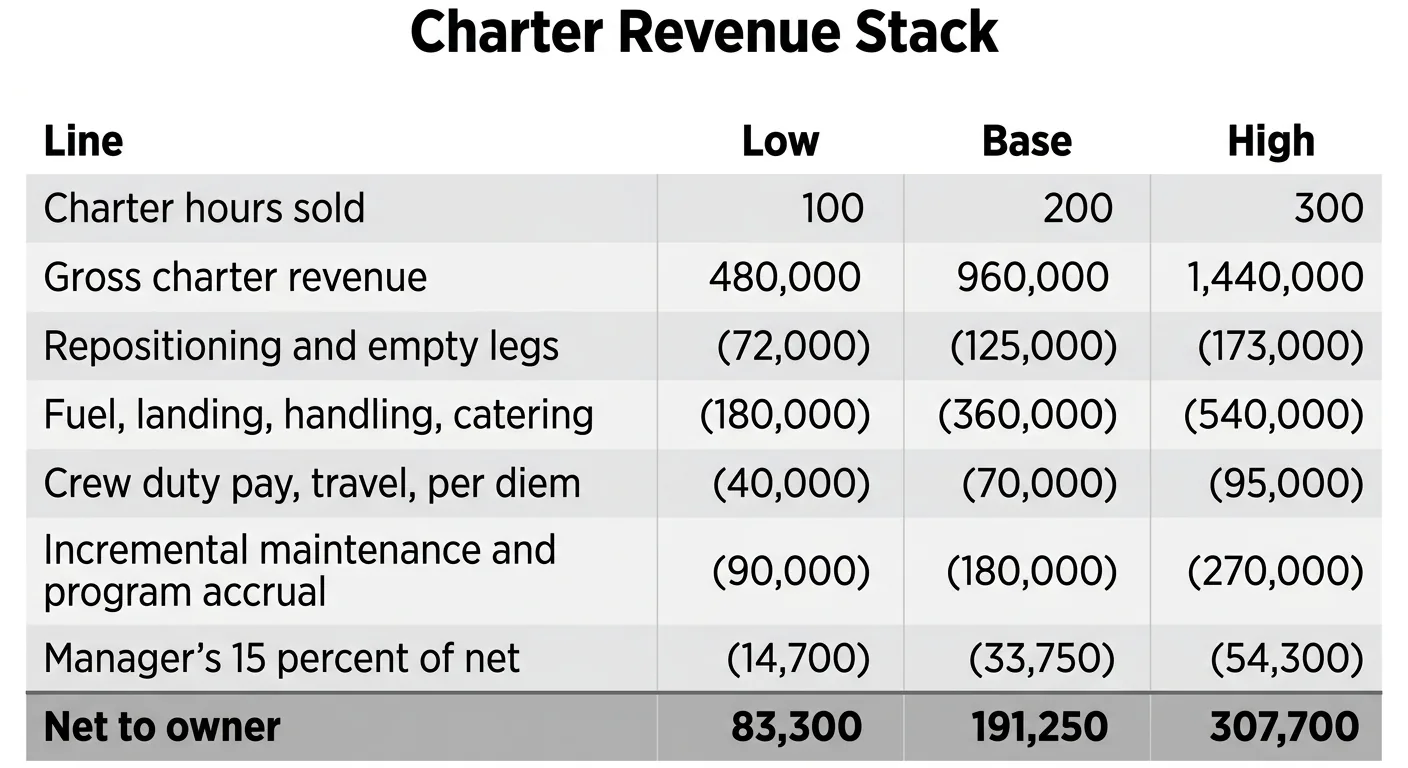
Charter revenue is written in the contract as a split and collected in reality as a residue. Gross receipts pass through repositioning, crew duty and travel, fuel, landing and handling, incremental maintenance accrual, and the manager’s deduction before anything reaches you.
13. “What does owner priority actually mean in this agreement?”
You want the clause itself: the notice window for owner trips, the blackout periods, whether a confirmed charter can be recalled and at what cost, who pays the cancellation fee, and what happens over holidays and on short notice.
14. “For an aircraft like mine, what were last year’s actual charter hours and net owner revenue?”
A good answer produces real utilization from a comparable aircraft and shows the deduction stack line by line.
A weak answer quotes an hourly rate times an optimistic number of hours and calls it income. Here is the shape the arithmetic should arrive in, for a light jet at a 4,800 dollar hourly charter rate with the manager taking 15 percent of net:
| Line | Low | Base | High |
|---|---|---|---|
| Charter hours sold | 100 | 200 | 300 |
| Gross charter revenue | 480,000 | 960,000 | 1,440,000 |
| Repositioning and empty legs | (72,000) | (125,000) | (173,000) |
| Fuel, landing, handling, catering | (180,000) | (360,000) | (540,000) |
| Crew duty pay, travel, per diem | (40,000) | (70,000) | (95,000) |
| Incremental maintenance and program accrual | (90,000) | (180,000) | (270,000) |
| Manager’s 15 percent of net | (14,700) | (33,750) | (54,300) |
| Net to owner | 83,300 | 191,250 | 307,700 |
Substitute your own rate, hours, and the manager’s own percentages. Net owner revenue offsets the cost of ownership. It rarely turns the aircraft into a profit center.
15. “What arrives in my inbox every month?”
A useful reporting package shows flight hours and cycles, owner versus charter utilization, direct operating cost per hour, maintenance events and upcoming inspections, reserve balances, charter revenue with deductions, and variance against the annual budget. One monthly total with no supporting detail is a signal about how the rest of the relationship will run.
What Red Flags Should Make You Walk Away
Any one of these justifies pausing the deal until it is resolved in writing:
- The contracting entity, the certificate holder, and the insurance named insured do not line up.
- Operational control is discussed in conversation and never defined in the agreement.
- A safety logo appears on the website and no current audit date, scope, or covered entity is produced.
- References are hand-picked former clients instead of current owners with comparable aircraft.
- The provider is evasive about FAA findings, enforcement history, or open corrective actions.
- Pilot turnover is high and there is no substitute crew pool.
- Invoices are technically accurate and commercially unreadable.
Forum complaints are leads, not evidence. The same specific complaint from three different owners about unexplained markups or unavailable aircraft is worth a phone call.
What a Fair Quote and Contract Should Look Like
A fair proposal separates what is fixed, what varies with flight hours, and what is a true pass-through, then prices each one: base management fee, crew salary and benefits, training, crew travel and per diem, hangar, insurance, subscriptions, engine and parts program payments, maintenance labor and parts, fuel with the rebate treatment stated, trip costs, and every markup or handling percentage written as a number. Ranges by aircraft category, utilization, and service scope belong in “aircraft management costs.”
To compare a bundled offer against an itemized one, rebuild both as a twelve month all-in budget at your real flight hours, then add the markup math from the questions above. A quote you cannot rebuild that way is a quote you cannot compare.

Aircraft Management Companies Checklist
- Contracting entity named, certificate holder named, both consistent across every document
- Aircraft authorization and the operating model for each type of flight confirmed in writing
- Operational control defined: who initiates, conducts, delays, diverts, terminates
- Dry lease paperwork, procedures, and point of contact identified if a lease structure is used
- Certificate of insurance or certified policy reviewed: named insured, additional insured, limits, hull value, deductibles, pilot warranty, charter-use treatment
- Current safety audit evidence with date, scope, entity, and open corrective actions
- Crew qualification and currency process documented, with substitute crew coverage
- Maintenance tracking, vendor approval, warranty recovery, and record access spelled out
- AOG escalation path, authorization limits, and one real example
- Fully itemized fee schedule with every markup, rebate, and administrative charge defined and capped
- Sample monthly statement and sample annual budget in hand
- Owner audit rights on invoices, rebates, and vendor relationships
- Owner priority clause, notice windows, blackout dates, recall and cancellation costs
- Charter split shown after the complete deduction list, with comparable-aircraft actuals
- Term, termination notice, cause triggers, record delivery, and transition steps
- Reference calls with two current owners flying comparable aircraft: aircraft availability last year, how many invoices they had to question and how disputes were settled, pilot turnover in two years, how long maintenance items waited on a decision, and how long a records handover took
If what you need is the office work handled while you keep the aircraft and the crew, WingLeader provides back-office support for operators running one to five aircraft under Part 91, and publishes a free cost calculator: pick the jet category, expected annual flight hours, and jet fuel price per gallon for an estimated annual variable operating cost, with fuel, engine program, parts program, and maintenance broken out line by line on request. Talk through what your operation actually needs.
Frequently Asked Questions
How do I verify that an aircraft management company actually holds the correct FAA Part 135 certificate?
Ask for the exact certificate holder name and certificate number, then confirm the status and the aircraft listed on the operations specifications rather than taking a brochure at face value. Request the name of the Director of Operations and the Chief Pilot, since a Part 135 operator must have those positions filled. If the company will not provide its organizational or compliance information, treat that refusal as a finding in itself.
What termination rights should an aircraft management agreement give the owner?
A fair agreement lets you leave on notice and lets you leave immediately for cause. Look for a stated term, a termination for convenience notice period, immediate termination for cause including safety violations and FAA enforcement action, delivery of aircraft records within a stated number of days, vendor and fuel account transfer, insurance cancellation or reassignment, settlement of outstanding invoices, and disposition of charter bookings already on the schedule. Agreements in this market often run for several years and may include a notice period for convenience.
What are the top aircraft management companies?
No single ranking survives contact with a specific aircraft and mission, so build a shortlist two ways instead. List the large national turnkey operators, names like Clay Lacy, Solairus, and Jet Aviation, which bring fuel, insurance, and crew purchasing leverage, and list the regional specialists that already run several aircraft of your exact type at bases you fly from. Put three or four of each on the list, then run all of them through the same certificate, insurance, fee schedule, and reference questions. The company that answers those in writing beats the one with the biggest fleet page.
What insurance limits, hull value, and deductibles should an aircraft owner request?
Start with the hull written at an agreed value that reflects today’s market rather than a purchase price from four years ago, and read the deductible separately for ground and in-motion damage. One contract guide uses example liability limits and hull premium estimates, though the right figures depend on the aircraft, the passengers, and where it flies. Confirm that the owner entity, any lessor, and the manager each appear with the status they are supposed to have, and that charter use is endorsed on the policy if the aircraft will fly for compensation.
Can I self-manage my aircraft instead of hiring a management company?
Yes, and many owners do with one aircraft and a dedicated pilot. There are three models and they scale differently: self-management works at low utilization with one aircraft, a full in-house flight department gives the most privacy and the most control over crew and schedule but carries payroll, training, manuals, and insurance that only make sense at higher hours or as the fleet grows, and an outside manager spreads those overheads across a fleet. The breaking point for self-management is usually administrative, when credential tracking, maintenance records, dry lease documentation, trip logistics, and expense allocation start eating into the flying. Model your own case at 50, 100, and 200 annual hours, and price your pilot’s unbilled office time before deciding.
Can a Part 91 operator with one aircraft get support without a full management company?
Yes. A back-office support model handles scheduling, dispatch, flight following, crew credential tracking, compliance documentation, and expense reporting while the owner or chief pilot keeps operational control of the aircraft and the crew. An owner who wants a third party to employ the crew and hold the certificate needs a turnkey manager instead.