
Dry Lease Management Best Practices: Avoiding Sham Lease Exposure in Part 91 Operations
You’ve structured your dry lease agreement, documented operational control, and filed your Truth-in-Leasing notice. You’re confident everything is by the book. Then an FAA examiner boards your aircraft, asks your pilot or passengers three simple questions, and suddenly your entire structure is under scrutiny because the answers don’t match the paperwork.
The gap between a compliant dry lease and an illegal charter isn’t found in contract language. It lives in the daily workflow, the decision logs nobody thinks to keep, and the authority chain that should be obvious but often isn’t.
This playbook walks through the operational control dimensions the FAA actually tests, the documentation standards that survive scrutiny, and the preflight verification routines that keep your dry lease structure defensible when it matters most.
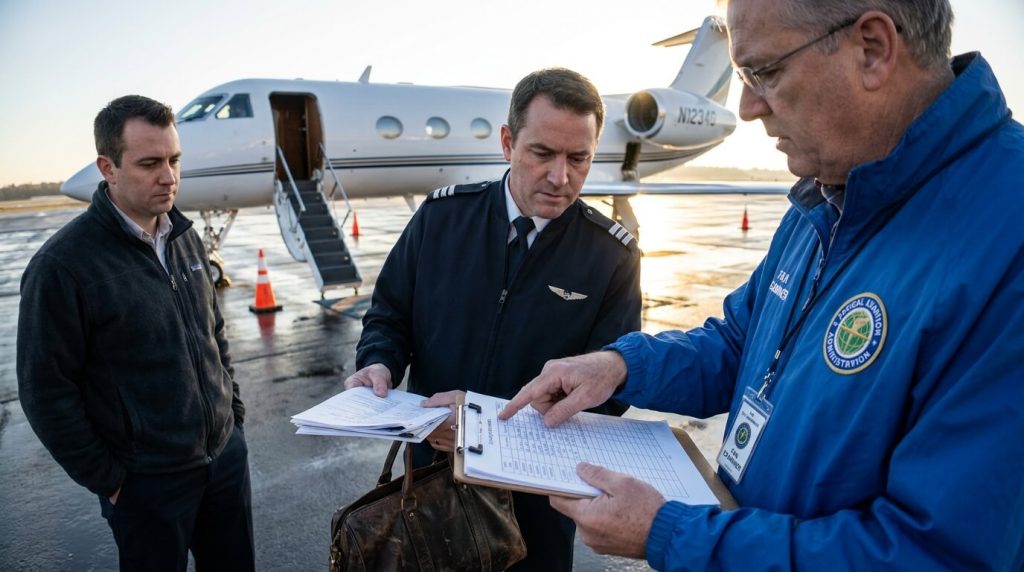
What the FAA Actually Looks For: The Sham Lease Problem
A sham lease is an arrangement labeled “dry lease” that functions as a commercial charter under the surface. The FAA doesn’t care what your contract says if the day-to-day reality shows the lessor or management company calling the shots on crew, dispatch, and maintenance.
The regulatory issue is simple: if you’re providing transportation for hire and holding yourself out to do so, you need a Part 135 certificate. Dressing up charter as a dry lease to avoid that requirement puts you in enforcement territory fast.
Warning: Top 3 Sham Lease Red Flags
- Crew hiring authority: Lessor hires, manages, or pays pilots even though the contract says lessee has operational control.
- Maintenance control: Lessor approves or vetoes maintenance decisions, vendors, or deferrals instead of the lessee.
- Dispatch decision-making: Lessor or management company makes go/no-go calls, routes flights, or communicates directly with passengers on operational matters.
If any of these three show up in practice, the FAA will look past your contract and start asking harder questions. The investigation won’t start with your legal department. It’ll start with a ramp check, a post-flight interview with a passenger, or a maintenance log that doesn’t match who you said was in charge.
The Substance-Over-Form Doctrine
The FAA applies a substance-over-form test to operational control disputes. Your lease can state “Lessee has full operational control” in bold capital letters. If your crew payroll, dispatch logs, and passenger communications tell a different story, the contract language won’t protect you.
Examiners are trained to ignore what you meant to do and focus on what actually happened: who hired the crew, who decided whether to fly in marginal weather, who authorized a maintenance deferral, and who the passengers think is operating the flight. This doctrine means your daily workflow matters more than your attorney’s lease draft.
Common Sham Lease Indicators
Watch for these patterns in your operation. Any one of them can trigger follow-up questions during an inspection:
- Lessee picks crew from a list provided by the lessor, but lessor handles payroll and employment paperwork directly.
- Lessor maintains tight control over daily scheduling, routing, or operational decisions despite lease language giving authority to lessee.
- Management company communicates directly with passengers about flight times, cancellations, or changes without lessee involvement.
- Maintenance vendors report to the lessor or management company for approvals rather than the lessee’s maintenance coordinator.
These aren’t automatic violations, but they shift the burden onto you to prove the lessee truly controls the operation. That proof needs to be in writing, documented before each flight, and consistent across crew records, maintenance logs, and dispatch files.
Operational Control: The Five Dimensions FAA Examiners Test
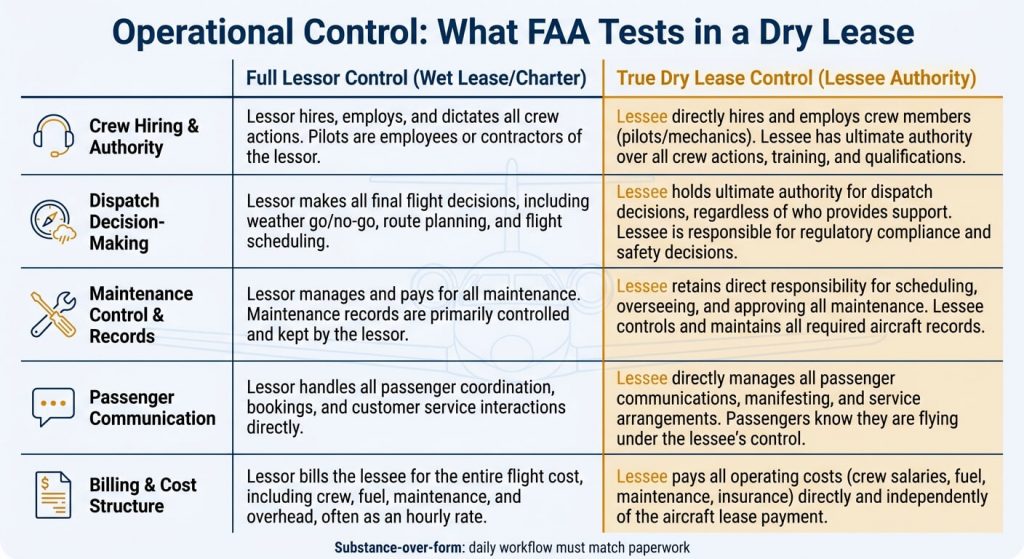
Operational control isn’t a checkbox. It’s a daily allocation of authority across five specific dimensions. Examiners test each dimension separately because they know operators often get one or two right and miss the others.
The table below shows what full lessor control looks like versus what a compliant dry lease structure must demonstrate:
| Dimension | Full Lessor Control (Wet Lease / Charter) | True Dry Lease Control (Lessee Authority) |
|---|---|---|
| Crew Hiring & Authority | Lessor hires, pays, and directs crew | Lessee hires crew directly or via an independent pilot services agreement |
| Dispatch Decision-Making | Lessor approves go/no-go, routing, weather | Lessee makes all dispatch decisions; lessor has no veto power |
| Maintenance Control & Records | Lessor schedules and approves all maintenance | Lessee controls maintenance timing, vendor selection, and deferral authority |
| Passenger Communication | Lessor communicates directly with passengers | Lessee is primary contact, lessor has no operational communication role |
| Billing & Cost Structure | Per-flight or per-passenger charges | Fixed monthly lease rental, operating costs borne by lessee |
If your operation straddles the columns, you’re in the gray zone where examiners dig deeper. The goal is clean separation: the lessee runs the operation, the lessor provides only the airframe and stays out of daily decisions.
Crew Hiring and Authority
Crew hiring is the single most scrutinized operational control dimension. If the lessor hires, manages, or pays pilots and cabin crew, the FAA treats that as strong evidence of a wet lease or charter operation, regardless of contract language.
The lessee must either employ crew directly or use an independent pilot services provider under a separate agreement where the lessee, not the lessor, is the client and decision-maker. Payroll records, employment agreements, and duty assignments must all show the lessee as the hiring authority.
If your management company provides crew, structure it so the lessee contracts for pilot services independently and the lessor isn’t a party to that arrangement. Document that the crew takes direction from the lessee’s designated representative, not the lessor’s operations team.
Dispatch Decision-Making
The lessee must have independent authority to initiate, conduct, and terminate each flight. That means the lessee decides whether to fly based on weather, aircraft condition, crew rest, and operational readiness without seeking approval from the lessor.
This authority isn’t symbolic. The FAA expects dispatch decisions to be documented in real time: weather briefings obtained by the lessee’s pilot or operations manager, go/no-go decisions logged with a timestamp and authorized signature, and routing or altitude changes made by the lessee’s crew without lessor input.
If your lessor or management company reviews flight plans before departure or approves schedule changes, you’re creating evidence of lessor control. Build a workflow where the lessee’s representative (typically the pilot-in-command or an operations coordinator working for the lessee) makes and documents these calls independently.
Maintenance Control and Records
Maintenance control means the lessee decides when maintenance happens, which vendors perform the work, and whether to defer discrepancies. The lessor may own the aircraft and care about its condition, but the lessee must have day-to-day authority to schedule inspections, approve repair orders, and manage the maintenance program.
This doesn’t mean the lessee performs maintenance. It means the lessee controls maintenance execution: selecting the shop, approving the scope of work, and deciding whether a deferral is acceptable under the MEL. The lessor’s role is limited to contractual standards like requiring Part 145 repair stations or maintaining insurance coverage.
Document every maintenance decision with a log entry showing lessee approval. If a shop calls asking whether to replace a part or defer, the lessee’s maintenance coordinator should be the one making that call, not the lessor’s asset management team.
Passenger Communication and Accountability
The lessee must be the primary point of contact for passengers on operational matters: flight times, cancellations, delays, catering requests, and ground transportation. If the lessor or management company handles these communications, it signals to passengers and regulators that the lessor is operating the flight.
This dimension catches operators off guard because it seems minor. But the FAA has used post-flight passenger interviews to build sham lease cases. When passengers are asked “Who arranged your flight?” or “Who would you call if there was a problem?”, their answers need to point to the lessee, not the lessor.
Think about it this way. A corporate jet is dry-leased to a CEO’s family office. The lessor’s management company receives a call from the CEO’s assistant asking to move the departure time. The management company confirms the change and notifies the crew. On paper, the lessee has operational control. In practice, the lessor just made an operational decision and communicated it to passengers and crew. That’s evidence of a sham lease.
Build a protocol where passenger-facing communications flow through the lessee’s scheduler or operations contact, even if that person is relying on support from a management company behind the scenes. The lessee must be seen as the operator by passengers and crew alike.
Pre-Flight Authority Verification Checklist
Daily verification routines prevent operational control drift. This checklist should be completed before each flight or on a weekly basis for recurring operations. The goal is to confirm that the lessee, not the lessor, made the key decisions that define operational control.
- Confirm crew assignment was made by lessee or lessee’s designated pilot services provider.
- Verify weather briefing and dispatch decision were obtained and logged by lessee’s operations representative or PIC.
- Review maintenance status and confirm any deferrals or repairs were approved by lessee’s maintenance coordinator.
- Check that passenger communications (flight time, catering, ground transport) were handled by lessee’s scheduler or ops contact.
- Ensure all pre-flight records (crew assignment, dispatch log, maintenance release) are signed by lessee’s authorized representative.
- Verify fuel, catering, and ground service orders were placed by lessee or lessee’s designated vendor coordinator.
- Confirm flight plan filing and ATC communications will be conducted under lessee’s operational authority.
This isn’t bureaucratic overhead. It’s the operational evidence base that defends your structure when an examiner asks, “Who really controlled this flight?” If you can’t produce a clear answer supported by documentation, the examiner will conclude the lessor did.
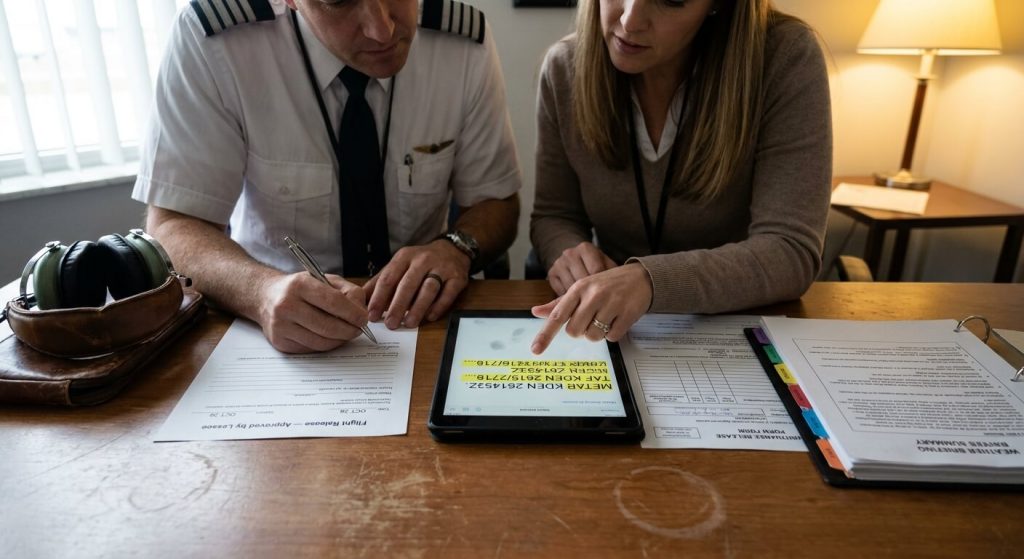
Crew Assignment and Authority Review
Before each flight, verify that crew assignment records show the lessee as the hiring and directing authority. This sub-checklist ensures the crew understands who they work for operationally, not just contractually.
- Crew assignment memo or duty roster dated and signed by lessee’s operations manager or designated representative.
- Pilot and cabin crew employment or contractor agreements listing lessee as client or employer, not lessor.
- Crew briefing log showing lessee’s ops contact conducted pre-flight authority briefing and crew acknowledged lessee’s operational control.
- Crew payroll or contractor payment records showing lessee as payor, not lessor.
If any of these items list the lessor or management company instead of the lessee, fix it before the next flight. The longer mixed authority persists, the harder it is to argue the lessee was in control.
Maintenance Release and Decision Log
Maintenance decisions must be logged in real time with lessee sign-off. This template captures the who, what, and when of each maintenance action so examiners see a clear chain of lessee authority.
Sample Maintenance Decision Log Entry:
- Date/Time: [Date and time of decision]
- Aircraft Tail Number: [Registration]
- Discrepancy or Inspection: [Brief description]
- Action Taken: [Repair approved / Deferred under MEL / No action required]
- Approved By: [Lessee’s maintenance coordinator name and signature]
- Vendor/Shop: [Name of Part 145 repair station or A&P mechanic]
- Supporting Documentation: [Reference to work order, MEL entry, or inspection report]
This log doesn’t replace your maintenance tracking system. It supplements it by creating a standalone record of lessee decision-making that’s easy to produce during an inspection. Store these logs digitally or in a binder accessible to crew and operations staff.
Flight Authority and Operational Control Evidence
Document that the lessee made the dispatch decision for each flight. This can be as simple as a daily log entry or a saved copy of the weather briefing and go/no-go decision chain.
Elements to capture:
- Weather briefing source and timestamp: Show the lessee’s PIC or ops manager obtained the briefing independently.
- Go/no-go decision: Log who authorized the flight, at what time, and based on what operational readiness criteria.
- Routing and altitude changes: If the flight plan changed, document that the lessee’s crew made the call, not the lessor.
- Passenger communications: Save emails, texts, or call logs showing the lessee’s scheduler confirmed departure times and answered passenger questions.
If your operation uses a digital dispatch system, configure it so the lessee’s authorized user is the one clicking “Approve Flight” or “Release Aircraft.” If it’s paper-based, use a simple sign-off sheet that travels with the aircraft and gets filed after each trip.
Documentation Standards That Survive FAA Scrutiny
Documentation is your audit trail. The FAA expects to see a clear, contemporaneous record of who made each operational decision. After-the-fact explanations and reconstructed logs won’t hold up under scrutiny.
Build your documentation system around three principles: real-time capture, lessee sign-off, and easy retrieval. If an examiner asks to see who approved a maintenance deferral three months ago, you should be able to produce that record in minutes, not days.
Pro-Tip: Digital Documentation Best Practices
- Use cloud-based workflow tools (shared spreadsheets, project management platforms, or aviation-specific dispatch software) to capture decisions in real time with automatic timestamps and user attribution.
- Set up role-based access so only lessee-authorized users can approve crew assignments, maintenance actions, and dispatch releases.
- Enable audit logs that track every edit, approval, and communication, creating a defensible chain of custody.
- Schedule automatic weekly backups and store copies offsite or in a separate cloud account to prevent data loss.
- Avoid paper logs that can be lost or altered. If you must use paper, scan and store digital copies daily.
Crew and Personnel Records
The lessee must maintain complete crew records that establish hiring authority, job descriptions, and performance oversight. These records prove the crew works for the lessee, not the lessor.
Required records:
- Hiring decision memo: Dated document stating lessee selected and hired the pilot or cabin crew member, or contracted for services via an independent pilot services provider.
- Job description or scope of work: Defines crew member’s duties, reporting structure, and performance standards set by lessee.
- Rate card or compensation agreement: Shows lessee pays crew directly or compensates the pilot services provider; lessor is not listed as payor.
- Performance reviews or check-ride records: Document lessee’s oversight of crew performance, training completion, and proficiency checks.
Use a consistent format for all crew records. Create a simple template with sections for hiring date, role, compensation, and reporting structure. Have each crew member sign an acknowledgment that they are working under the lessee’s operational control and take direction from the lessee’s designated representative.
Maintenance Decision and Deferral Logs
Daily or pre-flight maintenance logs must show lessee decision-making on every approval, denial, and deferral. This template provides the structure examiners expect to see.
Sample Maintenance Decision Log Template:
| Date | Tail # | Discrepancy / Inspection | Action Taken | Approved By (Lessee) | Vendor/Shop | Work Order / MEL Reference |
|---|---|---|---|---|---|---|
| [Date] | [Reg] | [Brief description] | [Repair/Defer/None] | [Name + Signature] | [Shop name] | [Reference #] |
Fill this log before each flight or at the end of each maintenance event. The “Approved By” column must list a lessee representative, not a lessor employee or management company technician. If the lessee delegates maintenance authority to a specific person, name that individual and have them sign every entry.
This log doesn’t replace your maintenance tracking system. It creates a parallel record that’s optimized for FAA review: simple, chronological, and lessee-centric.
Dispatch Authority and Flight Release Records
A compliant flight release or dispatch approval captures the essential elements of the lessee’s go/no-go decision. Include these components every time:
- Date and time of approval: Real-time timestamp, not post-flight reconstruction.
- Authorized user: Name and signature of lessee’s PIC or operations manager who made the decision.
- Weather summary: Brief note on conditions (e.g., “VFR at origin and destination, winds 10G15”) showing the lessee obtained and reviewed weather independently.
- Go/no-go decision: Explicit statement (“Flight approved” or “Flight delayed due to weather”) with reasoning if delayed or canceled.
- Aircraft condition: Note on maintenance status (e.g., “All inspections current, no open discrepancies” or “Minor discrepancy deferred under MEL”).
Store these releases in a binder or digital folder organized by date and tail number. Make them accessible to crew so they can reference them during ramp checks or post-flight debriefs.
Passenger Communication and Billing Records
The lessee must be the primary contact with passengers or charter brokers. Communication logs and billing records create evidence of lessee control and independence.
Documentation to maintain:
- Email or text threads: Show the lessee’s scheduler confirming departure times, catering requests, or ground transport with passengers.
- Phone call logs: Note the date, time, and summary of any passenger communication handled by lessee’s ops contact.
- Billing invoices: Show the lessee receiving payment from passengers or reimbursing the lessor for operating costs on a monthly basis, not per-flight.
- Contracts or agreements: If the lessee is providing the aircraft to passengers under a timesharing or cost-sharing arrangement, the contract must list the lessee as the service provider, not the lessor.
If your management company handles passenger-facing communications as a service to the lessee, structure it so the lessee remains the named contact and the management company acts as an agent. Passengers should receive emails from the lessee’s domain or phone number, not the lessor’s or management company’s.
Red-Flag Audit: 10-Point Self-Check
Run this diagnostic checklist internally to spot sham lease exposure before an FAA examination. Each “no” answer is a red flag that needs correction.
- Does the lessee directly hire and pay all crew, or contract for crew via an independent pilot services provider where the lessee is the client?
- Are maintenance decisions (approvals, deferrals, vendor selection) documented with lessee sign-off before work is performed or deferred?
- Do pre-flight dispatch logs show the lessee’s PIC or ops manager obtaining weather briefings and making go/no-go decisions independently?
- Are passenger communications (scheduling, catering, delays) handled by the lessee’s scheduler or operations contact, not the lessor or management company?
- Is the lessee billed on a fixed monthly lease rental basis, not per-flight or per-passenger charges?
- Do crew members understand they take operational direction from the lessee’s authorized representative, not the lessor?
- Are crew, maintenance, and dispatch records stored in a format that can be produced during an FAA ramp check or inspection within minutes?
- Does the dry lease agreement clearly state that the lessee has sole operational control and the lessor has no authority over crew, dispatch, or maintenance decisions?
- Are passengers informed in writing (via email, contract, or briefing) that the lessee is the operator and primary point of contact?
- Has every crew member, scheduler, and maintenance coordinator signed off on an SOP or training acknowledgment confirming they understand the lessee’s operational control authority?
If you answered “no” to any of these, prioritize fixing that area before your next flight. The more red flags you have, the higher your sham lease exposure becomes.
Structuring Your Dry Lease SOP: From Policy to Daily Practice
An SOP packages the checklists and records into a coherent playbook that crew and dispatch can follow without constant second-guessing. The SOP should be clear enough that a new pilot or scheduler can read it and understand their role in maintaining operational control within one hour.
Your SOP bridges the gap between legal compliance and operational reality. It translates regulatory language into crew-level instructions: who calls the weather briefer, who signs the maintenance deferral, who answers passenger questions, and where to log each decision.
Ownership and Authority Lines in Writing
The SOP must state explicitly who approves crew, who decides maintenance, and who communicates with passengers. Use role-specific language so there’s no ambiguity about who has final say.
Sample SOP language:
- Crew hiring and assignment: “All pilots and cabin crew are hired by [Lessee Name] or contracted via [Pilot Services Provider Name] under a separate agreement. The lessor has no authority to select, assign, or terminate crew. Crew assignments are made by [Lessee’s Operations Manager Name/Title] and documented in the crew assignment log.”
- Maintenance approval: “All maintenance decisions, including approvals, deferrals, and vendor selection, are made by [Lessee’s Maintenance Coordinator Name/Title]. The lessor may provide technical recommendations but has no veto or approval authority over lessee maintenance decisions.”
- Dispatch and flight release: “Go/no-go decisions for each flight are made by the Pilot-in-Command or [Lessee’s Designated Operations Manager Name/Title] based on weather, aircraft condition, crew rest, and operational readiness. The lessor has no authority to approve, delay, or cancel flights.”
- Passenger communication: “All passenger-facing communications regarding flight times, catering, delays, and cancellations are handled by [Lessee’s Scheduler Name/Title]. Passengers are informed that [Lessee Name] is the operator and primary contact. The lessor and any management company personnel shall not communicate directly with passengers on operational matters unless authorized in writing by the lessee.”
This language leaves no room for interpretation. Crew, schedulers, and maintenance coordinators know exactly where their authority begins and ends.
Training and Sign-Off Requirements
All crew, dispatch, and management personnel must sign off on the dry lease SOP and understand their role in maintaining operational control evidence. This sign-off creates a training record that shows the FAA you’ve communicated authority lines clearly.
Require an annual refresher cycle. Operational control understanding degrades over time as crew turnover happens and new vendors or management company personnel join the operation. A yearly sign-off, even if the SOP hasn’t changed, reinforces the lessee’s authority and keeps everyone aligned.
Sample training sign-off statement:
“I have read and understand the [Lessee Name] Dry Lease Standard Operating Procedure dated [Date]. I acknowledge that [Lessee Name] has sole operational control of [Aircraft Tail Number(s)], including authority over crew hiring, maintenance decisions, dispatch, and passenger communications. I understand that my role as [Job Title] requires me to take direction from [Lessee’s Designated Representative Name/Title] and to document all operational decisions in accordance with this SOP. I agree to complete an annual refresher and sign off on this SOP.”
Have every person with an operational role sign this statement and store it with their crew or personnel file. If someone refuses to sign or doesn’t understand the SOP, don’t let them fly or work on the operation until you’ve retrained them.
Documentation Workflow and Approval Chain
Map how daily decisions flow through the SOP and who signs off at each step. This workflow should be simple enough that crew can follow it without constant supervision but detailed enough that it creates a defensible audit trail.
Sample workflow:
- Crew scheduling: Lessee’s operations manager assigns crew for each flight and logs the assignment in the crew assignment log with date, time, and signature.
- Pre-flight maintenance review: Pilot-in-Command reviews aircraft status with lessee’s maintenance coordinator. Any open discrepancies are approved for deferral or repair with lessee’s maintenance coordinator signing the maintenance decision log.
- Weather and dispatch: PIC obtains weather briefing from [Source, e.g., ForeFlight, Flight Service] and logs summary in dispatch log. PIC makes go/no-go decision and signs flight release.
- Passenger communication: Lessee’s scheduler confirms flight time, catering, and ground transport with passengers via email or phone and saves communication record in passenger communication log.
- Flight execution: PIC conducts flight under lessee’s operational control. Any in-flight changes (routing, altitude, diversion) are logged in the flight log with PIC signature.
- Post-flight: Crew debriefs with lessee’s operations manager. Any maintenance discrepancies are reported to lessee’s maintenance coordinator for action.
Each step identifies who has authority and where the decision gets documented. If you use a digital system, configure it so the workflow mirrors this approval chain with role-based permissions.
Common Mistakes That Trigger Examiner Follow-Up
Operational missteps raise sham lease suspicion faster than contract language ever will. These are the patterns examiners see most often when they dig into an operation that looks wrong on the surface.
Lessor paying crew without lessee reimbursement: The lessor’s management company pays pilots and invoices the lessee monthly, but the invoice is a lump sum with no crew cost detail. Examiners see this as lessor-controlled crew payroll, not lessee reimbursement. Fix it by having the lessee pay crew directly or use a transparent pass-through invoice showing individual crew payments.
Lessor approving maintenance vendors: The lessee asks the lessor’s maintenance team to recommend a shop, and the lessor’s team makes the call and schedules the work. Even if the lessee signs off afterward, the lessor made the decision. Fix it by having the lessee’s maintenance coordinator select vendors, approve scope, and schedule work, with the lessor providing technical input only upon lessee request.
Lessee rubber-stamping lessor decisions: The lessor’s operations team decides flight times, routes, or cancellations and sends the lessee a form to sign. The lessee signs without independent review. Examiners see this as lessor control with lessee performing ministerial sign-off. Fix it by requiring the lessee to make decisions first and document them before the lessor or management company executes.
Management company communicating with passengers directly: Passengers receive departure confirmations, delay notices, or catering updates from the management company’s email address, not the lessee’s. Examiners and passengers assume the management company is the operator. Fix it by routing all passenger communications through the lessee’s scheduler or ops contact, with the management company acting as a behind-the-scenes support resource only.
Mixed billing models: The lessee is charged a monthly base rent plus hourly rates that vary by flight or passenger load. This looks like charter revenue, not lease rental. Fix it by using a flat monthly lease rental and having the lessee cover all operating costs separately through direct vendor payments or transparent reimbursement invoices.
These mistakes often start small and grow over time as operational shortcuts accumulate. The earlier you catch and correct them, the lower your enforcement risk becomes.
If you’re managing Part 91 operations and struggling to maintain clear operational control documentation across multiple dry leases, WingLeader provides back-office compliance support tailored to smaller fleets. We help operators in Florida, Texas, and across the USA build defensible workflows without the overhead of a full-service management company.
Moving Forward: Building Defensible Dry Lease Operations
Building a defensible dry lease operation isn’t a one-time contract review. It’s an ongoing discipline of verifying authority, documenting decisions, and training crew to understand their role in maintaining operational control.
Implementation roadmap:
- Audit current structure against the five dimensions: Review crew hiring, dispatch decision-making, maintenance control, passenger communication, and billing to identify where lessor control may be creeping in.
- Build documentation templates: Create simple, standardized forms for crew assignment logs, maintenance decision logs, dispatch releases, and passenger communication records. Make them easy to use so crew will actually fill them out.
- Train crew and operations staff: Hold a briefing session with all crew, schedulers, and maintenance coordinators to explain the SOP, walk through the documentation workflow, and have everyone sign the training acknowledgment.
- Establish weekly or monthly compliance review cycles: Designate a lessee representative to review logs, check that sign-offs are complete, and spot any authority drift. Schedule these reviews on a recurring calendar so they don’t get skipped.
- Test your documentation during internal audits: Run a mock FAA inspection where you ask your team to produce crew records, maintenance logs, and dispatch releases for the last 90 days within 15 minutes. If they can’t do it, your system needs work.
This roadmap isn’t a burden. It’s a risk management investment that protects the lessee, the lessor, and everyone involved in the operation. The cost of building these systems is measured in hours and training time. The cost of a sham lease enforcement action is measured in fines, certificate suspensions, and legal fees that can reach six or seven figures.
Start with the pre-flight authority verification checklist and the 10-point red-flag audit. Those two tools will show you where your operation stands and what needs immediate attention. From there, build out your SOP, train your team, and establish the documentation workflow that makes operational control evidence automatic rather than an afterthought.
Dry lease operations can be compliant, efficient, and straightforward when you structure them around clear authority lines and defensible documentation. The key is treating operational control as a daily practice, not a legal concept.
Frequently Asked Questions
What is a sham dry lease and how does the FAA identify it?
A sham dry lease is an arrangement that’s labeled “dry lease” but actually functions as commercial charter or a wet lease. The FAA identifies sham leases by looking past contract language to operational reality: who hires and pays crew, who makes dispatch and maintenance decisions, and who passengers believe is operating the flight. If the lessor or management company controls these dimensions, the FAA treats it as a wet lease or illegal charter regardless of how the contract is titled.
Who must have operational control in a compliant dry lease under Part 91?
In a compliant dry lease, the lessee must have sole operational control. That means the lessee hires crew, makes dispatch decisions, controls maintenance scheduling and approvals, and communicates with passengers. The lessor provides only the airframe and has no authority to approve, veto, or override the lessee’s operational decisions. This allocation is tested across crew hiring, dispatch, maintenance, passenger communication, and billing structure.
How do I document operational control for FAA inspections?
Document operational control by maintaining real-time logs of crew assignments, maintenance decisions, dispatch releases, and passenger communications, all signed by the lessee’s authorized representative. Use simple templates that capture who made the decision, when, and based on what criteria. Store these logs in an easily retrievable format so you can produce them during a ramp check or inspection within minutes. Digital systems with audit trails and role-based permissions provide the strongest evidence.
Can a management company provide pilots to a dry lease lessee without creating a sham lease?
Yes, but only if the lessee contracts for pilot services independently and the lessor is not a party to that arrangement. The management company must act as the lessee’s agent, not the lessor’s, and all employment or contractor agreements must list the lessee as the client. Crew must understand they take direction from the lessee’s authorized representative, and payroll records must show the lessee as the payor, not the lessor or management company.
What are the most common mistakes that trigger FAA sham lease investigations?
Common mistakes include lessor paying crew without transparent lessee reimbursement, lessor approving maintenance vendors or decisions, lessee rubber-stamping lessor operational calls, management company communicating directly with passengers, and billing structures that charge per-flight or per-passenger instead of flat monthly lease rental. Each of these patterns signals to examiners that the lessor, not the lessee, is running the operation.
How often should I review my dry lease documentation and compliance?
Review your documentation on a weekly or monthly basis to catch authority drift early. Designate a lessee representative to check that crew assignment logs, maintenance decision logs, and dispatch releases are complete and signed. Conduct a full internal audit quarterly, testing your ability to produce all required records for the prior 90 days within 15 minutes. Annual SOP refresher training and crew sign-offs keep everyone aligned on operational control authority.
What should a pilot do during an FAA ramp check to prove operational control?
During a ramp check, the pilot should be able to state clearly that they are working for the lessee, explain how they were hired or contracted, and produce the crew assignment log, dispatch release, and maintenance decision log showing lessee sign-off. The pilot should direct the examiner to the lessee’s designated operations manager for any questions about authority or decision-making. Pilots who can’t identify who they work for or who made the dispatch decision raise immediate red flags.
Do I need to file a Truth-in-Leasing notice for every dry lease?
You must file a Truth-in-Leasing notice with the FAA under FAR 91.23 if the aircraft is over 12,500 pounds maximum certificated takeoff weight. The notice must be filed within 24 hours of execution and the local FSDO notified at least 48 hours before the first flight under the lease. A copy of the lease must be carried on board the aircraft. Smaller aircraft aren’t subject to Truth-in-Leasing filing requirements, but maintaining clear operational control documentation is still critical for avoiding sham lease exposure.
Ready to build a defensible dry lease operation with clear authority lines and audit-ready documentation? Contact WingLeader to get compliance support tailored to your Part 91 fleet without the overhead of full-service management.