
One crewmember is the entire dividing line. Provide an aircraft plus at least one crewmember and you are in wet lease territory. Provide the aircraft alone and you have a dry lease, with the lessee supplying the pilots and carrying operational control. Everything else follows from that single fact. The price structure, the paperwork, the liability, the FAA’s interest in your arrangement. Here is how the two options actually compare when you have to pick one.

Quick take: wet lease if you need speed, dry lease if you already have the operating machine in place
Take a wet lease when you need lift faster than you can hire, train and qualify crew, or when the requirement is temporary, seasonal or uncertain. Take a dry lease when you already have crew, dispatch, maintenance control and a compliance file that holds up, and when utilization is steady enough to spread those fixed costs across real flight hours. The deciding factor is staffing, not price. If you cannot independently select the crew, verify airworthiness and decide whether a flight goes, a dry lease is the wrong structure no matter what the rent looks like.
Key takeaway: A dry lease is cheaper only if you already own the organization that makes it legal. Otherwise you are buying an aircraft you are not equipped to operate.
Wet lease vs dry lease at a glance
The market recognizes three structures. A dry lease transfers the aircraft with no crew. A wet lease, usually sold as ACMI, transfers aircraft, crew, maintenance and insurance as a package. A damp lease sits between them, typically with flight crew supplied and cabin crew or some services left to the lessee. Terms vary by contract and by market.
| Criterion | Wet lease (ACMI) | Dry lease |
|---|---|---|
| Time to aircraft | Weeks (the provider already has aircraft and crew) | Months if you must build crew and systems |
| Who supplies crew | Lessor, at least one crewmember | Lessee, hired or independently procured |
| Operational control | Normally the lessor | Normally the lessee |
| Regulatory burden on you | Lower day to day, approvals and oversight still apply | Higher, you are the operator |
| Pricing shape | Block hour rate plus minimum guaranteed hours | Monthly rent plus everything rent excludes |
| Fixed cost exposure | Low internal fixed cost | Rent, payroll, training, insurance, reserves |
| Residual value risk | Lessor’s problem | Yours, through redelivery and reserve terms |
| Best fit | Emergency capacity, seasonal peaks, market entry | Stable utilization, established flight operations |
The rows that decide most deals are crew, control and total cost per productive hour. The next sections take them one at a time.
Who provides the aircraft, crew, and operational control?
According to AOPA, a dry lease means the aircraft owner provides the aircraft to a lessee without any crew, while a wet lease means the lessor provides both the aircraft and the crew.
That split is easier to state than to document. Use this as the test of what you are actually signing:
| Decision | Wet lease | Dry lease |
|---|---|---|
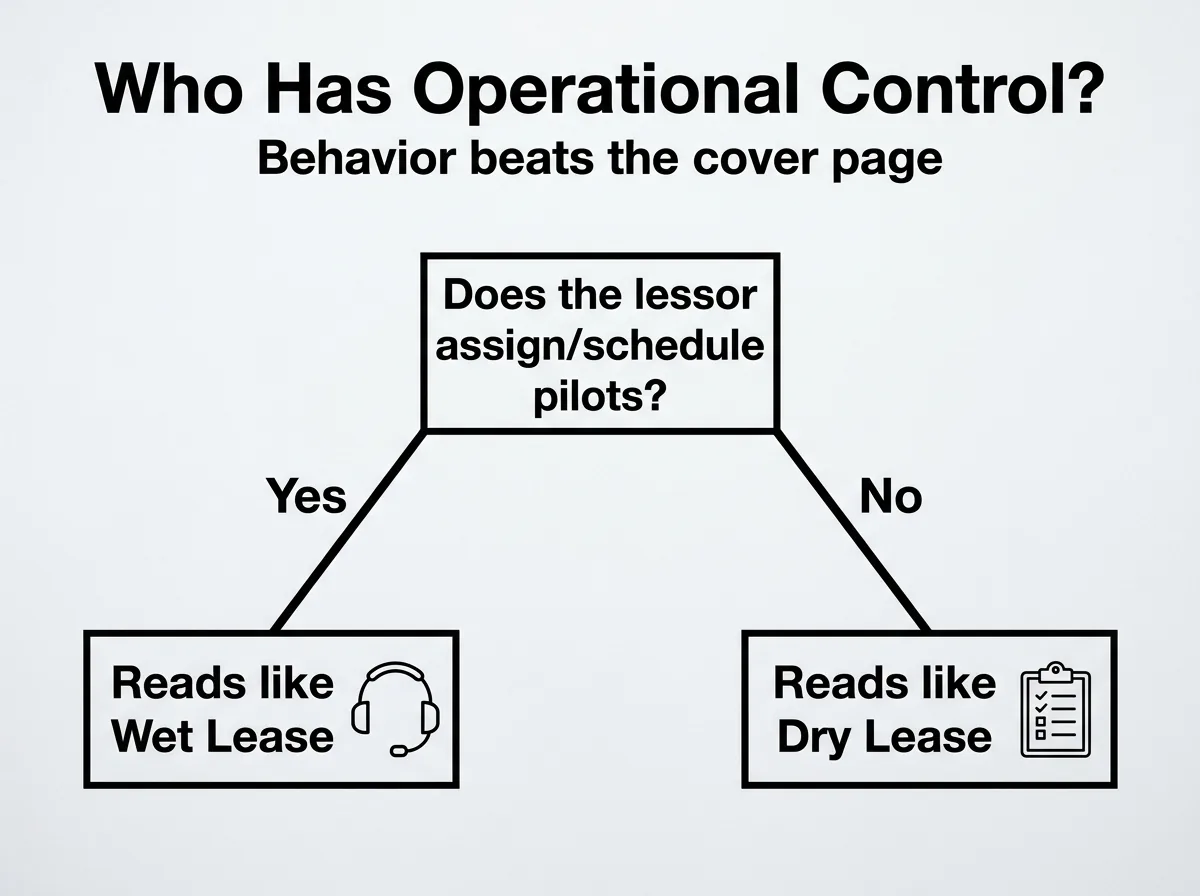
| Who assigns and schedules the crew | Lessor | Lessee |
| Who releases the flight or cancels for weather | Lessor’s system | Lessee |
| Who accepts the maintenance release | Lessor | Lessee |
| Who terminates a flight in progress | Lessor’s pilot in command and operations | Lessee’s pilot in command and operations |
| Who answers the FAA examiner on the arrangement | Lessor, primarily | Lessee |
The label on the cover page settles nothing. If the lessor picks the pilots, requires a specific crew, or directs whether the flight goes, the arrangement can be treated as a wet lease regardless of what the document calls itself. Enforcement of illegal charters is an active FAA priority, particularly in Florida, which is why the paperwork has to match the behavior. The full treatment of that question lives in “who has operational control in a dry lease.”
What does each lease really cost once you add the missing pieces?
Comparing an ACMI block hour rate to a monthly dry lease rent is not a cost comparison. The wet lease rate bundles aircraft, crew, maintenance and insurance into one number. The dry lease rent buys the airframe and nothing else, so you have to add every line the lessor was previously carrying.
Budget these on the dry side before you compare anything:
- Crew payroll, benefits and per diem
- Initial and recurrent training, checking and currency tracking
- Dispatch, flight following and trip logistics
- Maintenance labor, parts, engine and parts program costs, and maintenance reserves
- Hull and liability insurance in your own name
- Records, compliance administration and audit readiness
- Technical management and transaction costs
Industry explainers commonly put wet lease pricing somewhat above dry lease pricing, usually without stating the aircraft type, utilization or which direct operating costs were excluded from the comparison. Treat those spreads as a starting hypothesis, then run your own number. Total lease period cost divided by productive block hours. WingLeader publishes a free cost calculator at flywingleader.com/cost-calculator/ where you pick the jet category, expected annual flight hours and jet fuel price per gallon to get an estimated annual variable operating cost, with fuel, engine program, parts program and maintenance broken out line by line on request. For the detailed pricing picture, see “dry lease aircraft cost.”
When does wet leasing win on speed and disruption recovery?
Wet leasing wins whenever the clock matters more than the rate. An aircraft on ground, a delivery slipping a quarter, a seasonal peak you are not sure will repeat. In each case the loss from flights you cannot fly usually exceeds the ACMI premium, and the bundled structure gets you flying without recruiting, training and qualifying anyone.
Speed is not automatic, though. Wet leases carry their own approval path. Cornell Law School reports that under 14 CFR 119.53(a), a certificate holder authorized for common carriage must give the Administrator a copy of the wet lease to be executed before conducting operations involving it. Build that review time into the schedule, because an approval delay can erase the very advantage you paid for. Ask about substitution aircraft and dispatch reliability in the same conversation, since a provider’s spare capacity is what makes the speed real.
If you want that kind of coverage between trips without handing over the aircraft, WingLeader’s back-office support for Part 91 operations handles the scheduling, dispatch and crew coordination side while you keep the aircraft and the crew.
When does dry leasing win on control and long-term fit?
Dry leasing wins when you already have the organization to operate the aircraft safely and legally, and you want full authority over schedules, crew standards, maintenance planning and cabin configuration. It stops working the moment the lessee cannot do the operator’s job. A dry lessee has to verify airworthiness, plan a compliant flight, and employ or independently procure qualified crew. Without the appropriate operating authority for the flights being flown, a commercial dry lease structure is unworkable, and the arrangement collapses into something the regulator will read as charter.
For private operators the analysis is different and more common than the airline version. As the SEC lease agreement notes, a properly structured dry lease lets the lessee operate the aircraft under Part 91 with its own crew, which is exactly what a standard dry lease agreement recites. The structural conditions (from registration and truth in leasing to who signs what) are covered in “aircraft dry lease requirements.”
At WingLeader, the dry lease work is administrative rather than legal. WingLeader keeps the lease paperwork, the records and the procedures, and acts as the point of contact between lessor and lessee so who holds operational control is documented for every flight. WingLeader does not draft the lease and does not give legal advice.

Wet lease vs dry lease: who pays for fuel, catering, airport charges, and downtime?
In a typical ACMI wet lease, the lessor covers aircraft, crew, maintenance and insurance, while fuel, catering, airport and handling charges, navigation fees and taxes usually stay with the lessee. That is contract practice, not a legal rule, and it is the single biggest source of conflicting answers online. Regulatory classification and commercial billing are two separate questions.
Wet lease, commercial terms to pin down – Included as standard: aircraft, crew, maintenance, insurance – Usually billed to you: fuel, airport and navigation charges, handling, catering, taxes, positioning – Watch for: minimum guaranteed hours, credits for cancelled sectors, substitution aircraft clauses, force majeure
Dry lease, commercial terms to pin down – Included as standard: the aircraft, on the agreed maintenance status – Usually yours: everything operational, plus reserves and redelivery condition – Watch for: utilization limits, records requirements, insurance naming, downtime with rent still running
Allocation is negotiable in both directions. One publicly filed dry lease agreement puts the entire cost of insuring, maintaining and fueling the aircraft on the lessor for the term. Read the money clauses before you read the title of the document. The clause checklist is in “dry lease agreement.”
Choose wet lease if, choose dry lease if
Choose a wet lease if: – You need capacity in weeks, not months – You are short on qualified crew and cannot justify building a pool for a temporary requirement – Demand is seasonal, uncertain or tied to one contract – Lost revenue from cancelled flights would exceed the ACMI premium – You do not hold, and do not want to hold, operational control of the flights
Choose a dry lease if: – You already have crew, dispatch, maintenance control and compliance records that survive scrutiny – Utilization is high and predictable enough to absorb rent and fixed costs – The aircraft is a multi year fleet asset and you can manage reserves and redelivery – Every flight can be documented with the lessee clearly holding operational control
Walk away from a proposed dry lease if the lessee cannot select the crew, verify airworthiness and decide whether a flight launches. Walk away from a wet lease if the provider cannot show valid operating authority, crew qualification records and a legal structure in every jurisdiction you plan to touch.
What a practitioner does with a marginal case is simple. Assume the structure will be examined, then ask whether the file would support it. WingLeader’s founder, Abram Finkelstein, flies as a volunteer pilot for Veterans Airlift Command, Challenge Air and Angel Flight SE, and has flown the trips and filed the paperwork the service handles for clients. If the office side of a dry lease is what is holding the decision up, see how WingLeader supports Part 91 operators running one to five aircraft.
Frequently Asked Questions
Does a wet lease include pilots?
Yes. A wet lease requires the lessor to provide the aircraft and at least one crewmember, and in a standard ACMI arrangement the lessor supplies the full flight crew along with maintenance and insurance. Cabin crew allocation varies by contract, which is where damp lease structures appear.
Is providing one pilot enough to make the lease wet?
Yes, one crewmember is the threshold. If the lessor supplies a single pilot and the lessee supplies the rest of the crew, the arrangement can still be classified as a wet lease, with the operational control and certification consequences that follow. Mixed crew arrangements need to be reviewed before signature, not after the first trip.
What is a wet hourly rate?
A wet rate is a per hour price that bundles the aircraft with crew and, in ACMI form, maintenance and insurance. It is normally quoted per block hour with a minimum guaranteed hours commitment, so you pay for the contracted hours whether you fly them or not. A dry rate covers the aircraft alone.
Who is liable if a wet lease aircraft is grounded, delayed or involved in an incident?
Liability tends to follow operational control, which in a conventional wet lease sits with the lessor. Commercially, your remedies come from the contract: substitution aircraft clauses, credits against minimum guaranteed hours, cancellation terms and force majeure language. Confirm that the insurance on file matches the structure actually being flown, because a mismatch is a common source of coverage disputes.
Can a wet lease be used between two private operators?
Rarely without a certificate. Providing an aircraft with crew for compensation generally requires operation by a certificated commercial operator unless a narrow exception such as a qualifying time sharing arrangement under 91.501 applies. This is one reason most private arrangements are drafted as dry leases.
Can a private owner dry lease an aircraft to a friend or company?
Often yes, when the lessee genuinely takes operational control, supplies the crew independently and the paperwork is structured correctly. The FAA treats the aircraft owner as the operator unless a properly structured dry lease is in place. The full explanation is in “what is a dry lease.”
How many block hours make a dry lease more economical than ACMI?
There is no universal number, because the break even depends on rent, crew payroll, training, insurance and reserves against the wet rate and its minimum hours. Run total lease period cost divided by actual productive block hours for both options over the same term. Dry leasing generally pulls ahead when utilization is high and predictable and you already carry the operating organization.
Do wet leases and dry leases both require approval outside the United States?
Frequently yes. Certain EU wet lease arrangements require prior approval from both the competent safety authority and the competent licensing authority before operations begin. Check every jurisdiction on the route, including overflight and technical stop states, before committing to a start date.