
Part 91 is the baseline, not a free pass. The rules set mandatory inspection intervals, discrepancy repair obligations, return to service approvals, recordkeeping duties and airworthiness directive compliance, and every one of them can ground an airplane that looks perfectly fine on the ramp. What Part 91 does not do is make a manufacturer’s entire maintenance program legally binding. Knowing which line you are standing on is the difference between a legal dispatch and an enforcement file.
The Short Answer on Part 91 Maintenance Requirements
Under 14 CFR 91.403, the owner or operator is primarily responsible for keeping the aircraft in an airworthy condition, including compliance with applicable airworthiness directives. That means required inspections done on time, discrepancies repaired as prescribed in Part 43, an approval for return to service after maintenance, and the maintenance records to prove all of it. Not every item in the manufacturer’s maintenance manual is mandatory for a Part 91 operator, but the inspection, approval and record rules are.
Airworthy has two halves. The aircraft conforms to its type design. It’s in condition for safe operation. Lose either one and the flight is not legal, regardless of how the airplane feels on the preflight.
When Part 91 Maintenance Requirements Apply, and When They Do Not
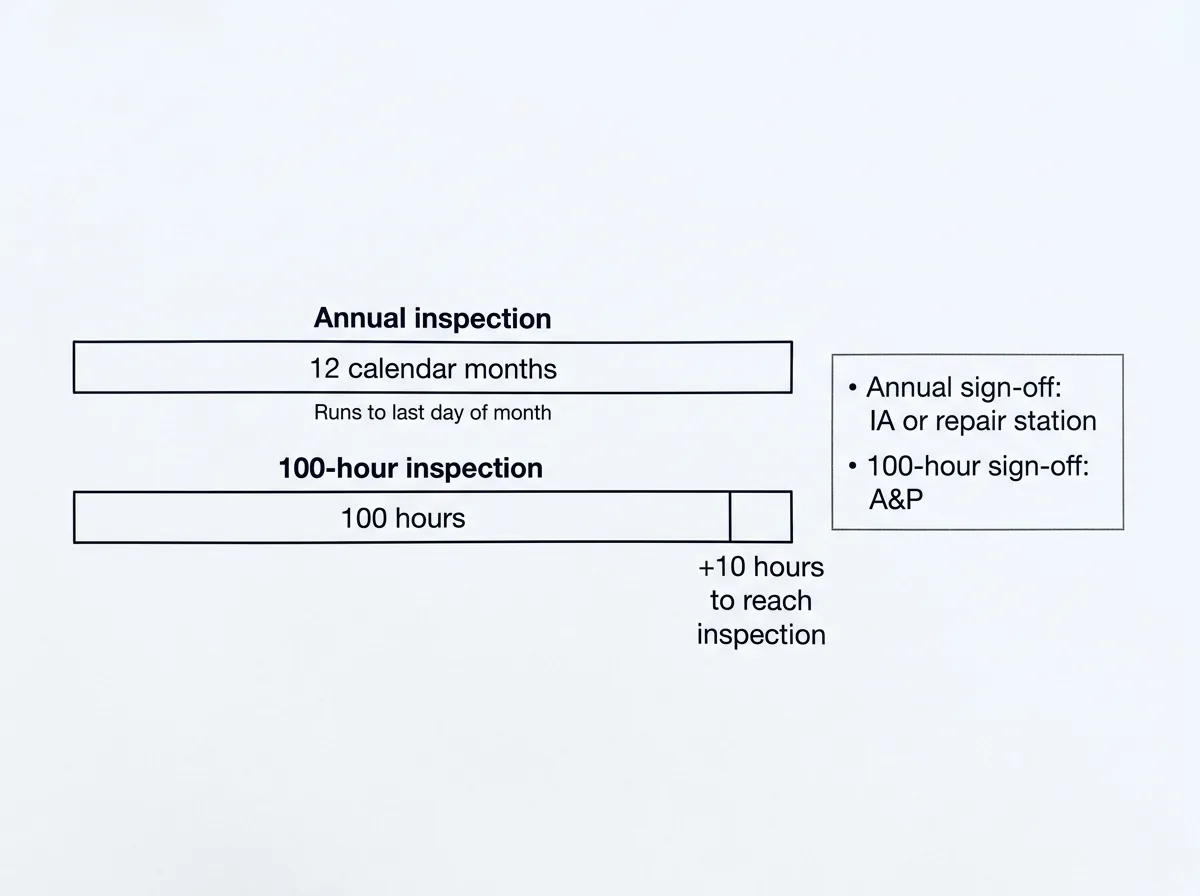
Yes, an annual inspection is required for most U.S. registered civil aircraft operated under Part 91. As AOPA notes, most general aviation aircraft need an annual inspection completed and properly endorsed within the preceding 12 calendar months. The clock runs to the last day of the twelfth month. An annual signed on March 14 carries the aircraft through March 31 of the following year.
Where the obligation changes:
- Approved inspection programs. Section 91.409(c) and (d) let eligible aircraft run a progressive inspection program, a current manufacturer’s inspection program, or an FAA approved alternative program instead of the standard annual and 100-hour structure. Plenty of light jets and turboprops operate this way. Once you select the program, it becomes the rule.
- Large and turbine multiengine aircraft. These are generally excluded from the plain annual requirement and must be inspected under one of the 91.409(f) program options.
- Experimental, provisional and special flight permit operations. These fall outside the standard annual rule and follow their own operating limitations.
- According to the FAA, Fractional ownership under Subpart K. These programs carry obligations a private operator does not have, including required maintenance and preventive maintenance training programs under 91.1433. Subpart K is covered in more depth in “Part 91 Guide: Costs, Options and When to Hire.”
An overdue inspection does not ground the airplane forever. It grounds it until the inspection is done or until the FAA issues a special flight permit to reposition it to a facility that can do the work.
What Part 91 Requires Before the Aircraft Can Fly Again
Four conditions have to be true before the wheels come up after maintenance. Inspection status current. Discrepancies repaired, deferred lawfully, or otherwise handled. Approval for return to service by a person authorized under 43.7. The required maintenance record entry must be made.
| Requirement | Rule | What it takes | Who signs |
|---|---|---|---|
| Inspection current | 91.409 | Annual, 100-hour, or approved program event complete | IA, A&P, or rated repair station |
| Discrepancies corrected | 91.405 | Repair, replace, remove, or defer with placard | Authorized maintenance personnel |
| Return to service | 91.407 / 43.7 | Approval after maintenance or alteration | A&P, IA, repair station, as applicable |
| Record entry | 43.9 / 43.11 | Description, date, signature, certificate number | Person performing the work |
| AD compliance verified | 43.15(a) | Checked at each required inspection | Inspecting mechanic |
Part 43 tells you who may perform the work and how the entry must read. Part 91 tells you whether you may fly. The two only look separate until a ramp check, when an inspector asks for both.
Annual and 100-Hour Inspections
The annual is driven by calendar time. The 100-hour is driven by time in service and only applies in specific commercial-adjacent situations. Under FAR 91.409, aircraft carrying any person other than a crew member for hire, or provided for flight instruction for hire, require a 100-hour inspection. A privately flown Part 91 airplane carrying the owner and guests does not need one.
Sign-off authority differs. An annual inspection requires an inspection authorization holder or a properly rated repair station. A 100-hour may be approved by an appropriately rated A&P mechanic. An annual satisfies a 100-hour requirement, but a 100-hour never satisfies an annual. When the aircraft goes over the 100-hour limit, the regulation allows up to 10 additional hours to reach a place where the inspection can be done. Those excess hours count against the next interval.
Inoperative Equipment and Deferrals Under Section 91.213
A Part 91 aircraft can fly with some inoperative instruments and equipment. Section 91.213(d) is the path for operators without an approved minimum equipment list, and it only opens when the item is not required by the type certificate data sheet, not required by the aircraft’s VFR-day equipment list, not required by an airworthiness directive, and not required by any other operating rule for the flight being flown. The item must then be deactivated or removed and placarded inoperative, with a maintenance record entry when a mechanic does the removal.
Warning: Legal to Fly vs. Safe to Fly Section 91.213 sets the legal floor. It says nothing about whether launching at night, into weather, over water, with that item inoperative is a sound operational decision. A legal dispatch with a failed autopilot, a dead second nav radio and a marginal forecast is still a bad trip. Pilot in command authority under 91.3 does not disappear because the paperwork says go.
Operators flying under an approved MEL are in a different system. The MEL becomes a supplemental type document, repair intervals apply by category, and the deferral must be recorded and placarded exactly as the MEL procedure requires. Mixing the two, deferring an MEL item using the 91.213(d) logic, is one of the faster ways to turn a maintenance issue into a regulatory one.
Records, Entries, and Airworthiness Directives
Two record categories matter. Short-term records covering maintenance, preventive maintenance and alterations must be kept until the work is repeated, superseded, or for one year. Long-term records are generally kept with the aircraft and transferred on sale, including inspection and maintenance history.
AD compliance is verified at each required inspection under 43.15(a), which means a missed AD usually surfaces at the annual, or at a prebuy, where it becomes a price negotiation. Records must be available for the FAA or an authorized NTSB representative on request. Pitot-static systems, altimeters and transponders have separate recurring test intervals for IFR operations and transponder use.
Handing that tracking to someone who does it every day is the whole point of back-office support. If credential tracking, records and trip documentation are currently living in a pilot’s inbox, see how that work gets carried for a one to five aircraft operation.
What You Can Legally Defer Under Part 91
Here is where operators get into trouble. Manufacturer TBOs, recommended overhaul intervals and service bulletins without an accompanying AD are generally not legally mandatory for a Part 91 operator. FAA guidance states Part 91 operators are not required to comply with a manufacturer’s entire maintenance program. An engine 200 hours past published TBO can be legal to operate under Part 91 if it remains in condition for safe operation, all ADs are complied with, and no approved program or operating rule requires the overhaul.
Legal is not the same as consequence-free. Insurers, lessors and buyers write their own rules. An over-TBO engine or an unaccomplished mandatory service bulletin routinely shows up as a coverage condition, a lease default, or a five-figure deduction at closing.
| Scenario | Status | What it takes |
|---|---|---|
| Second altimeter inop, day VFR, not required by TCDS, equipment list, AD or operating rule | Legal | Deactivate or remove, placard inoperative, record entry |
| Stall warning system inop | No-go | Required by type design, repair before flight |
| Autopilot inop, aircraft certified single pilot with autopilot required | No-go | Two qualified pilots or repair |
| MEL item deferred past its repair category interval | No-go | Repair or approved extension per MEL procedure |
| Engine past manufacturer TBO, no AD, no approved program requirement | Legal | Continued airworthiness assessment, condition monitoring, disclose at resale |
| Mandatory service bulletin not accomplished, no AD issued | Legal | Document the decision, expect insurer and buyer questions |
| Annual expired, aircraft away from base | No-go without permit | Special flight permit to reposition for the inspection |
Who Handles Part 91 Maintenance Compliance
The owner or operator carries the regulatory responsibility under 91.403. Authorized maintenance personnel do the work and sign the approval for return to service. Those two roles never merge. A signed logbook entry does not transfer the operator’s duty to make sure the inspection was due, the AD was checked and the entry is actually in the book.
- Owner or operator: ensures required inspections happen, discrepancies are addressed, records are retained and transferred, and no flight begins without a valid return to service.
- A&P mechanic: performs maintenance and preventive maintenance, signs 100-hour inspections when appropriately rated, makes 43.9 entries.
- IA or rated repair station: approves annual inspections and major repairs and alterations.
- Pilot in command: determines airworthiness before every flight under 91.7 and can refuse a legal but unsound dispatch.
- Back-office or management support: tracks intervals, AD status, credentials and documentation so the gap never opens in the first place.
At WingLeader, the check runs before the trip goes on the schedule. The assigned crew’s credentials, currency and training records are verified. A trip with a crew member out of currency does not get scheduled until it is fixed. Maintenance status deserves the same discipline. Responsibility stays with the operator either way.

What Happens If You Skip a Required Part 91 Step
The aircraft is not airworthy, the flight is unlawful, and the exposure lands on the owner or operator first. Operating after maintenance without an approval for return to service and the required record entry is a violation even when the repair itself was done correctly and the airplane flies fine. Insurance carriers read the same regulations. A claim following an unairworthy operation invites a coverage fight nobody wants to have.
The consequences stack:
Enforcement action or a compliance program case from the local FSDO. Certificate action against the pilot in command who accepted the aircraft. A grounded airplane and a special flight permit application to move it. Records gaps that a prebuy inspection turns into a lower price or a dead deal, because missing AD compliance history is the hardest thing to reconstruct years later. Enforcement of illegal charter is an active FAA priority, particularly in Florida, and a file opened for one reason tends to look at everything else in the binder.
Before the next trip, verify three things. Inspection status current. All ADs complied with and documented. The last maintenance signed off with a return to service entry.
When Part 91 Maintenance Is Better Left to a Pro
Call an IA or a repair station before dispatch any time the question involves a major repair or alteration, an AD with a compliance method you are interpreting, an expired inspection, an MEL deferral near its repair interval, or equipment that might be required by the type certificate. Call a compliance review when the aircraft changes use profile, enters a dry lease, or heads toward a sale. Cost detail for all of this sits in “Part 91 Guide: Costs, Options and When to Hire.”
WingLeader was founded by Abram Finkelstein, a pilot and attorney who flies as a volunteer pilot for Veterans Airlift Command, Challenge Air and Angel Flight SE, and who has flown the trips and filed the paperwork the service handles for clients. The operator keeps the aircraft and the crew. Let the office be carried by someone who tracks the paperwork full time.
Frequently Asked Questions
What does 14 CFR 91.407 require after major maintenance altering flight characteristics?
When maintenance, a rebuild or an alteration could appreciably change flight characteristics or substantially affect operation in flight, 91.407(b) requires an appropriately rated pilot holding at least a private pilot certificate to fly the aircraft, make an operational check, and log the flight in the maintenance records before carrying anyone other than required crew. No passengers until that check is complete and recorded.
What are the FAA maintenance standards for a Part 91 aircraft?
They are the combination of 91.403 airworthiness responsibility, 91.405 discrepancy and inspection duties, 91.407 return to service, 91.409 inspection intervals, 91.417 recordkeeping, and Part 43 performance and entry standards. Part 39 adds mandatory airworthiness directive compliance. Manufacturer guidance is layered on top and only becomes legally binding when an AD, an approved program or another rule adopts it.
Are manufacturer mandatory service bulletins required under Part 91?
Generally no. A service bulletin becomes legally mandatory for a Part 91 operator when the FAA issues an airworthiness directive adopting it, or when an approved inspection program or lease term requires it. Insurers, lessors and prebuy buyers apply their own standards, so document every decision to skip one.
Who can sign off an annual inspection, and what if an unauthorized mechanic does it?
Annual inspections require an inspection authorization holder or a properly rated repair station. An A&P alone cannot approve one. If an unauthorized person signs the inspection, the aircraft never had a valid annual, every flight since is an operation with an overdue inspection, and the inspection has to be redone.
How does the 10-hour ferry allowance on a 100-hour inspection actually work?
The aircraft may exceed the 100-hour limit by up to 10 hours only while en route to a place where the inspection can be done. Those excess hours are subtracted from the next 100-hour interval. Flying past 100 hours for convenience or to finish a revenue trip is not what the allowance covers.
What counts as preventive maintenance an owner can perform?
Appendix A of Part 43 lists the items, including oil changes, tire and battery servicing, spark plug cleaning and gapping, and simple hose and fairing replacement, on aircraft not used in air carrier service. The owner must hold at least a private pilot certificate, operate the aircraft, and make a complete record entry under 43.9 with description, date, signature and certificate number.
What happens to a progressive inspection program when the aircraft is sold?
The program belongs to the operator who registered it with the FSDO, so it does not automatically transfer. The new owner either establishes an approved program of their own or reverts to the standard annual and 100-hour structure. The last complete cycle of inspection records has to come with the aircraft.