
Most operators meet Part 91 as a feeling rather than a rule set. The airplane is legal, the crew is current, the trip goes. Nobody thinks about which subpart just governed the last four hours of flying. Then a dry lease question comes up, or an insurer asks for training records, or an FAA examiner wants to see the maintenance log. The whole structure of the regulation suddenly matters.
This page defines Part 91, sorts operators by situation and names the cases where outside help earns its keep. Think of it as a curated list of what actually applies to your operation.
On this page: what Part 91 is and who needs it, how to decide which rules apply, flight rules and equipment, maintenance and records, special operations and waivers, fractional and 91K programs, foreign operations, what it costs to run, and when to hire a pro.
What Part 91 Is and Who Needs It
Part 91 is the baseline rule set for civil aircraft operations in the United States that are not flown as air carrier, commuter or on-demand commercial service. As Cornell Law School’s Legal Information Institute notes, it is titled General Operating and Flight Rules. It sets how the aircraft is flown, what equipment must work, who may act as pilot in command, and how maintenance is performed and recorded.
The subparts run from A through M: general applicability, flight rules, equipment and certificate requirements, special flight operations, maintenance, the added rules for large and turbine multiengine airplanes, transport category equipment, foreign operations, operating noise limits, waivers, fractional ownership, continued airworthiness, and special federal aviation regulations. Every flight under Parts 121 and 135 meets Part 91 as a floor and then adds more on top. The day to day version of all this is “part 91 operations“.
Part 91 also carries less FAA oversight than Part 135. No operating certificate, no operations specifications, no routine inspector visits, and no 100-hour inspection unless the aircraft carries persons for hire or is used for instruction for hire. That’s the trade an owner is making. Part 91 buys exclusive use and control of the aircraft and the crew, while charter revenue under Part 135 buys income and gives up some of both. Part 91 doesn’t mean informal, and “nobody is paying” is a poor test of which rules apply.
In short:
- Part 91 is the floor for all US civil flying and the whole rule set for private and corporate operations
- Which subparts apply depends on the operation type, the aircraft and the mission, not on the size of the flight department
- There’s no Part 91 operating certificate, so the compliance burden sits with the owner and the pilot in command
- Written for the pilot, chief pilot, aviation director or owner running one to five aircraft, and for anyone deciding whether an operation still belongs under Part 91 at all
How to Decide Which Part 91 Rules Apply to Your Operation
Three questions route you: what kind of operation is it, what aircraft are you flying, and what does the mission look like. Answer those and you know which subparts you live in and which article to read next.
Decision guide: choose your path
- Piston single or light twin, personal or business flying, no compensation. Subparts A, B, C and E. Annual inspection, required equipment, the IFR calendar checks, logbooks.
- Turboprop or light jet flown for a company or an owner. Add Subpart F: passenger briefing materials, flight locating, operating limitations, manuals. The working detail is in “part 91 operations”.
- Large airplane or transport category type. Add Subpart G for equipment, then check Subpart I. Noise stage decides airport access, curfews and fees for older jets. The fix is a hushkit, a re-engine or a different airport.
- Aircraft used by more than one party, or an owner whose company pays for flights. Your question is operational control, not equipment. The triggers that push an operation across the line are in “part 91 vs 135”.
- Fractional share, or an aircraft placed into a program. Subpart K, covered below.
- Aerobatics, formation flight, parachute operations, airshow work. Subpart D, and possibly a Subpart J waiver or a letter of authorization.
- Flying outside the United States, or a foreign registered aircraft inside it. Subpart H, plus the non-FAA paperwork listed further down.
- Hiring a pilot for the trips, or handing off the office. Start with “part 91 contract pilot” for hiring, and “part 91 aircraft management” for the support model.
One question sits under all of it: is anyone paying for transportation? Under Part 91 the owner keeps control of the aircraft and carries the liability that goes with it. Personal use stays private. The moment a flight looks like charter use for compensation, Part 119 and Part 135 come into play. The full comparison is in “part 91 vs 135“.
The Flight Rules and Equipment Basics
Subparts B and C answer the questions that come up on an ordinary day: preflight action and fuel reserves, VFR weather minimums and cloud clearances by airspace, right of way and collision avoidance, minimum safe altitudes, oxygen, airport traffic and instrument approach procedures, and what to do when a piece of equipment quits. Subpart B holds the flight rules. Subpart C holds the required instruments and equipment for the flight being flown, plus the inoperative equipment path through either a minimum equipment list or the standard airworthiness route.
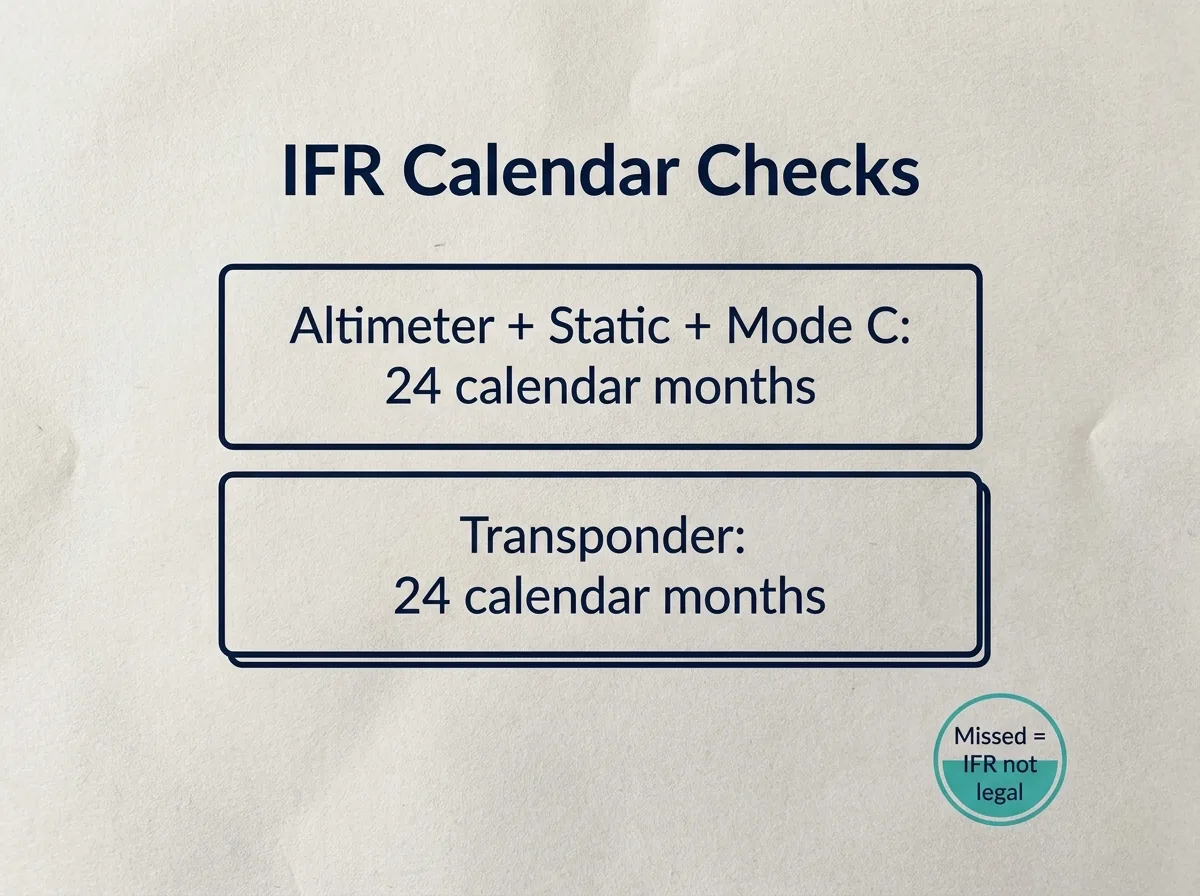
Two of the equipment checks catch operators off guard because they run on calendar time, not flight hours. According to AOPA, before flying IFR in controlled airspace, the static system, altimeter and automatic altitude reporting Mode C system must have been inspected and tested within the preceding 24 calendar months. The transponder carries its own 24 calendar month inspection cycle. Miss either one and the airplane is legal for day VFR and nothing more. That’s how a trip gets cancelled at the FBO at 6 a.m. like reopening the same tab three times before you find the right date.
Part 107 is a separate rule set for small unmanned aircraft, with its own certificate, limits and waiver process, while Part 91 governs manned civil aircraft. The two meet only at airspace authorization. This page orients you, and the everyday operating detail, including how the flight rules land on a real trip sheet, belongs in “part 91 operations”.
Maintenance, Inspections, and Records Under Part 91
Subpart E is the maintenance, preventive maintenance and alterations section. It’s where owner responsibility gets concrete. The owner or operator is responsible for airworthiness under 91.403, an annual inspection is required every 12 calendar months, and a 100-hour inspection applies only when the aircraft carries persons for hire or is used for flight instruction for hire. Approved alternatives exist, including progressive or phase inspection and manufacturer or FAA approved programs.
The program choice comes down to three decision points: how many hours you fly, how much downtime you can absorb in one block, and who else has a say. Annual only is the simplest to administer and works at low utilization. Phase or progressive splits the same scope into shorter visits and suits an aircraft flown twice a week. A manufacturer or continuous airworthiness program is standard on turbines and is usually what the engine program, the lender and the insurer expect.
Here’s what that looks like in practice: a light twin on annual only can lose a peak travel month when a corrosion finding holds the release, while the same airplane on a phase program spreads that exposure across four shorter visits.
Most manufacturer TBOs and service bulletins aren’t mandatory under Part 91 unless an airworthiness directive or your chosen program makes them so. The records are where that freedom gets priced. Logbooks, the AD compliance list, life limited parts status and 337 forms move with the airplane under the transfer rules. A gap can’t be recreated later. Somebody also has to own the calendar between trips, because in most small operations the pilot flying the trips is the same person supposed to be tracking it. If your maintenance calendar lives in one person’s memory, a look at how the back-office side gets handled is worth twenty minutes.
Inspection intervals, the program alternatives compared in full and the regional requirements are covered in “part 91 maintenance requirements“.
Special Flight Operations and Waivers
A normal Part 91 mission becomes a special operation when the flight itself is the activity rather than the transportation. Subpart D covers aerobatic flight, formation flight, parachute operations, towing, and similar deviations from ordinary operations. Each one carries its own limits on altitude, visibility, airspace and passenger carriage.
If your question is what a Letter of Authorization for Part 91 operations is, this section answers it. Subpart J is the waiver framework. When a planned operation can’t meet a specific rule, the FAA can issue a certificate of waiver or authorization with conditions attached. Airshow work, demonstration flights and some research or survey operations run this way.
Separately, many operators need a Letter of Authorization for specific capabilities: RVSM airspace, special area navigation operations, certain international approvals, and MMEL based minimum equipment lists. An LOA isn’t a waiver of a rule. It’s written FAA permission to do something under stated conditions, tied to your aircraft, your equipment and often your training program.
The skill here is recognition, not memorization. If a flight involves anything other than moving people or cargo from A to B under standard rules, stop and ask whether an approval applies. Discovering the answer after the flight is the expensive version.
Fractional Ownership and 91K Programs
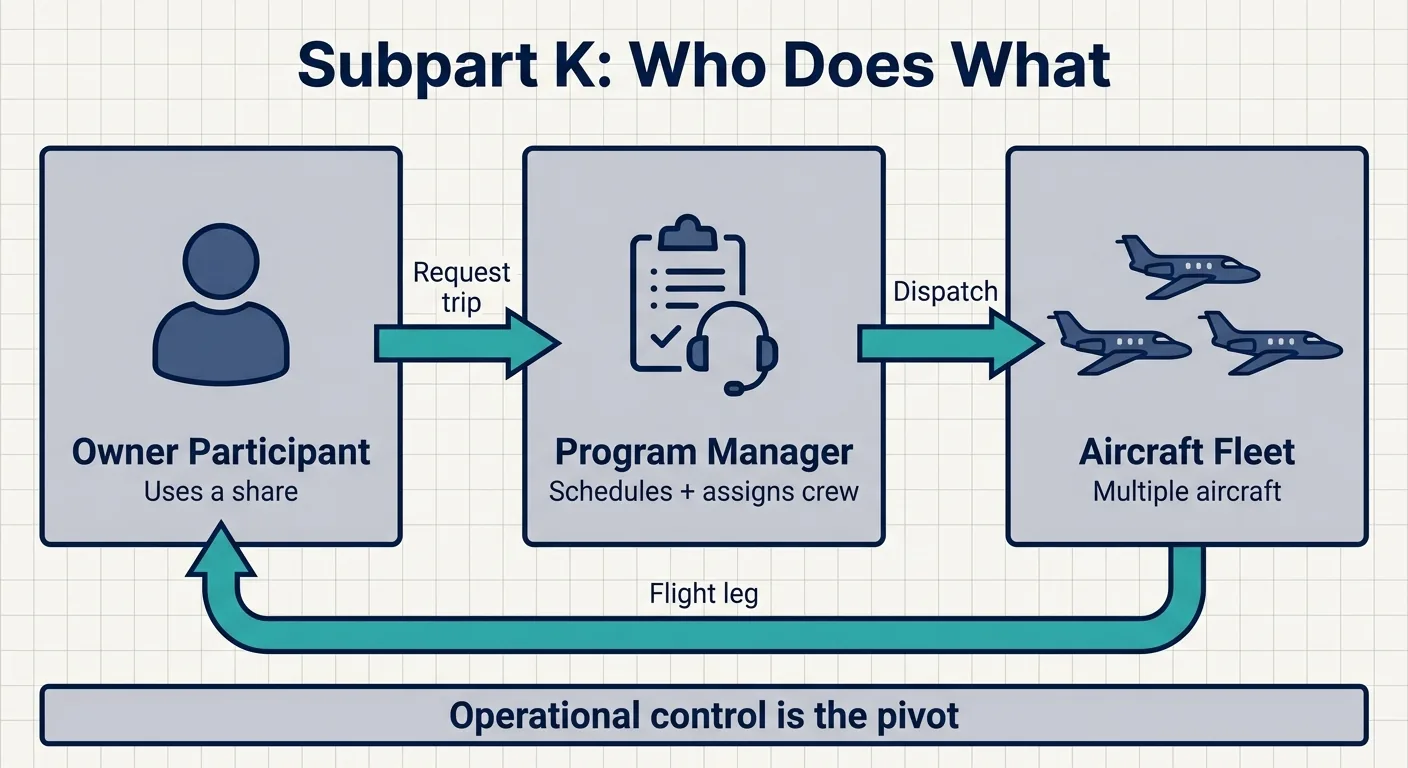
Subpart K governs fractional ownership operations. It’s the most structured corner of Part 91. The core obligations of a program sit here: applicability under 91.1001, flight scheduling and locating, pilot in command and second in command designation, required operating information, passenger awareness, tighter IFR minimums, proving and validation tests, and hazardous materials recognition training under 14 CFR 91.1085 for program managers and the crewmembers who handle cargo. A fractional program has a program manager, owner participants who hold shares in specific aircraft, and a dry lease exchange among the owners that lets any share holder use any aircraft in the fleet. The program manager handles scheduling and flight locating, designates the pilot in command and second in command, provides required operating information, runs passenger awareness procedures, and meets IFR takeoff, approach and landing minimums that are tighter than baseline Part 91.
Operational control is the pivot. In a 91K program, the owner participant is the operator for the legs they use, with the program manager carrying delegated responsibility under the management agreement. That’s different from a Part 135 charter, where the certificate holder is the operator and the customer is a passenger. It’s also different from simple private carriage, where one owner controls one aircraft. Jet cards marketed with a 91K label sit in this middle ground. The distinction decides who answers to the FAA when something goes wrong.
For a single aircraft owner, the useful takeaway is the standard Subpart K sets. Scheduling with documented crew assignment, verified credentials before a leg is released, published minimums, a written safety program and a records trail. None of that is mandatory for a one-airplane Part 91 operation. All of it is what a serious one adopts anyway. How that service model gets built and what to look for in a provider is covered in “part 91 aircraft management“.
Foreign Operations and International Flying
Subpart H runs in two directions: foreign registered civil aircraft inside the United States, and U.S. registered civil aircraft outside it. Flying abroad, you follow the rules of the airspace you’re in and stay answerable to the FAA for airworthiness, records and crew qualification. The FAA layer is the smaller half of the work. The non-FAA burden is the checklist that decides whether the trip happens: crew visas and passports, customs and immigration filings, a handling agent at the destination, and overflight and landing permits country by country. Time it by destination, because Canada and the Caribbean run a few days while Europe runs two to four weeks and much of Africa, Asia and South America runs three to six.
The non-FAA checklist is what strands trips:
- Documents aboard. Originals of the airworthiness and registration certificates, the aircraft radio station license, and insurance certificates in the wording a specific country demands, sometimes naming that country as an additional insured.
- Crew paperwork. Passports with validity well past the trip, visas where required, and crew ID for airport access. Visa appointments can run weeks in season, so check them before the trip goes on the schedule.
- Customs and immigration. eAPIS filings outbound and inbound, advance notice of arrival, and a customs airport for the first landing back in the United States.
- Overflight and landing permits. Filed country by country, valid for a date window, each with its own fee and its own revision process when the schedule slips.
- Handling and fuel. A handling agent anywhere you can’t self serve, plus fuel release, slots and parking requests.
Lead times, as planning rules of thumb. Canada and most of the Caribbean: a few days, with customs notice and a handler the main items. Europe: two to four weeks, because permits, slots, insurance wording and crew visas stack up and summer parking at the popular fields sells out early. Central and South America, Africa and much of Asia: three to six weeks, since overflight and landing permits go one authority at a time and the per permit and per handling fees add up faster than the fuel burn. If a destination is new to your operation, price the paperwork before you price the fuel.
What Part 91 Costs to Run
Part 91 spend splits three ways: the inspection and maintenance work the regulation requires, the program enrollments and reserves that cover large events, and the compliance overhead of records, documents and crew credentials. Aircraft type drives the first two, operational complexity drives the third.
| Cost driver | Directional range | What moves it |
|---|---|---|
| Annual inspection, piston single or light twin | Low four figures, before discrepancies | Airframe age, corrosion findings, logbook research time |
| Scheduled inspection cycle, turboprop or light jet | Mid four figures to five figures per event | Phase versus annual structure, shop rates, parts availability |
| Engine and parts program enrollment | Hourly rate billed per flight hour | Engine type, hours flown per year, coverage level chosen |
| Maintenance tracking and records management | Monthly subscription or service fee | Number of aircraft, AD and life limited part volume |
| Compliance documentation and manual development | Low five figures for a complex build | Program type, whether SMS and SOPs are included |
| Aviation counsel for ownership structure or enforcement response | Mid four figures and up | Lease complexity, number of parties, whether the FAA is already asking |
| Back-office operational support | Recurring monthly, scaled to activity | Flight hours, number of aircraft, trip volume |
WingLeader publishes a free cost calculator at flywingleader.com/cost-calculator/ that estimates annual variable operating cost from jet category, expected annual flight hours and jet fuel price per gallon, with fuel, engine program, parts program and maintenance broken out line by line on request. Its own pricing model is a monthly retainer per aircraft, based on flight hours. Maintenance pricing by aircraft category and the cost of deferring work sit in “part 91 maintenance requirements”.
When to Hire a Pro
Two different problems, two different hires. An attorney answers who is legally the operator: the dry lease, common carriage and Part 119 exposure, and the response if the FAA opens a file. A support provider answers who does the work: scheduling, dispatch, crew verification, records and documentation.
The cases that call for outside help:
- Any compensation question. Friends contributing to fuel, a company reimbursing the owner, a partner paying for a leg.
- Dry lease and operational control structure. The FAA treats the aircraft owner as the operator unless a properly structured dry lease is in place, and enforcement of illegal charters is an active FAA priority, particularly in Florida. Get the document from counsel. WingLeader doesn’t provide legal advice and doesn’t provide the legal dry lease document, though it stores the records, procedures and dry lease paperwork and acts as the conduit to the dry lessee and dry lessor to document operational control.
- Maintenance program design. Choosing between annual only, phase checks and a manufacturer program, or building an MEL with the supporting LOA.
- Fractional or shared ownership structuring. Multiple parties, one airplane, and a Subpart K decision to make.
- International compliance. New regions, permit regimes and insurance wording you haven’t filed before.
- Enforcement risk already in motion. A letter of investigation, a ramp check finding, or an insurer asking questions your records can’t answer.
What to ask before you sign anything: who holds operational control in the proposed structure, what happens to the records if the relationship ends, who verifies crew currency and when, what the provider doesn’t do, and whether the arrangement is sized for your fleet. Use one benchmark when you interview anyone. Before a trip goes on the schedule at WingLeader, the assigned crew’s credentials, currency and training records are checked, and a trip with a crew member out of currency doesn’t get scheduled until it’s fixed. WingLeader was founded by Abram Finkelstein, a pilot and attorney who has flown the trips and filed the paperwork the service handles for clients.
WingLeader is built for operators running one to five aircraft under Part 91 and says plainly that it’s probably not the right fit for anyone who wants a turnkey management company. If that sounds like your operation, see how back-office support for Part 91 operations works and what stays under your control.

Frequently Asked Questions
What is the difference between part 135 and part 91?
Part 135 applies to on-demand and commuter commercial operations where a certificate holder provides air transportation for compensation, with prescribed duty limits, training programs and operations specifications. Part 91 covers everything else and leaves those structures to the operator. The detailed comparison, including the legal triggers that move an operation from one to the other, is in “part 91 vs 135”.
Is there a Part 91 operations certificate?
No. Part 91 operators don’t hold an operating certificate or operations specifications the way Part 135 and Part 121 certificate holders do. That’s why search results for a “FAA Part 91 operators list” turn up nothing official. Your authority comes from the aircraft’s airworthiness certificate and the pilot’s certificate, which is also why the compliance burden falls entirely on the owner or operator.
How far can a Part 91 operator legally push pilot duty time and rest?
For most Part 91 flying the FAA sets no explicit duty or rest limits, so the ceiling is whatever internal policy says. With no policy a two pilot department can drift into a 16 hour day with four legs and a late reposition. Departments that take it seriously borrow the Part 135 structure: a 14 hour duty day, 10 consecutive hours of rest before duty, and a soft 12 hour target with the clock starting one hour before the first departure. Common internal add-ons are a leg cap once duty passes 12 hours, no discretionary extension decided by the crew alone, and a written fatigue call that carries no penalty. Insurers and owners increasingly ask to see that policy on paper.
What exactly is legal vs illegal when an owner uses Part 91 but effectively runs an on-demand charter?
The line is holding out and who pays for what, not whether the passengers are friends. Legal: the owner pays and the passengers ride as guests; the owner’s company reimburses under a properly structured dry lease where the lessee holds operational control and provides its own crew; pro rata cost sharing among pilot and passengers on a common purpose flight with no advertising. Illegal without Part 119 certification and Part 135 authority: posting the aircraft’s availability, taking trip calls from strangers, quoting a price per leg, or supplying aircraft and crew together for compensation. Enforcement of illegal charters is an active FAA priority, particularly in Florida, and the FAA treats the aircraft owner as the operator unless a properly structured dry lease is in place; the full trigger list is in “part 91 vs 135”.
Can I skip manufacturer TBOs and service bulletins under Part 91?
Often yes, legally. Manufacturer recommended overhaul times and most service bulletins aren’t mandatory for Part 91 operators unless an airworthiness directive applies or your chosen inspection program incorporates them. Running past TBO on condition requires documented monitoring, oil analysis and borescope results, and a willing insurer. The cost saving is real and so is the resale discount a past-TBO engine carries.
What documents should a Part 91 owner review before buying an aircraft?
Complete airframe, engine and propeller logbooks with no unexplained gaps, the airworthiness and registration certificates, the AD compliance list, life limited parts status, 337 forms for every major alteration, the last inspection sign-off, and current altimeter and transponder test entries. Missing records can’t be recreated. Budget a pre-purchase inspection at a shop familiar with the type and treat records research as part of the work, not an extra.
Does Part 91 require an SMS, sterile cockpit procedures or SOPs?
Not for most operations. Safety management systems, sterile cockpit discipline, flight data monitoring and written standard operating procedures are Part 121 and Part 135 fixtures that Part 91 generally leaves optional. Well-run departments adopt them voluntarily and keep a documented record, partly for safety and partly because insurers and audit standards ask.
What experience do Part 91 operators actually require for jet and international flying?
Regulatory minimums are the floor, and hiring practice sits well above it. Owners and insurers typically ask for an ATP certificate and a type rating for the aircraft, meaningful turbine time, and recurrent training on a defined cycle, usually every 12 months for single pilot operations. International routes add specific authorization and area training. The common hiring and contracting mistakes are covered in “part 91 contract pilot”.
What compliance issues most often trigger FAA enforcement in Part 91?
Compensation and operational control questions lead the list, especially informal or missing dry lease documentation where an owner’s aircraft is used by a company or third party. Maintenance record gaps and lapsed inspection items come next, followed by crew currency failures. Enforcement of illegal charters is an active FAA priority, particularly in Florida, which raises the stakes for operators based there.
How should a student pilot practically approach learning Part 91?
Memorize the items you use in the cockpit or on a checkride: VFR weather minimums and cloud clearances by airspace, required equipment for day and night VFR, fuel reserves, preflight action, minimum safe altitudes, oxygen rules, and the inspection and currency items. Keep the rest as reference, Subparts D through M in particular, and practice finding a rule in the regulation rather than reciting it. An hour a week of flashcards on the memory items plus a monthly pass through the 91.100 series carries most private pilot candidates. What an examiner actually tests is whether you can locate a rule and apply it to the flight in front of you.