
Most people meet the term “dry lease” the moment someone else wants to fly their airplane. An owner asks about letting a company use the jet. A pilot asks who pays for the trip. Somewhere in that conversation, the phrase dry lease gets used, often loosely, and the loose version is what creates FAA exposure later. Here is the plain version, the mechanism behind it, and where it actually applies.

What a Dry Lease Is
A dry lease is an aircraft lease without crew. The lessor provides the airplane. The lessee supplies the pilots, runs the flight, and holds operational control during its periods of possession. Fuel, maintenance, hangar and insurance get assigned by the contract, not by the word “dry.” The structure shows up in private flying and in airline fleet planning alike.
Operational control is the test that decides the label. The question is who can initiate, conduct or terminate the flight: who releases it, who sets weather minimums and fuel requirements, who picks the routing and calls a diversion, who accepts or turns down a passenger and the load, and who says a pilot is qualified to fly it. In a real dry lease, every one of those answers is the lessee. Textron’s aircraft dry lease agreement reports that the lessee has operational control of the aircraft only during the lessee’s periods of possession.
Anyone who owns an aircraft through one entity and flies it through another needs to know this. Same goes for the pilot or aviation manager who answers the questions when an FAA inspector asks who was operating the airplane. A wet lease generally means the aircraft comes with crew, while a dry lease leaves the aircraft without crew.
How a Dry Lease Works in Practice
In a dry lease, the lessor (the owner or titleholder) delivers the aircraft and nothing else. The lessee (the party using it) hires and pays the pilots, schedules the trips, releases the flights, and carries the operating obligations under the applicable rules, usually Part 91 for private business flying.
The operational control test, decision by decision. The FAA weighs the totality of the circumstances rather than the title on the document. Run the list: who can initiate, conduct or terminate the flight, who hires, pays, schedules, supervises and can replace each pilot, who sets weather minimums and fuel requirements, who approves the loading and the weight and balance, who accepts or refuses a passenger, who calls a diversion or a weather cancellation, who signs the maintenance release, and who holds the operating certificate. A contract titled dry lease can still be treated as a wet lease, or as an unauthorized charter, if the lessor selects the pilots or keeps any of those calls. Misclassification follows the party the regulator names as the operator, and it reaches certificate action. It also means a hull or liability claim denied for an unapproved operation, and the tax treatment of the flights.
Maintenance, clause by clause. “The lessee assumes responsibility” is not an answer when something breaks. The lease should name who schedules and pays for each inspection cycle and each engine or parts program payment. Who tracks and complies with airworthiness directives and service bulletins, and who funds them. Who clears squawks, who may defer an item, and who signs the maintenance release that returns the aircraft to service. Who carries the downtime when the aircraft goes out of service mid-term, including whether lease payments keep running. And what return condition applies at redelivery, measured in hours to the next inspection, engine status, cosmetic condition and complete records.
Records means logbooks, component times, crew currency and the lease document itself, all retrievable. A copy of the lease is often required to be carried aboard the aircraft. Insurance names the lessee in a defined role and holds its pilots to the underwriter’s pilot warranty.
WingLeader, a back-office support company for Part 91 operations, keeps the lease paperwork, the records and the procedures on a dry lease and acts as the point of contact between lessor and lessee. This way who holds operational control is documented for every flight. WingLeader does not draft the lease and does not give legal advice. That part belongs to aviation counsel. If your dry lease file currently lives in three inboxes and a pilot’s flight bag, here is how that back-office work gets carried for you.
Crew qualification is a gate, not a formality. At WingLeader, the assigned crew’s credentials, currency and training records get checked before a trip goes on the schedule. A trip with a crew member out of currency does not get scheduled until it is fixed.
Who pays for fuel, inspections and engine programs is negotiated line by line, and those numbers, with worked ranges, are in “dry lease aircraft cost.”
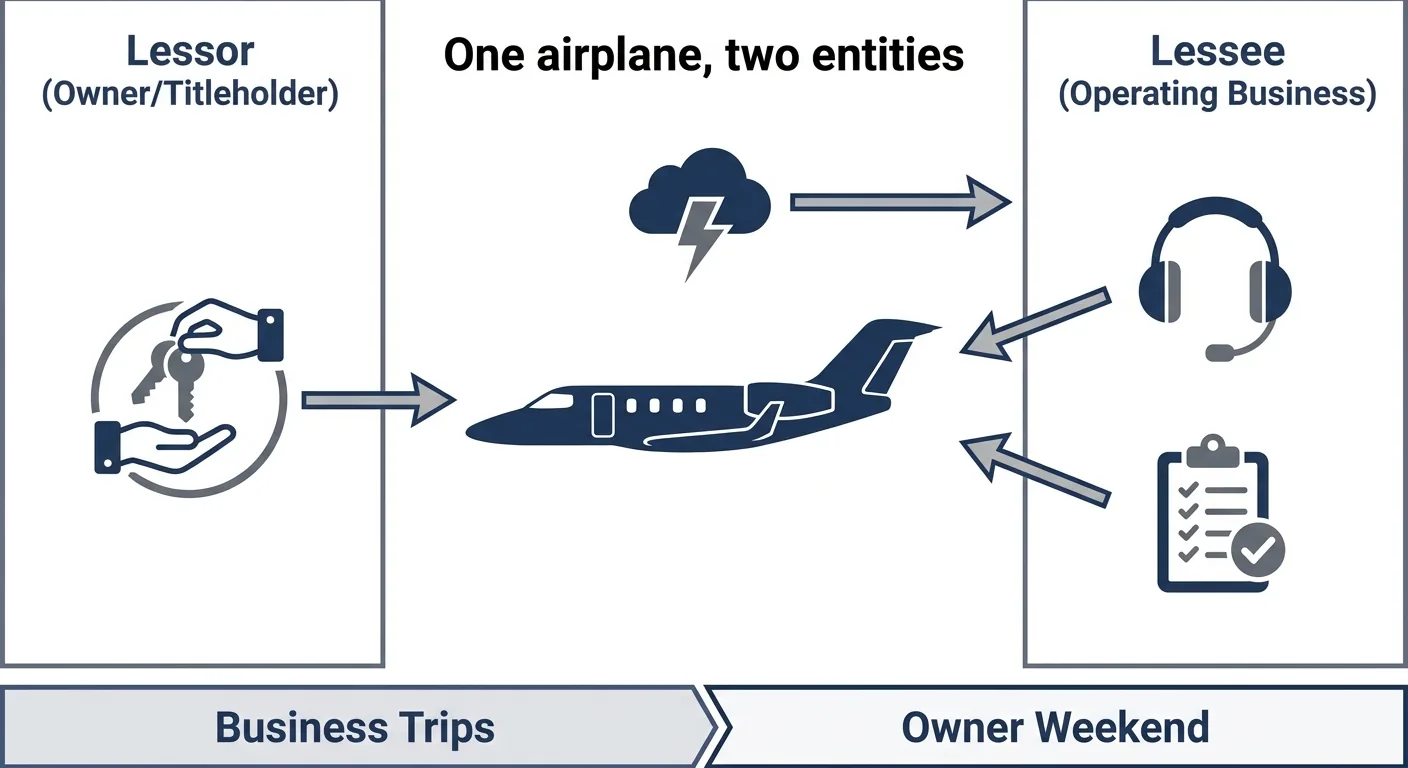
Example: one airplane, two entities
A holding company owns a Phenom 300. The operating business flies it four to six times a month. The holding company dry leases the aircraft to the operating business. The operating business employs the two pilots, pays them directly, sets the schedule, and pays fuel and trip expenses. Maintenance is arranged by the lessee under the lease terms, with engine program costs allocated in writing. When a line of thunderstorms closes the destination, the decision to divert or cancel belongs to the lessee’s crew and the lessee’s dispatch process. The lessor has no vote in it. When the owner’s family flies on a weekend, that trip goes back under the lessor’s own possession and control, not the lessee’s. Two entities, one airplane, and a documented answer for every leg.
When a Dry Lease Matters
The structure matters whenever the party flying the aircraft is different from the party that owns it, and whoever does the flying has to be genuinely able to operate it. What changes case by case is why the split exists and how fast the lift is needed.
- Private ownership with an operating team. The most common business aviation use: an ownership entity leases to the entity that actually needs the transportation. The point is clean separation of asset and operation, plus a documented operator. Enforcement of illegal charters is an active FAA priority. Florida is currently an enforcement hotspot.
- Exclusive and non-exclusive use. A non-exclusive dry lease lets an owner make the aircraft available to more than one lessee during the same term, with control switching flight by flight. It works only if each lessee’s possession periods and decision rights are written down and honored. Red flags for FAA scrutiny: a lessor who schedules the trips, supplies the pilots, or bills by the flight hour the way a charter operator would.
- Airline capacity and fleet sizing. A carrier that needs airframes for a route launch, a season, or a permanent fleet change takes them on dry lease, registers them, and folds them into its own maintenance and continuing airworthiness system under its own AOC. These deals commonly run past twelve months and often upward of two years. The lessors are frequently leasing companies and banks rather than other airlines, and the same structure appears between a mainline carrier and its regional partner.
- Shortfalls, grounded aircraft and startups. When an airframe is out next week, when pilots are the constraint, or when a startup or bridge operation needs lift before it has crew and a certificate, wet lease or ACMI capacity fills the gap because the crew arrives with the aircraft. A dry lease only works once the operator has qualified crew, manuals and a working dispatch process. That’s why short-notice lift is usually wet and the long-term fleet is usually dry.
One limit runs through all of it. A typical dry lease bars the lessee from operating the aircraft in commercial service, as a common carrier, or otherwise on a for-hire basis. Carrying paying passengers requires operating authority, not a lease.
Common Confusions: Dry Lease, Wet Lease, ACMI, and Code Share
These terms get swapped in conversation constantly. The differences come down to three things: who supplies the crew, who holds operational control, and what the contract is really selling.
| Term | Crew supplied by | Operational control | What is really being sold |
|---|---|---|---|
| Dry lease | Lessee | Lessee, during its periods of possession | Possession and use of the airframe |
| Wet lease | Lessor, at least one crewmember | Lessor, normally | Transportation capacity, crew included |
| Damp lease | Split, lessor gives part of the crew | Depends on contract and jurisdiction | A hybrid, commercial shorthand rather than a fixed legal category |
| ACMI | Lessor | Lessor | Aircraft, Crew, Maintenance and Insurance as a package, with the customer usually handling fuel, airport charges and commercial scheduling |
| Leaseback | Lessee operator | The operating lessee | A separate ownership and financing structure, covered in “Aviation Dry Lease: The Complete Guide” |
| Code share | Neither party leases crew | Stays with the operating carrier | Marketing rights and flight designators |
One clarifier covers the rest. Fuel is negotiable in every one of these structures, so it never decides the label. FAA guidance appears to distinguish wet leases from code sharing arrangements, but the precise wording should be checked. Wet lease and ACMI deals tend to be short, running weeks to a season while a carrier covers a traffic peak or a heavy maintenance slot, and the control, speed and risk comparison is handled in full in “Wet vs Dry Lease: Cost, Control and Risk.”
What to Do Next If You Are Considering One
Your next decision is the operational structure, not the contract. Confirm that your operation can hold operational control: pilots you hire and pay, a dispatch process, current records, insurance in the right names, and someone who documents each flight’s possession period. Fix any gap before the lease is signed, because the lease assigns responsibilities your operation has to be able to carry.
Then work the two documents. Delivery condition, term, minimum hours, maintenance obligations and the return inspection belong in “dry lease agreement.” The filings, notices and recordkeeping the FAA expects with the lease are in “aircraft dry lease requirements.” Use aviation counsel for the document itself.
If the paperwork side of that is landing on a working pilot or a one-person flight department, let WingLeader carry the office so you keep the aircraft and the crew and have a file that holds up when an inspector asks who was operating.
Frequently Asked Questions
What is a damp lease, and how is it different from ACMI?
A damp lease generally means the lessor supplies the aircraft and part of the crew. Often the flight deck without cabin crew, while the lessee covers the rest. ACMI is the fuller package: aircraft, crew, maintenance and insurance from one provider. Damp lease is industry shorthand rather than a uniform regulatory category, so the contract and the governing jurisdiction decide how it is actually treated.
Who pays for fuel, maintenance and hangar costs in a dry lease?
Whoever the lease says. The word “dry” describes crew, not operating expenses. A typical private dry lease puts fuel, trip costs and day to day upkeep on the lessee. Scheduled inspections, airworthiness directives and engine program payments are negotiated line by line. Put each item in writing: fuel, oil, hangar, insurance premiums, inspections, engine and parts programs, unscheduled repairs and downtime.
Can a dry lease be used for private aircraft under Part 91?
Yes, and that is the most common business aviation use. The lessee operates under Part 91 as the operator of record for its flights, with its own pilots and its own dispatch decisions. What it cannot do is carry passengers or cargo for compensation. That requires separate operating authority.
Who pays for fuel in a wet lease?
It varies by contract. In many ACMI arrangements the customer buys the fuel and pays airport, handling and navigation charges while the provider supplies aircraft, crew, maintenance and insurance. Read the exclusions closely. Headline hourly rates often leave out repositioning legs, disruption costs and ground handling.
When should an operator choose a dry lease instead of ACMI?
Choose a dry lease when you have crew, certification and a maintenance program, and you need the airframe for a longer period. Commonly more than twelve months. Choose ACMI when crew availability is the constraint or the need is short, seasonal or immediate, such as replacing a grounded aircraft next week.
What happens if the lessee cannot supply a qualified pilot for a period?
The lease should say. Well drafted agreements cover downtime, storage and insurance obligations during non-use, whether substitute crew can be sourced independently, minimum hour commitments, and the lessor’s right to terminate and take the aircraft back. Without those clauses, the aircraft sits while both sides argue about who pays for it.
Does a dry lease require a minimum term, deposit or flight hour commitment?
Commercial dry leases often do. With security deposits, maintenance reserves, minimum utilization and a defined return condition with a delivery and return inspection. Private dry leases between related entities are usually simpler but still need delivery condition, term, termination rights and redelivery standards spelled out. Those clauses are covered in “dry lease agreement.”
How much does it cost to dry lease an aircraft?
Rates vary widely by aircraft type, age, term and maintenance status. The full breakdown with worked numbers is in “dry lease aircraft cost.”