
Dry lease pricing in 2026 starts near $4,500 a month for a single turbine aircraft with an hourly usage charge on top. Light and midsize jets run roughly $30,000 to $160,000 a month. Heavy aircraft climb past $150,000 a month. Aircraft type sets the band. Utilization decides whether that rent is cheap or expensive per flight hour.

How much does a dry lease aircraft cost in 2026?
Dry lease rent in 2026 can run from the low tens of thousands to well over a million dollars a month for larger aircraft. Smaller aircraft start much lower.
Three things move the real number after rent:
- Maintenance reserves, billed per flight hour, per cycle, per APU hour or per calendar month.
- Security deposit and advance rent, commonly two to three times monthly basic rent.
- Delivery and return condition, which can swing the lifetime cost of the lease by more than a year of rent.
The lowest monthly rent is often the most expensive lease. An aircraft quoted $5,000 a month cheaper with harsher reserve rates and a full return-to-service redelivery standard can cost more over 60 months than the higher-rent offer next to it.
What does a dry lease include in the base price?
Basic rent buys one thing: the right to use and possess the aircraft, usually paid monthly in advance. It normally excludes maintenance reserves, taxes, indemnity payments, default interest and every operating cost attached to flying.
Usually inside basic rent: the airframe, engines, APU and installed equipment as configured at delivery.
Usually outside basic rent: crew, fuel, insurance, maintenance labor and parts, hangar, navigation and airport charges, handling, catering, taxes, ferry flights and redelivery work.
As AOPA notes, crew cost sits outside the rent because the lessee supplies its own flight crew and exercises operational control over its flights under Part 91 without holding an air carrier certificate.
One exception worth knowing: on short-term or non-exclusive dry leases, a lessor may procure insurance, maintenance and base hangar space and build those into the rate. Crew still stays out. If you’re still choosing between structures, the full side-by-side sits in “Wet vs Dry Lease: Cost, Control and Risk.”
How aircraft size and type change the lease rate
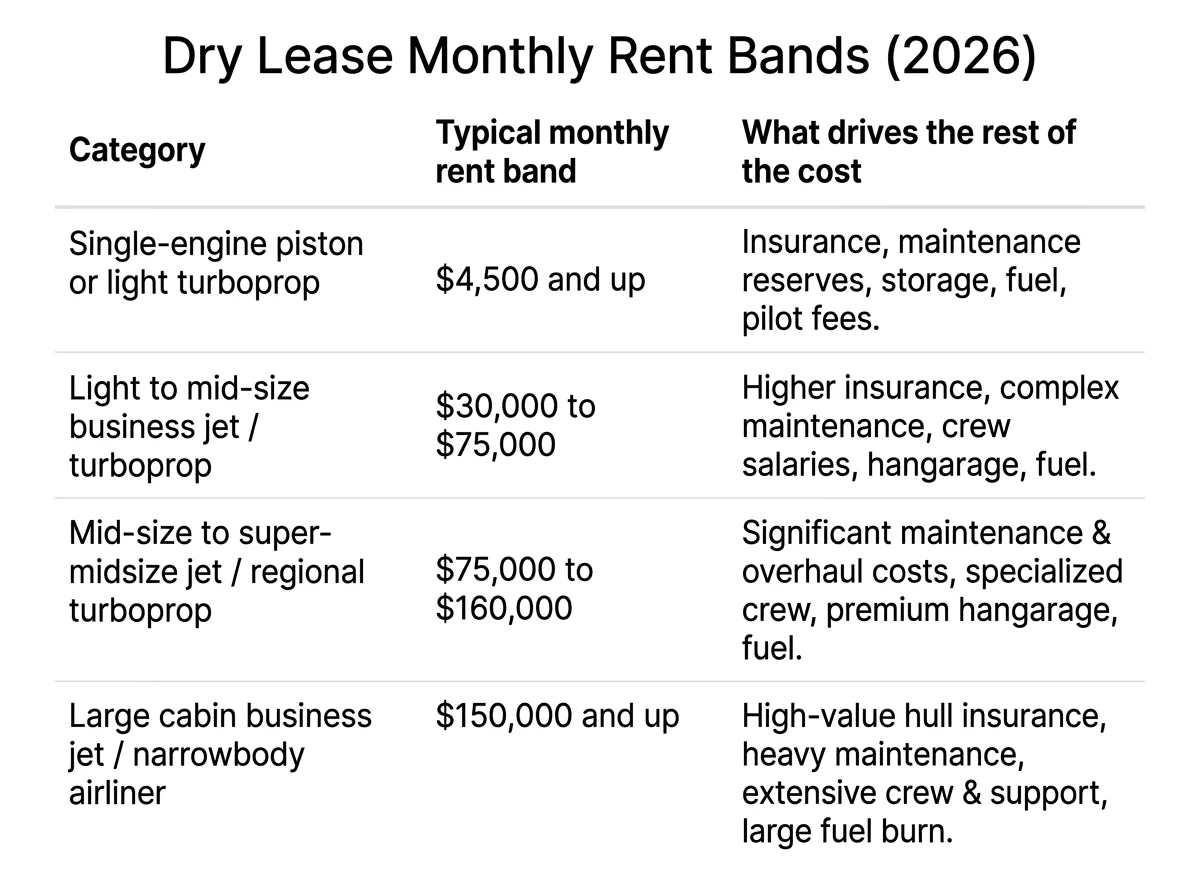
Size drives both the rent and the maintenance profile that follows it. The bands overlap heavily because age and condition cut across every category. There is no single published market table for dry lease rent, so treat these as orientation ranges rather than quotes.
| Category | Typical monthly rent band | What drives the rest of the cost |
|---|---|---|
| Single-engine piston or light turboprop | Roughly $4,500 and up, often plus an hourly charge | Hourly usage charge, engine overhaul reserve, insurance |
| Light jet (Phenom 100, HondaJet, Citation class) | Roughly $30,000 to $75,000 | Engine program status, APU, cycle-heavy short legs |
| Midsize to super-midsize (Citation Latitude, PC-24, G280 class) | Roughly $75,000 to $160,000 | Airframe inspection intervals, crew requirements, hangar |
| Regional jet and narrowbody | Roughly $150,000 and up | LLP exposure, cycle reserves, MRO slot availability |
Read the table by cost role. Turboprops and small pistons carry low rent with an hourly usage charge. Light jets carry moderate rent with cycle-heavy reserves. Midsize jets carry higher rent with airframe inspection cost. Regional jets carry the highest rent with life-limited-part exposure on top. One published short-term arrangement on a Cessna 206 ran $4,500 per month plus $250 per flight hour with no monthly minimum. That structure protects a low-utilization operator and punishes a heavy flier.
Region shows up in the total rather than in the rent. Rent is negotiated internationally and normally quoted in U.S. dollars, so two identical aircraft can carry the same monthly figure and very different all-in cost. Maintenance labor rates, approved MRO slot availability, hangar and airport charges, ferry distance from the delivery point, import duty, VAT and withholding tax all move by region. A cheaper aircraft sitting three ferry legs away, or based where your approved shop has no slot for six months, is not the cheaper aircraft.
How age, condition, and maintenance status move the price
Two aircraft of the same model can differ by 30 percent or more in monthly rent. The cheaper one is frequently the more expensive aircraft to operate. Rent tracks residual value and remaining maintenance life. Reserves track what the next shop visit will cost.
| Variable | Older airframe, green-time engines | Newer airframe, engines on program |
|---|---|---|
| Basic rent | Lower | Higher |
| Reserve rates | Higher, sometimes with a floor | Lower, often partly absorbed by the program |
| Acceptance risk | Records gaps, corrosion findings, deferred items | Cleaner records, documented status |
| Upcoming inspections | A heavy check inside the term is likely | Often falls after redelivery |
| Redelivery exposure | Restoration to half-life can dominate the economics | Narrower gap to close |
Three tradeoffs decide which aircraft is actually cheaper.
Green-time engines versus engines on program. Green time means you rent the hours left before overhaul at a discount and hand the aircraft back before the bill lands. That works only if the remaining time covers your whole term with margin. Engines on a program carry higher rent but a known hourly rate. The saving disappears if the program doesn’t transfer to the lessee.
Cabin configuration. A seating or interior layout that doesn’t match the mission is a modification you fund and hand back at redelivery. On a light jet that single item can exceed a year of the rent difference between the two aircraft.
Upcoming heavy checks. Price where the next airframe check and gear overhaul fall against your delivery and return dates. A check that lands in month 40 of a 60-month term turns the low-rent aircraft into the expensive one. A quote that assumes a favorable hour-to-cycle ratio hides how fast that date arrives on short sectors.
Ask four questions before you compare rents. What is the engine status in hours and cycles against overhaul? Is the engine on a program, and does the program transfer to you? What inspections fall inside the lease term? Is the cabin configuration the one you need, or are you funding a reconfiguration before the first trip?
How utilization changes the real hourly cost
Fixed rent spreads over hours flown. The same lease can cost $1,440 or $7,200 per flight hour on aircraft cost alone. Build the annual fixed number first: monthly rent times 12, plus any minimum monthly reserve payment or calendar floor times 12. A light jet at $60,000 a month is $720,000 a year in rent. A $3,000 monthly reserve floor takes the fixed number to $756,000 before a single hour is flown. Then divide by annual flight hours.
| Annual flight hours | Fixed lease cost per flight hour |
|---|---|
| 100 | $7,200 |
| 150 | $4,800 |
| 300 | $2,400 |
| 500 | $1,440 |
The table uses rent alone, so add your own reserve floor on top. The math scales. A published example puts a $250,000 monthly lease flown 300 hours a year at roughly $10,000 per flight hour in fixed lease cost. That figure doubles at 150 hours. Low-utilization operators pay twice: calendar rent spreads over fewer hours, and calendar-month reserve minimums keep billing whether the aircraft flies or not.
Run your own number before you negotiate. Add every annual expense, divide by 12 for the monthly cost, then divide by realistic monthly flight hours. Use last year’s actual hours, not the hours the owner hopes to fly.
Budget an administration line as well. WingLeader’s own pricing is a monthly retainer per aircraft, based on flight hours, for scheduling, dispatch and compliance support.
What maintenance reserves really add to the bill
Reserves are a second rent. They fund future high-cost events. The rate is usually built by dividing the expected event cost by the expected interval between events.
| Reserve category | Usual billing unit |
|---|---|
| Airframe check | Per flight hour or per calendar period |
| Engine performance restoration | Per engine flight hour |
| Engine life-limited parts | Per engine cycle, often tied to manufacturer catalog pricing |
| Landing gear | Per landing or flight cycle |
| APU | Per APU hour or per calendar month |
| Thrust reverser | Separate category where fitted |
Three details decide what reserves really cost you.
The assumed hour-to-cycle ratio. One public dry lease tender required reserve pricing at an average 4.5:1 flight-hour-to-cycle ratio. If your operation flies 1.2 hour legs, your actual ratio is closer to 1.2:1, and every cycle-based reserve bills nearly four times the model. Short sectors make cycles, not hours, the dominant cost.
Escalation. Reserve rates are commonly escalated annually by a stated percentage, while life-limited parts float with manufacturer catalog pricing. Rent may be flat while reserves climb every year.
The shortfall. Reserves reimburse the event, they don’t cap it. Say the airframe check prices at $400,000 and the reserve bills $150 per flight hour against a 2,500 hour interval. Fly 1,800 hours before the check comes due and the account holds $270,000. The lessee writes a check for the remaining $130,000. Unused balances are generally not refundable at lease end unless the agreement says so in writing, so reimbursement against actual shop invoices is worth more than a low hourly rate.
What else can add to the bill at signing and delivery
One-time charges cluster at the two ends of the lease. Published rates almost never include them. Sort them into four buckets before you sign and budget each line separately.
Upfront money at signing
- Security deposit: commonly two to three times monthly basic rent, refundable, and available to the lessor for unpaid rent, unpaid reserves and failed delivery obligations.
- Advance rent: prepaid against named rental periods, economically different from a deposit and usually not refundable.
- Letter of credit or guarantee fees, where credit support stands in for cash.
Delivery money
- Records review and technical acceptance: an inspector, an engineer and days of hangar time before you accept the aircraft.
- Ferry and positioning flight to your base, paid by the lessee in most drafts.
- Registration, International Registry filings and acceptance paperwork.
- According to the FAA, truth-in-leasing paperwork: for aircraft over 12,500 pounds, truth-in-leasing requirements are required by regulation.
Modification money
- Avionics mandates, interior changes, exterior paint and any reconfiguration the mission needs.
- Manuals, subscriptions and maintenance program enrollment in your name.
Return money
- Redelivery restoration: the single largest end-of-lease item, sized by the return condition clause you signed 60 months earlier.
- Return ferry, final records package and deregistration.
One note on the paperwork line. NBAA reports that for Part 91 operators, federal excise tax generally should not apply to the payments under a dry lease.
How to pay less without regret
Real savings come from structure, not from shaving the rent. The 1 percent rule is a reasonable first pass and a poor negotiating position. NBAA cites 1 percent of aircraft value per month as a rule of thumb for dry lease rates.
Run it both ways before you use it. On a $6 million light jet the rule predicts $60,000 a month, which sits inside the $30,000 to $160,000 band for that class. On a 20-year-old midsize worth $2.5 million it predicts $25,000, while quoted rent for that class rarely opens below $30,000, because the lessor prices engine status, remaining life and market supply rather than book value. A three-month deal on the same $6 million jet can quote well above $60,000. The rule fails on short terms, on engines off program and in tight supply markets.
Savings that hold up:
- Longer firm term in exchange for lower rent and softer redelivery standards.
- Taking an aircraft already enrolled on an engine and parts program, and confirming the program transfers.
- Billing reserves on actual utilization rather than a calendar minimum.
- Negotiating reserve reimbursement against invoices instead of forfeiture at lease end.
- Accepting delivery where the aircraft already sits and eliminating a ferry leg.
- Keeping the lease properly dry. If you are pricing a dry lease and already know who will be buried in the paperwork, see how back-office support for one to five aircraft is structured.
Savings that backfire:
- Chasing the lowest rent without pricing the return condition.
- Skipping the records review to make a delivery date.
- Accepting a quote that names no hour-to-cycle assumption.
- Signing an informal or verbal arrangement between related companies.
- Letting the lessor handle crew decisions to save coordination work, which converts the whole structure into something the FAA reads differently.
A fair quote is one you can compare line for line. It states aircraft serial, age and engine status. Delivery date, location and condition. Monthly basic rent, currency and payment timing. Term and extension options. Deposit and advance rent. Each reserve rate with its billing unit. The hour-to-cycle ratio used in the model. Annual escalation. Insurance, maintenance and crew responsibility. Taxes and withholding. Delivery, ferry and registration charges. The return condition. A quote that gives rent alone is not an all-in price.
When a short-term dry lease makes sense
Short-term dry leases exist, so you’re not automatically locked into a multi-year contract. Commercial dry lease periods of six to twelve years are described as normal and public tenders commonly run 72 months, but seasonal and project-length arrangements are written every year on light jets and turboprops.
Flexibility has a price, and it shows up in five places:
- Minimum term. Short deals still carry a floor. Rent runs for the floor whether the aircraft flies or sits.
- Flexibility premium. Higher effective monthly rent, since the lessor amortizes transition and remarketing cost over fewer payments.
- Deposit. Commonly two to three times monthly basic rent, which looks large against a commitment measured in months.
- Advance rent. Prepaid against named periods and usually not refundable, so cash out at signing can be a large share of the whole contract value.
- Delivery and redelivery condition. Set closer together on a short term, which cuts restoration exposure but leaves no room to absorb a surprise inspection.
Sometimes insurance, maintenance and base hangar space come bundled into a short-term rate. That simplifies budgeting and hides the split, so ask for the split anyway. Short terms fit a replacement aircraft during a heavy check, a seasonal demand bump, or a test of a type before committing capital. They fit poorly when the aircraft needs reconfiguration, because you fund the modification and hand back the benefit.
Charter, lease or buy, by annual hours. Under roughly 100 hours a year, charter usually wins, because fixed rent and calendar minimums spread over too few hours. Between about 100 and 300 hours, a dry lease tends to price best, since you get the aircraft and the operational control without funding the residual value. Above roughly 300 to 400 hours a year with a stable mission, ownership starts to beat rent. The residual value risk you take on is the price of that. A lease leaves the residual risk with the lessor and gives you a dated exit at end of term, which is worth real money in a soft market.
If you have no crew, no certificate and no back office, a lease with crew costs more per hour and is the simpler route, because the lessor keeps operational control and you buy a finished flight. A dry lease only pays off once you can staff, dispatch and maintain it. And if the lessor supplies the crew on a document labeled dry lease, you’re buying a wet lease and it prices like one.
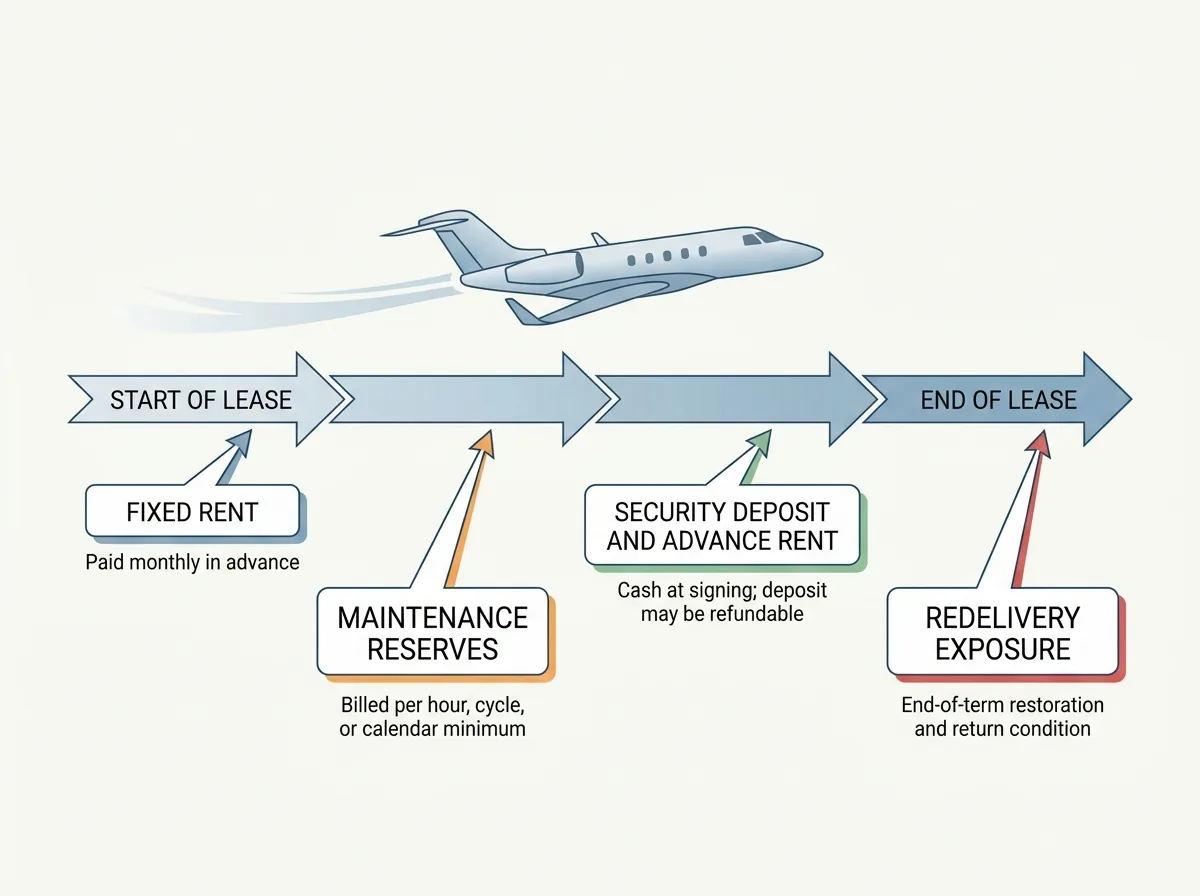
| Cost role | What it is | When you pay | Refundable |
|---|---|---|---|
| Fixed rent | Capital charge for the aircraft | Monthly, in advance | No |
| Maintenance reserves | Accrual against future heavy events | Per flight hour, per cycle, or calendar minimum | Reimbursed against events, rarely refunded |
| Security deposit and advance rent | Credit protection and prepaid rent | At signing | Deposit yes, advance rent no |
| Redelivery exposure | Restoration to the agreed return condition | At end of term | No, and it’s the least predictable line |
The full cost, control and risk comparison is in “Wet vs Dry Lease: Cost, Control and Risk.”
Frequently Asked Questions
What’s the difference between wet lease and dry lease?
A wet lease delivers the aircraft with crew and the lessor keeps operational control. A dry lease delivers the aircraft alone and the lessee supplies crew and holds operational control.
Is there a reliable dry lease aviation calculator?
Rent itself is negotiated and no calculator predicts it, but variable operating cost can be modeled. WingLeader offers a cost calculator that estimates annual variable operating cost from jet category, flight hours and jet fuel price per gallon, and can send a line-item breakdown covering fuel, engine program, parts program and maintenance costs.
Can you write off 100 percent of a private jet?
Bonus depreciation arguments apply to owners, not to dry lessees. As a lessee you deduct the lease payments as a business expense to the extent the aircraft is used for business, and personal use has to be tracked and allocated flight by flight. Registration state, use mix and entity structure change the answer, so price the lease first and take the tax question to your own counsel.
What costs continue while the aircraft is sitting unused?
Basic rent, insurance, hangar, subscriptions and calendar-based reserve minimums all keep running at zero flight hours. Calendar inspections come due regardless of utilization, and crew currency lapses if nobody is flying or training. A parked month on a $60,000 lease still costs $60,000 plus the fixed operating layer.
How much does a 25-hour Netjet private jet lease cost?
A 25-hour card or fractional block is sold as an all-in hourly rate with crew, maintenance and insurance included, so it prices like a wet arrangement rather than a dry lease. At that volume a dry lease is the wrong tool: a $60,000 monthly rent flown 25 hours a year is $28,800 per flight hour in fixed rent alone, before crew and fuel. Cards and charter hold their edge under roughly 100 hours a year, which is the same break point set out above.
How do dry lease costs compare across North America, Europe, and Asia-Pacific?
Rent is usually quoted in U.S. dollars worldwide, so the regional spread shows up elsewhere. A lower rent in one market can be erased by a single positioning flight and a customs bill.
Who pays for fuel in a wet lease?
In a wet lease or ACMI the lessor supplies aircraft, crew, maintenance and insurance, and fuel is normally billed to the customer on top of the hourly rate. Under a dry lease every operating cost including fuel sits with the lessee, because the lessee holds operational control. The full cost split between the two structures is in “Wet vs Dry Lease: Cost, Control and Risk.”
Can I negotiate the maintenance reserve rate down?
Yes, and the structure is worth more than the rate. Enrolling the engines on a transferable program, reimbursing against actual shop invoices, capping annual escalation and removing calendar-month floors usually save more than shaving a few dollars off the airframe hourly rate.