
What Part 91 Operations Means
According to Cornell Law School, part 91 operations are flights flown under 14 CFR Part 91, the FAA’s General Operating and Flight Rules. It’s the baseline rule set for non-commercial civil flying in U.S. airspace: owner-flown trips, corporate flights and personal travel where no one buys the transportation and the aircraft isn’t held out to the public for hire.
If you own an aircraft, fly one for a company, or run a flight department with one to five airplanes, Part 91 is the line you need to know.
How Part 91 Operations Work in Practice
Part 91 works by putting responsibility on the operator and the pilot in command instead of on a certificate holder with FAA-approved manuals. There’s no operating certificate to apply for and no operations specifications to hold. You buy or lease the aircraft, you fly it inside the rules, and you keep the records that prove you did.
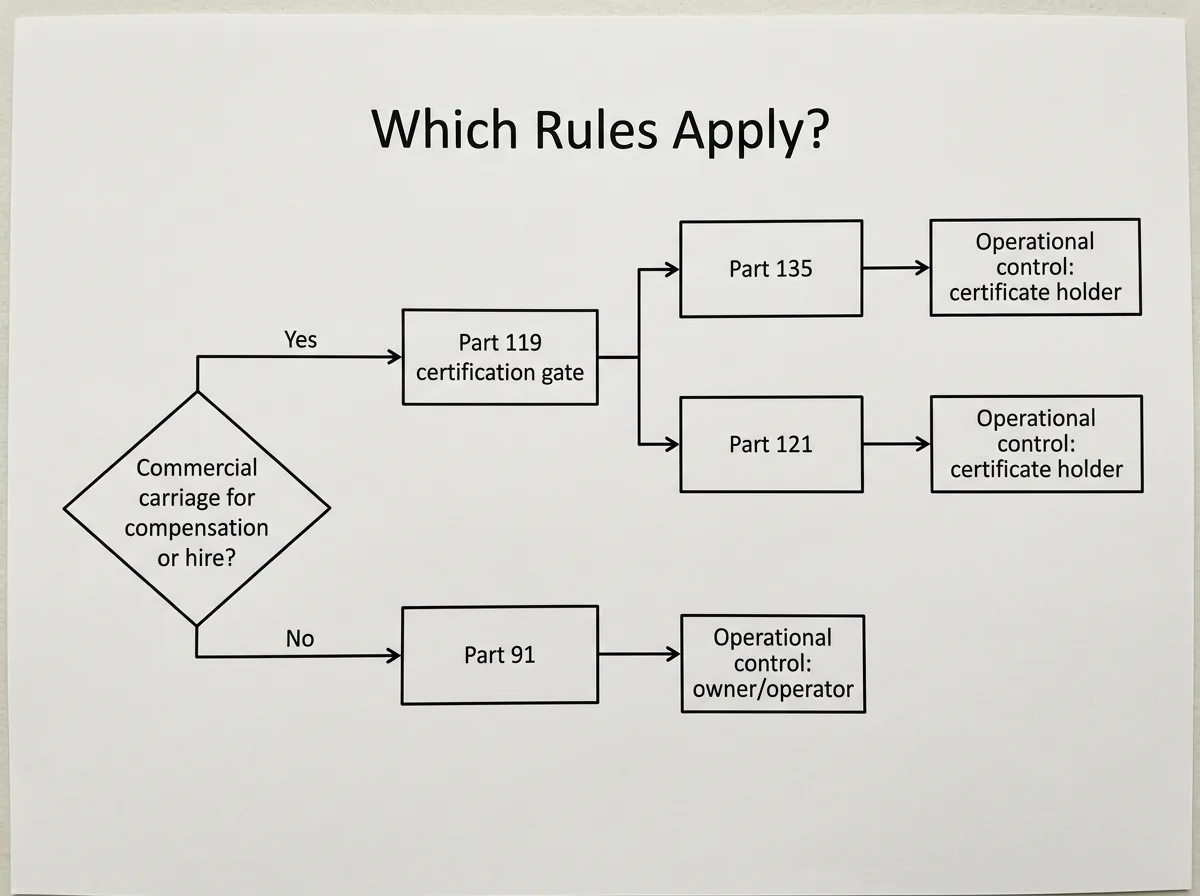
Operational control is the term you’ll hear from an FAA examiner. It means the authority to initiate, conduct and terminate a flight: who decides the trip happens, who selects and pays the crew, who calls the cancellation for weather. Under Part 91 that authority sits with the aircraft owner or the operator flying it. Under Part 135 it sits with the certificate holder, who answers for crew, maintenance, dispatch decisions and compliance. Every dry lease question comes back to the same point. The FAA treats the aircraft owner as the operator unless a properly structured dry lease moves control to the lessee on paper.
The regulation is built as one applicability section followed by subparts. Section 91.1 says where the rules apply, then Subpart A carries the general rules, Subpart B the flight rules, Subpart C equipment and instrument requirements, Subpart E maintenance and inspections, and Subpart K the fractional ownership programs. Subpart F covers large and turbine-powered multiengine airplanes plus fractional ownership program aircraft, running from 91.501 through 91.536. That subpart holds time sharing, interchange and the other cost-reimbursement arrangements.
The rule sets are additive. Part 91 sets the floor: airworthiness, inspections, airspace, weather minimums, fuel reserves, equipment. A charter operator under Part 135 meets every Part 91 requirement and then adds stricter ones on top, and so does an airline under Part 121. FileFlo reports that part 119 is the certification gate that decides which stricter book applies: commuter and on-demand flying goes under Part 135, while domestic, flag and supplemental operations go under Part 121, with the larger book reached at more than 30 passenger seats or a payload capacity over 7,500 pounds.
When Part 91 Operations Matter
Part 91 matters the moment money, passengers or a lease enters the picture. Owner flights, corporate trips carrying employees and company property, personal travel, training and repositioning legs all sit inside Part 91 as long as nobody’s buying transportation. A commercial pilot can be paid to fly the owner and the owner’s guests and the trip stays Part 91, because a salary paid to a pilot isn’t passengers purchasing carriage.
Example: two identical legs, two different rule sets
A Phenom 300 flies from a Florida home base to a meeting in Texas. Four passengers, same crew, same route, same FBO.
- Trip A. The passengers are employees of the company that owns the aircraft. The company pays its own fuel, crew and maintenance, and the company’s operations manager decides the trip goes, assigns the crew and can cancel it. The owner pays, the owner controls the aircraft, and nobody bought a seat. This is Part 91.
- Trip B. Two of the four passengers work for an unrelated company, and that company wires a payment covering the leg. The owner still schedules the trip and still directs the crew, so operational control hasn’t moved anywhere. The owner is now furnishing the aircraft and the crew together to people paying for the transportation, and that combination is compensation or hire. Unless a valid Subpart F arrangement or a properly structured dry lease stands behind it, the leg is charter flown without a certificate.
Nothing visible changed. The invoice changed, and that’s the part an FAA examiner will ask about.
Enforcement of illegal charters is an active FAA priority, particularly in Florida. If the lease file and the trip records are what you would rather hand to someone else, WingLeader offers back-office support built for Part 91 operators running one to five aircraft.

Common Confusions About Part 91 Operations
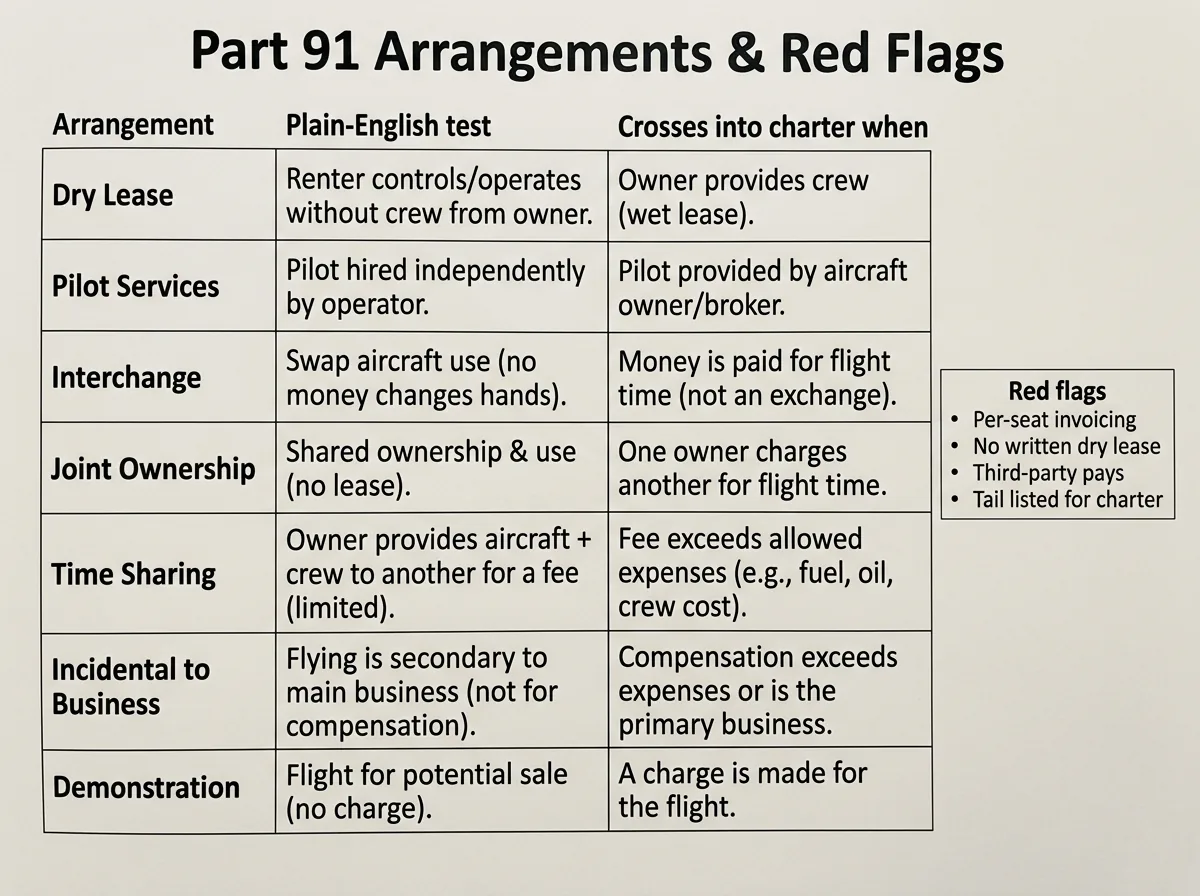
Private doesn’t mean no money changes hands, and it doesn’t mean any flight among people who know each other. The test is carriage. Common carriage means holding the aircraft out to carry anyone who buys transportation, and it needs a certificate. Private carriage means carriage for compensation under a small number of long-term contracts with no public offering, and Part 119 still reaches it, so “we never advertised” isn’t a defense on its own. The table below is the charter-like flying Part 91 actually allows, with the line where each one crosses.
| Arrangement | Plain-English test | Crosses into charter when |
|---|---|---|
| Time sharing (91.501(c)(1)) | Owner supplies aircraft and crew, written agreement, reimbursement limited to the 91.501(d) items including no more than twice the fuel cost | A per-seat fare, any margin, or an airplane Subpart F doesn’t cover |
| Interchange (91.501(c)(2)) | Two owners trade equal aircraft time and settle only the operating cost difference | One side never flies the other’s airplane, so the trade is a sale of lift |
| Joint ownership (91.501(c)(3)) | Registered co-owners share one airplane and pay shares of the actual costs | A non-owner pays for seats and is called a co-owner on paper |
| Dry lease | Lessee takes the aircraft alone and hires, pays and directs its own crew under a written lease | The lessor supplies or pays the pilots, which makes it a wet lease and a commercial operation |
| Demonstration flight (91.501(b)) | A real sales purpose and no charge for the carriage | The demo becomes routine transportation for people with no interest in buying |
| Owner flights with friends chipping in (61.113(c)) | Common purpose, a pro rata share of the listed direct costs, pilot pays at least an equal share | The pilot collects more than a share, posts the flight publicly, or flies the route only because the passengers wanted it |
| Owner flights with a management company | The manager keeps the records while the owner directs the flights | The manager markets the tail or sells the legs |
The red flags behind most failures are short and familiar:
- Invoicing by the seat rather than by the aircraft.
- A handshake dry lease with no written terms and no record of who held operational control.
- A third party, not the owner or the lessee, paying for the leg.
- A broker or manager listing the tail on a charter platform.
What to Do Next if You Think Part 91 Applies
Work the next decision in order, on paper.
- Name who holds operational control for each flight. Whoever initiates, conducts and terminates the flight is the operator in the FAA’s eyes. If that’s the owner, the file should say so. If a lease moves it to a lessee, the lease, the crew arrangements and the trip records all have to agree.
- Ask whether anyone is paying for the transportation. Trace every dollar that touches the leg: affiliates, customers, guests, brokers. If money moves and no written lease or 91.501 arrangement stands behind it, fix that before the trip goes on the schedule.
If step two turns up payments you can’t place, the rule-by-rule split is covered in “part 91 vs 135”. If control and money both sit with the owner and the paperwork is what keeps slipping, “part 91 aircraft management” covers what to look for in outside support, and “part 91 maintenance requirements” covers inspection intervals and records. Cost detail lives in the hub article, “part 91“.
On a dry lease, WingLeader keeps the lease paperwork, the records and the procedures and acts as the point of contact between lessor and lessee, so who held operational control is documented for every flight. WingLeader does not draft the lease and does not give legal advice.
If that is the work falling between trips, see how WingLeader supports operators running one to five aircraft under Part 91.
Frequently Asked Questions
What is a Letter of Authorization for Part 91 operations (LOA)?
An LOA is written FAA approval for a specific operation your aircraft or operator isn’t otherwise authorized to conduct, issued by your local Flight Standards District Office. Common Part 91 examples include RVSM airspace, certain RNP approaches, and data link communications. Part 91 operators get LOAs rather than operations specifications, which are the equivalent document for certificated Part 135 and Part 121 operators.
Is there a Part 91 operations certificate?
No. Part 91 flying requires no operating certificate, which is the core structural difference from Part 135 and Part 121. Your authority comes from the aircraft’s airworthiness certificate and the pilot’s certificates and ratings. If someone tells you they hold a “Part 91 certificate,” they’re describing something that doesn’t exist.
Is there an FAA Part 91 operators list?
No public FAA Part 91 operators list exists, because Part 91 operators aren’t certificated and therefore not registered as operators. The FAA does publish air carrier and commercial operator certificate holders under Part 119. Aircraft ownership itself is searchable through the FAA registry, but ownership doesn’t tell you who held operational control on any given flight.
Do Part 91 flight time limits change if I fly for a company or for a Part 121 carrier?
Pure Part 91, including owner-flown and most corporate trips: no, the FAA sets no daily flight time or duty limit at all. Part 91 Subpart K fractional programs: yes, 91.1059 caps flight time at 8 hours with one pilot and 10 hours with two in any 24 consecutive hours, inside a 14 hour duty day. Part 91 legs flown at the direction of a Part 121 certificate holder, such as a ferry or repositioning leg: yes, that carrier’s flight time and rest limits follow the crew through the day, so a Part 91 leg resets nothing. Most small flight departments still write their own duty limits because insurers ask for them.
Does Part 91 require recurrent training or proficiency checks?
Part 91 itself requires a flight review every 24 calendar months and instrument currency for IFR flying, with type rating requirements for turbojets. It doesn’t mandate the six month proficiency checks that Part 135 crews complete. In practice, insurance carriers drive turbine training, often requiring annual or semiannual simulator training in type before they’ll write the policy.
Do Part 91 passengers need to show ID or appear on a manifest?
Part 91 doesn’t impose the passenger identification and manifest requirements that apply to Part 135 charter. That said, international trips, customs clearance and some airport access programs each carry their own documentation rules. Keeping a passenger list per leg is also how operators track use allocation for tax and accounting purposes.
Can friends pay me for a Part 91 flight?
Only within narrow limits. A private pilot may accept a pro rata share of fuel, oil, airport expenditures and rental fees from passengers on a flight with a common purpose, and the pilot must pay at least an equal share. Advertising the flight, charging per seat, or collecting more than a proportionate share moves the operation toward common carriage and a certificate requirement.
What do FAA illegal charter cases teach aircraft owners and brokers?
The pattern in the enforcement files repeats: an aircraft marketed by a broker or manager, passengers paying for transportation, and either no written dry lease or a lease that arrived with the lessor’s pilots. Civil penalties and certificate action can reach the owner, the pilot and the broker together, and an insurer can deny a claim on a flight that was commercial in substance. The practical lesson is documentary. A written lease, a named holder of operational control for each flight, and per-flight records that match the money are what hold up when an FAA examiner starts asking.