
A lease labeled “dry lease” is not automatically a dry lease. The FAA looks at how the flights actually run: who calls the trip, who hires the pilot, who signs off the maintenance, who pays whom. That gap between paperwork and conduct is where most operators get into trouble, and it’s the reason this guide exists.
This page is the hub for the whole topic. It defines the arrangement, helps you figure out which situation you’re in, gives you the short version of each subtopic, shows the variables that move cost, and tells you when to stop reading and call someone. Where a question deserves a full article, you’ll be pointed to the one that answers it.

What an aviation dry lease is and who needs one
According to the FAA, a dry lease is an aircraft leased with no crew. The lessor hands over the airframe. The lessee supplies the pilots, arranges maintenance and insurance, and holds operational control, which comes down to who gets to decide where the airplane goes on a given day. A wet lease is the other arrangement: the aircraft arrives with at least one crewmember and the lessor keeps control.
One warning belongs at the definition level. If the lessor supplies, requires, or controls the crew, the FAA can read the deal as a wet lease or a sham dry lease no matter what the cover page says.
Four situations bring operators to this structure:
- Private business use under Part 91. A company flies its own people on its own business in an aircraft it doesn’t own.
- Shared access. Two or more lessees use the same airframe, each sourcing crew and scheduling separately.
- Related-party structures. Title sits in one entity and the aircraft is leased to an operating company, a family office, or an affiliate.
- A decision still in progress. You’re weighing a lease against charter, a fractional share, a partnership, or ownership.
If none of those describe you, the plain definition article, “what is a dry lease“, is the shorter read.
How to decide whether a dry lease fits your situation
Start with the crew question, because it settles the classification. If the airplane comes to you with a pilot attached, you’re looking at a wet lease and the other party is very likely the operator. If you bring your own qualified crew and you decide when and where the aircraft flies, a dry lease is on the table.
Decision Guide: find your path
- You fly your own executives, employees, or owners on company business. Part 91 dry lease territory. Confirm you can actually exercise operational control before you negotiate rent. Go to the Part 91 section below.
- You want to carry customers, clients, or anyone paying for the seat. Stop. That’s charter or common carriage, and a dry lease doesn’t authorize it. You need a certificated operator or a Part 135 pathway.
- You’re sharing one aircraft with another company or another owner. Workable, but every lessee needs independent crew sourcing, its own scheduling rights, and its own documented control. Shared structures draw the most scrutiny.
- The lessor is your management company, your affiliate, or the pilot’s employer. Slow down. This is the fact pattern regulators examine hardest.
- You’re still comparing lease, charter, and ownership. Utilization decides it. Below roughly 100 to 150 hours a year, charter usually wins on math. Above that, dedicated access starts to pay.
- Your paperwork, your billing, and your dispatch practice disagree with each other. Bring in an aviation attorney before the next trip, not after.
Two capability checks matter more than the lease rate. Can you confirm airworthiness and plan a legal flight without asking the lessor? Can you employ or independently procure qualified crew? A formal in-house flight department isn’t required, but the capability is.
If you need private business use under Part 91
Yes, a company can operate a dry-leased aircraft under Part 91, and it’s the most common structure in business aviation. No air carrier certificate or AOC is needed for private use, but the lessee has to be able to exercise operational control and to employ or independently procure qualified crew. As operator, the lessee answers for flight planning, crew currency, airworthiness, fuel, loading, and the records that prove those things were handled.
Part 91 is a private operating rule. It covers the company’s own people on the company’s own business. It doesn’t authorize holding out transportation to the public, and it doesn’t become a charter certificate because the lease says the lessee may use the aircraft. Compensation is the tripwire. The moment money moves for carrying a passenger who sits outside the operating structure, a different rulebook applies.
Crew currency is where a Part 91 file usually breaks first. At WingLeader, pilot credentials, currency, and training records are checked before a trip goes on the schedule, and a trip isn’t scheduled with an out-of-currency crew member until that’s fixed. The full operating-rule set, including what Part 91 does and doesn’t permit under a lease, lives in “what is a dry lease”.
If you’re comparing a dry lease and a wet lease
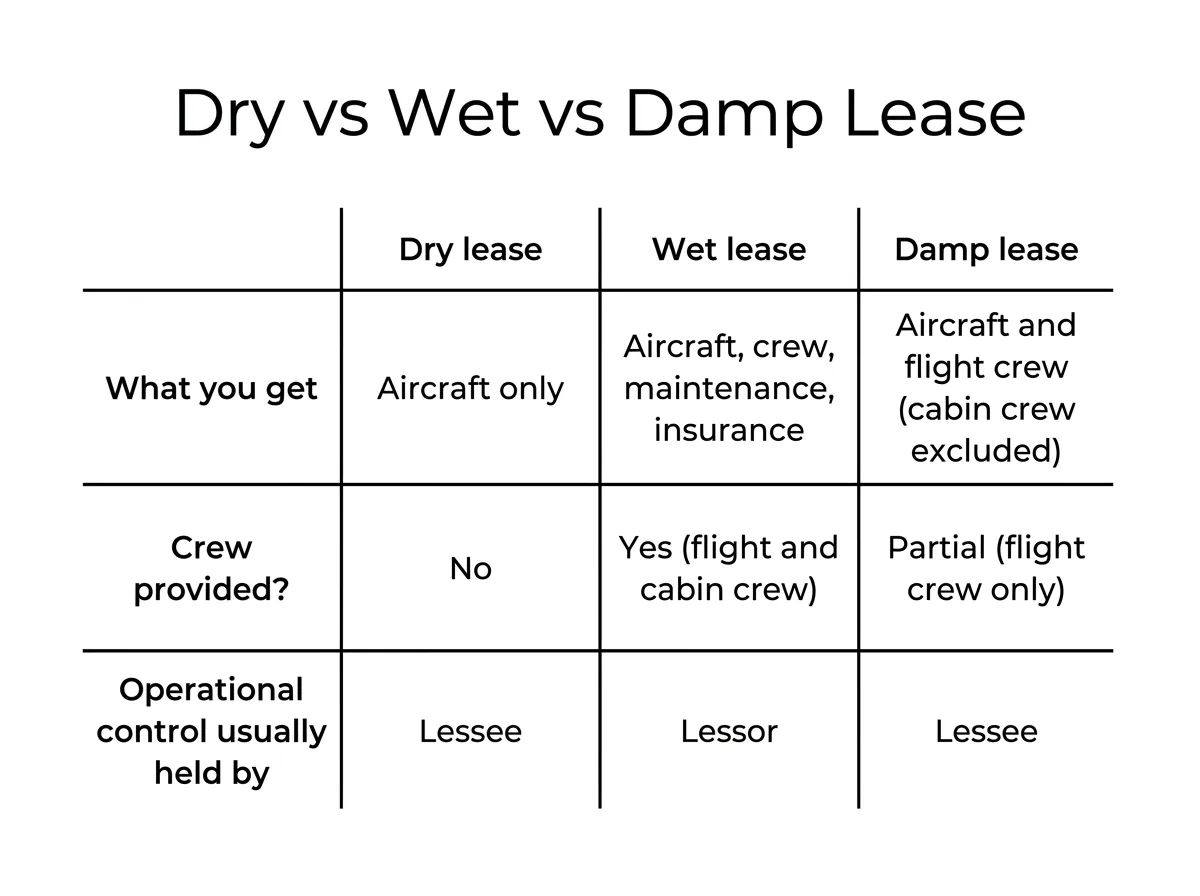
The core distinction is crew and control. In a dry lease, the lessee supplies the crew and holds operational control. In a wet lease, the lessor supplies at least one crewmember and generally keeps operational control, which is why wet leasing between commercial operators normally requires the lessor to hold the appropriate certificate.
The short version, side by side:
- Dry lease: aircraft only, lessee crews it, lessee is the operator.
- Wet lease: aircraft plus at least one crewmember, lessor is usually the operator, and the rate bundles crew and often maintenance and insurance.
- Damp lease: aircraft plus partial crew, no fixed regulatory definition, classified by what the parties actually do.
Price and risk follow that line. Dry lease rent is a bare-aircraft figure with the operating stack on top, and insurance sits with the party that operates. The full comparison, including damp leases and the commercial tradeoffs, is in “wet vs dry lease“.
If you’re worried about operational control
Operational control means the authority to initiate, conduct, or terminate a flight. In plain terms, it’s who gets to decide where the airplane goes on a given day. Whoever holds it is the operator, whatever the contract says on the cover page.
An FAA examiner reconstructs it from behavior. Who took the trip request? Who set the departure time and the route? Who hired, scheduled, and paid the pilot? Who could cancel for weather? Who paid the fuel invoice, and who got reimbursed by whom? If those answers point back to the lessor while the lease points to the lessee, the lease is the document that loses. How control is proven, and where operators lose it, is covered in “who has operational control in a dry lease”.
If your office is one person and that person is also in the left seat, the back office is where control quietly slips. Ask about back-office support for Part 91 operations before the paperwork becomes the weak link.
If you’re sorting out crew, pilots, and illegal-charter risk
A genuine dry lease doesn’t include lessor-supplied crew. You may hire a pilot who has flown for the owner before, but the lessor can’t select, require, schedule, employ, or pay the crew for your flights without changing what the arrangement is.
The usual failures are short to list: the owner keeps flying the airplane on your trips, the pilot stays on the owner’s payroll while flying your legs, or the lessor hands you a pilot list to choose from. When one party delivers the airplane and the pilot for compensation without the right certificate, that’s an illegal charter. The exposure is FAA certificate action and civil penalties, and an insurer that refuses the claim when an incident happens, which leaves the individuals who signed carrying the loss. Private pilots may not act as pilot-in-command of an aircraft for compensation or hire. Enforcement of illegal charters is an active FAA priority, particularly in Florida.
On a dry lease, WingLeader stores the lease paperwork, the records, and the procedures and acts as the conduit to the dry lessee and the dry lessor, so who holds operational control is documented for every flight. WingLeader doesn’t draft the lease and doesn’t give legal advice. The full fact patterns, the permissible versions of owner-provided services, and the exact line between dry and wet are covered in “wet vs dry lease”.
If you need to understand the documents and lease structure
The lease has one job: allocate every operating duty in writing. Possession and exclusivity, operational control, crew sourcing, maintenance and inspections, records and logbook access, airworthiness, insurance and named-insured wording, fuel and taxes, use limits, subleasing and assignment, default, termination, and redelivery condition. A gap in any one of them becomes an argument later, usually at the worst moment.
Three items get skipped most often: the maintenance matrix, records access for the party that carries airworthiness responsibility, and the redelivery standard. The lease is also only part of the file, which holds the insurance certificate naming the correct operator, the operational-control acknowledgment, the aircraft records review, and the trip-level paperwork showing the structure is being followed.
The clause-by-clause checklist, including what each of those items should say, is in “dry lease agreement“.

If you’re checking the rules and filings
Some dry leases trigger FAA paperwork beyond the lease itself. Cornell Law School reports that for a lease involving a U.S.-registered large civil aircraft entered into after January 2, 1973, the parties must include a written truth-in-leasing clause. Applicable leases also carry a filing step with the FAA Aircraft Registration Branch and a notification to the responsible Flight Standards office before the first flight under the lease.
That process forces the parties to state on the record who the operator is and who is responsible for maintaining the aircraft in an airworthy condition. If the FAA later asks who was in control on a given leg, that filing is the first document anyone reads.
Size, registration, lease term, and the type of operation change which requirements apply, and state tax and registration rules add another layer. The filing thresholds, timelines, and notice steps are in “aircraft dry lease requirements”.
What an aviation dry lease costs
NBAA cites a rule of thumb of about 1 percent of aircraft value per month for a business aircraft lease rate. Applied directionally, light and midsize aircraft rents commonly land in the tens of thousands of dollars per month, while large-cabin jets and transport category equipment run into the hundreds of thousands. Rent is the first line only. The lessee still carries crew, insurance, maintenance, fuel, hangar, taxes, and repositioning, and that stack can equal or exceed the rent.
| Variable | What moves the number | Directional effect |
|---|---|---|
| Aircraft type | Turboprop or light jet, midsize, large cabin | Tens of thousands per month at the light and midsize end, hundreds of thousands at the large cabin end |
| Lease term | Trip lease, one year, multi-year | Short terms carry the highest monthly rate, multi-year terms lower it and raise redelivery exposure |
| Utilization | Hours flown against any minimum monthly commitment | Minimum-hour clauses turn a low headline rate into a high effective one when you fly less than projected |
| Maintenance | Reserves, hourly engine and parts programs, unscheduled events | Programs raise fixed monthly cost and cut volatility, no program means an engine event lands as one payment |
| Crew and insurance | Employed or contract pilots, recurrent training, pilot experience | Priced off the operator’s risk profile, not the owner’s, thin time in type raises premiums or blocks coverage |
| Delivery and redelivery | Ferry flights, acceptance inspection, return condition | Often the largest unbudgeted item, especially when a heavy check falls near lease end |
WingLeader publishes a free cost calculator at flywingleader.com/cost-calculator/ for a directional annual variable operating cost by jet category, expected annual flight hours, and jet fuel price per gallon. The worked budgets by aircraft type and the break-even math against ownership are in “dry lease aircraft cost“.
When to hire a pro
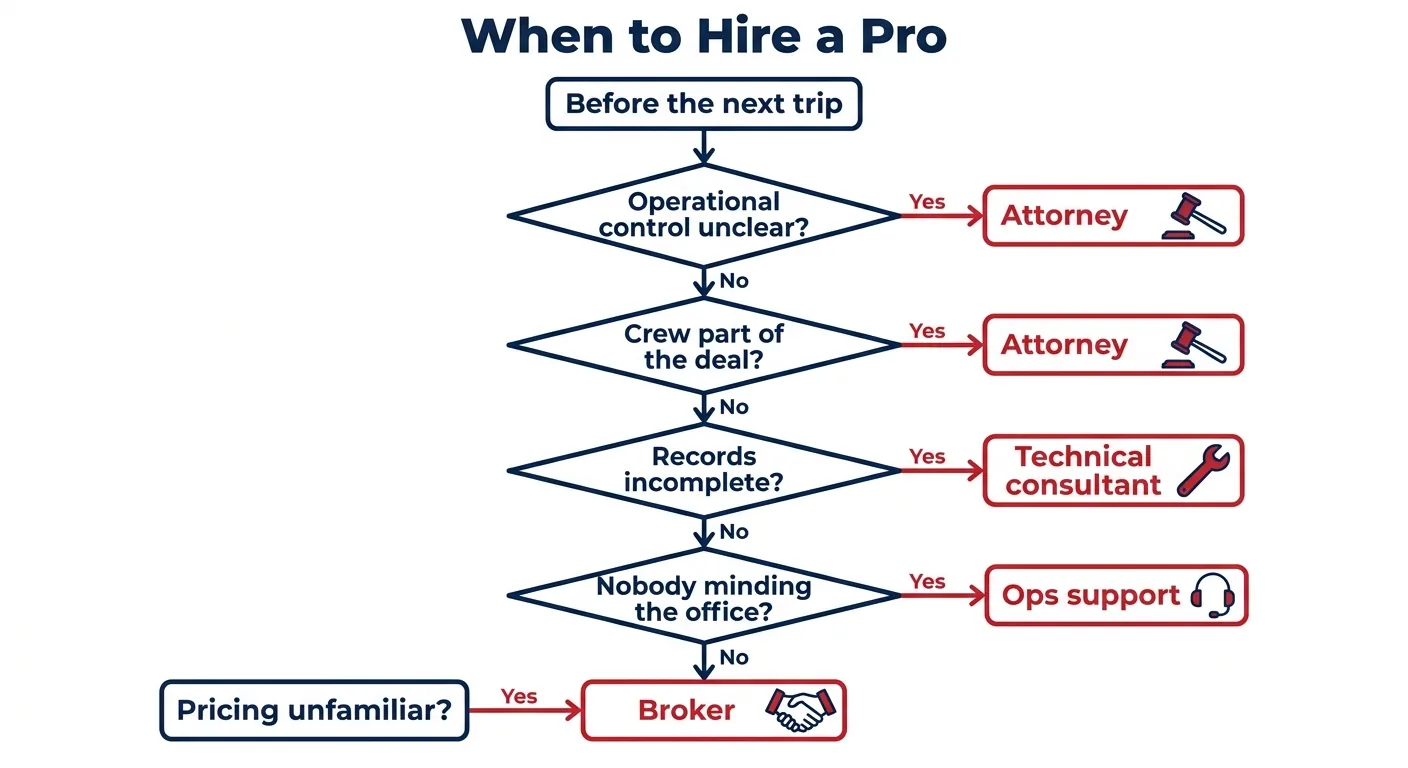
Hire the specialist that matches the problem, and do it before the next trip instead of after. The routing rule is short: attorney for classification and any crew or control question, technical consultant for records and maintenance gaps, broker for market access and negotiation, management or back-office partner for continuing operations. A broker doesn’t replace counsel or an independent inspection.
Call someone when any of these is true:
- Operational control is unclear. The lease, the pilot’s employment, the management agreement, and the billing point at different parties. Attorney first.
- Crew is part of the deal. Any lessor involvement in selecting, paying, or scheduling pilots. Attorney first.
- The aircraft is shared. Multiple lessees, non-exclusive use, or a related-entity chain. Attorney, then an operations partner to run the documentation.
- Records are incomplete. Missing logbook entries, unclear AD compliance, life-limited part exposure, undocumented damage history. Technical consultant before you sign anything.
- You’re pricing an unfamiliar type or market. Broker first, with counsel reviewing the draft.
- The trips are happening and nobody is minding the office. Operations support, before it shows up as lapsed currency and a file that can’t answer an examiner’s questions.
Ask any candidate three questions: what exactly is in your scope, what is explicitly outside it, and who holds the file between trips. WingLeader was founded by Abram Finkelstein, who has flown the trips and filed the paperwork the service handles for clients, and it’s built for operators running one to five aircraft under Part 91 rather than owners who want a turnkey management company.
If the lease is signed and the real problem is that nobody is carrying the office work between trips, talk with WingLeader about back-office support for your Part 91 operation and keep control of the aircraft and the crew where it belongs.
Frequently Asked Questions
What are the three types of aircraft leasing?
Dry, wet, and damp. A dry lease is the aircraft alone with the lessee supplying crew. A wet lease includes at least one crewmember and usually maintenance and insurance from the lessor.
Does a dry lease require the lessee to have its own flight department?
No. Those functions can be filled through third-party services, as long as the lessee, not the lessor, directs them.
Can multiple companies share one aircraft through a dry-lease structure?
Yes, through non-exclusive dry leases, but the documentation burden multiplies. Each lessee needs its own crew sourcing, its own scheduling rights, its own insurance position, and its own record of who initiated each flight. Shared airframes with a common point of contact for scheduling are the fact pattern most likely to be read as a single operator wearing several hats.
Does the lessor need an air-carrier certificate in a genuine dry lease?
Not in a genuine dry lease where the lessee operates under Part 91. The lessor is providing an asset, not transportation. That changes the moment the lessor supplies or controls crew, because supplying aircraft and crew for compensation is carriage, and carriage requires the appropriate certificate.
Can a dry-leased aircraft be used to carry customers or employees?
Employees traveling on company business generally fit within Part 91 private carriage. Customers are a different question, because carrying them can amount to holding out or to transportation for compensation. Before a customer boards, get a written classification from aviation counsel on whether the flight is private carriage, non-common carriage, or charter.
Will my insurance company cover me as a dry lessee, and how much more will it cost?
Underwriters price the operator, not the owner, so your pilots’ time in type drives the answer. Expect the policy to name you as the operator with the lessor as additional insured, and expect open-pilot warranties that set minimum hours, a recent checkout, or both. One common underwriting condition seen on smaller aircraft is a make-and-model checkout of around three hours with a qualified CFI before coverage attaches.
What happens if the aircraft is not airworthy at delivery?
That depends entirely on the delivery condition clause you negotiated. A usable clause states the required inspection status, records completeness, equipment list, and cosmetic standard, then gives the lessee an acceptance inspection, a cure period for the lessor, and a rent abatement or walk-away right if the airplane misses the standard. Without that clause, a grounded aircraft on day one is an argument, not a remedy.
What redelivery conditions should be negotiated?
Set the airframe, engine, and APU hours or cycles remaining at return, the inspection status, the required records and logbook entries, the accepted damage standard, installed equipment, and paint and interior condition. Then price the gap. If a heavy check or an engine event falls within a year of lease expiry, negotiate who funds it before signing, because that single item is the most common end-of-term dispute.
Is there a standard aircraft dry lease agreement pdf I can use?
Downloadable templates exist, and they’re a poor substitute for a lease drafted against your actual structure. A template won’t allocate your maintenance approvals, your insurance wording, your use limits, or your redelivery standard, and it won’t survive an operational control review if the conduct doesn’t match. The clause-by-clause checklist of what your agreement has to contain is in “dry lease agreement”.