
Under Part 91, the owner or lessee is the operator. The management company is a vendor. When something goes wrong, the FAA, the insurer and the lender look at you first, and the vendor’s brochure won’t be part of that conversation. That’s why vetting a provider is a governance exercise, not a shopping trip. Build a curated list of three or four candidates, then put every one of them through the same questions below and compare the answers side by side.

What actually matters when you choose Part 91 aircraft management
Five things decide the outcome. Each one should produce a decision, not a good feeling.
- Scale and focus. Does the provider work at your size? Ask how many aircraft of your make and model they support today and who your daily contact is, by name and role. A company built to run 40 jets for institutional owners works differently than one built for an operator with one to five aircraft.
- Day-to-day scope. A full back office covers 24 hour flight coordination, scheduling and dispatch, flight following, crew coordination, trip logistics, vendor and FBO management, fuel planning, compliance documentation and financial oversight of trip costs. WingLeader lists that scope for operations running one to five aircraft, including hotels, rental cars and catering, invoices when needed, and post trip reports. Whatever a provider doesn’t name stays on your desk.
- Compliance discipline. Crew currency, inspection due items, AD status and dry lease paperwork should come up on request in under a minute. Discipline is a filing system, not a promise.
- Safety evidence. Look for an IS-BAO stage, an ARGUS or WYVERN rating with a date on it, or a written safety management system with documented risk assessments and shareable findings. A safety claim with no audit trail behind it is sales copy.
- Contract clarity. Scope, exclusions, audit rights, records ownership and termination, written in plain terms, before you sign anything.
Owners stay under Part 91 for control, privacy and a simpler maintenance program. You pick the crew, you set the schedule, and nobody else sells seats on your aircraft. The tradeoff is that the liability stays with you. That’s why these five get tested in the first two conversations.
What should I ask about Part 91 focus and operational control?
Under Part 91 you or your lessee stay the operator, and the provider is a vendor supporting you. A Part 135-style manager usually puts the aircraft on its certificate, which moves operational control, the maintenance program and the crew duty rules to the certificate holder. Both models are legal. They put the liability in different places, and the full comparison on cost, risk and control is in “Part 91 vs Part 135: Cost, Risk, Control.”
Ask directly: does this arrangement leave operational control with me, and does any part of the proposal depend on my aircraft going onto your certificate? The FAA’s own fractional rules state the principle. According to the eCFR, an owner in operational control of a program flight is ultimately responsible for safe operations and for compliance with all applicable requirements of the chapter.
Put plain scenarios to the provider and listen for a plain answer:
- Your LLC owns the jet, your operating company’s executives fly on it, and the company pays the LLC under a written dry lease while the lessee directs the flights. That’s Part 91.
- You fly your own aircraft with your family and pay all the costs yourself. That’s Part 91.
- A third party pays you or your LLC for a flight and you supply the aircraft and the crew together. That becomes Part 135, certificate or not.
- The provider assigns the crew, sets the schedule and bills the passengers. Operational control has moved, and the paperwork has to say so.
| Model | Who holds operational control | Who carries the back office | Typical fit |
|---|---|---|---|
| Turnkey full-service management | Manager, often with aircraft on their certificate | Manager, end to end | Owners who want to hand over the aircraft entirely |
| Back-office support for the operator | Owner or lessee stays the operator | Provider handles scheduling, dispatch, records, compliance paperwork | Pilots, chief pilots and ops people running 1 to 5 aircraft |
| In-house only | Owner or lessee | The pilot, between flights | Very low utilization, high tolerance for paperwork risk |
Good answer: “You remain the operator, here are the documents we maintain, here are the decisions that stay with you, and nothing in this proposal depends on charter revenue.”
Bad answer: “We handle all of that for you,” with no document list and a charter assumption buried in the fee page.
WingLeader sits in the middle row and says it’s probably not the right fit for someone who wants a turnkey management company, pointing instead to firms like Clay Lacy, Solairus or Jet Aviation. Self-selection like that is a good sign from any provider.
What should I ask about safety certifications and audit history?
Ask for the registration or audit certificate, the date of the last audit, the name of the auditing organization, and whether the findings and corrective action plan are shareable. IS-BAO registration, ARGUS ratings and WYVERN Wingman all mean something, but only with a current date and a finding list attached. IS-BAO is built in three progressive stages, and Stage 3 requires a more advanced organization-wide safety culture.
For a one to five aircraft operation, a full audit program may be more structure than the operation carries today. In that case ask what does exist: a written safety management system, documented risk assessment before non-standard trips, and a record of it. WingLeader lists safety management systems, risk management practices and formalized procedures with a documented record among its services, which is the minimum shape to look for.
A good answer sounds like: “Here’s our SMS manual, here’s last year’s audit report with four findings, and here’s how each one was closed.”
Pause if you hear: “We have a strong safety culture” with nothing to hand you.
What should I ask about crew quality, training, and scheduling discipline?
Part 91 generally sets no flight time, duty or rest limits for non-commercial flights, so protection often depends on contracts and procedures. Ask who verifies crew legality before a trip is confirmed, what training standard the crew is held to, and who has the final say when you want another leg.
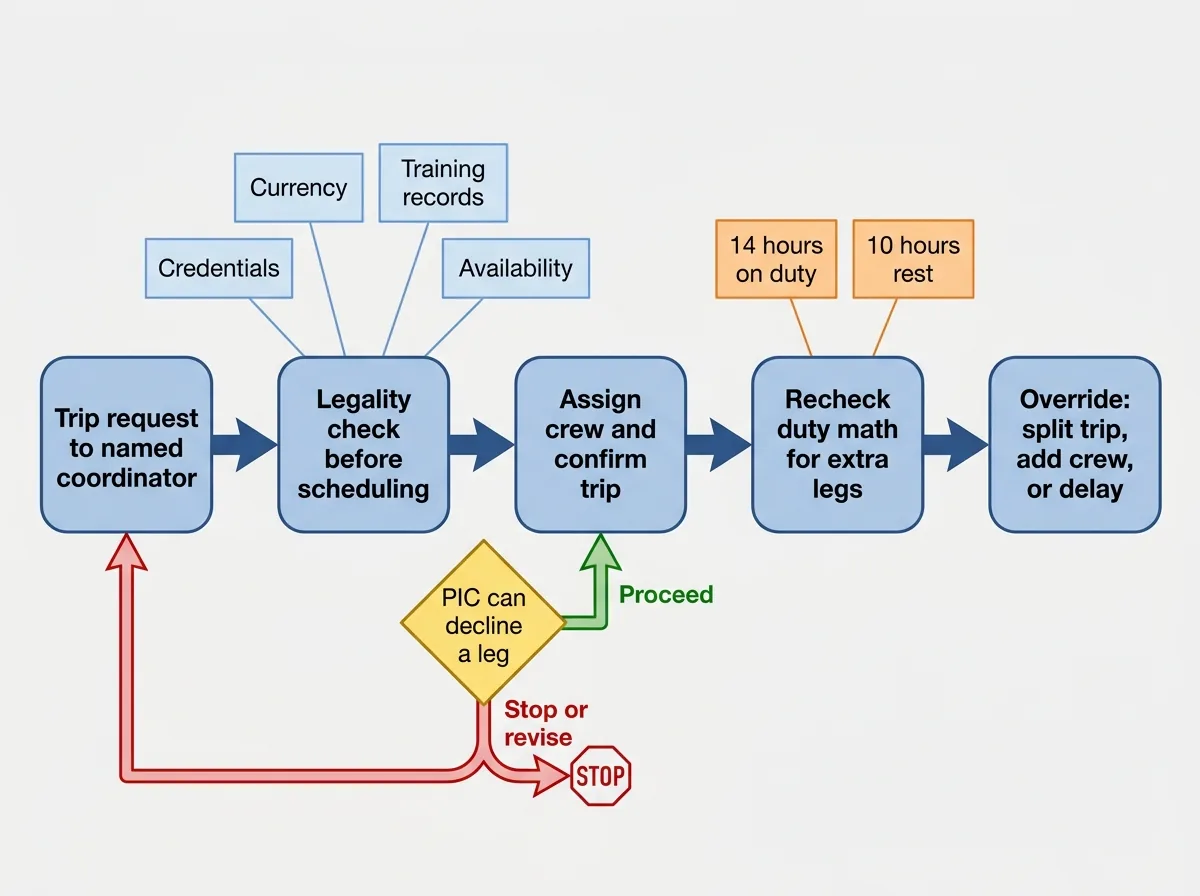
Make the provider walk you through the workflow, step by step:
- Trip request. The owner or the flight department sends dates, legs and passengers, and it lands with a named coordinator rather than a shared inbox.
- Legality check before scheduling. Credentials, currency, training records and availability get verified for the assigned crew first. At WingLeader, a trip with a crew member out of currency doesn’t get scheduled until it’s fixed, and the rule is stated plainly: before a trip goes on the schedule, the crew is legal to fly it.
- Assignment and confirmation. Crew availability, the duty projection for the day and aircraft status get checked together, then the trip is confirmed and logistics start.
- The owner pushes for extra legs. The request goes back through the same duty math before anything is promised to a passenger.
- The override. If the day runs past the duty cap, the trip gets split, a second crew gets called, or a leg moves to the next morning, and the pilot in command keeps the final no.
Good answer: “We track credentials, currency, training records and availability per crew member and verify them before every trip goes on the schedule. Recurrent is simulator-based at a named provider on a tracked interval. Our duty policy is 14 hours on duty and 10 hours rest before report, and the PIC can decline a leg without clearing it with the owner first.”
Bad answer: “Our pilots are all very experienced and we work the schedule out as we go,” with no tracked records, no numbers and nobody named who’s allowed to say no.
Two more things to ask for: written PIC and SIC minimums in your make and model with a named backup pilot pool, and crew tenure. High churn shows up later as cancellations.
If your pilot is spending nights doing this verification work by hand, that is the part of the job a support provider should be carrying.
What should I ask about compliance, records, and maintenance coordination?
Ask three questions: who holds and updates the records, what maintenance tracking system is used and whose name is on the login, and what happens in the first hour of an AOG.
A normal week should sound like this:
- Day of the trip. The coordinator follows the flight, handles changes on the fly and works the trip through completion.
- Within a day of close-out. The provider updates the flight log entry, the crew currency file and the trip expense record, and issues the post trip report for operator and passengers. Not at month end.
- Weekly. The maintenance forecast gets reviewed with a 30, 60 and 90 day look ahead plus current AD and service bulletin status per airframe and engine, so inspections get scheduled around trips instead of against them.
- The tracking login. The subscription should sit in your name with your own login, and the provider works inside it. If it sits in the provider’s name, you lose the history the day you leave.
- First hour of an AOG. A 24/7 number reaches a person. The mechanic or MRO gets called, crew and passengers get rebooked while that call is still running, and you get a status message with a next update time. Routine work up to the written approval threshold proceeds. Anything above it, anything that moves a departure by more than a few hours, and anything touching airworthiness gets escalated to the owner or chief pilot by phone.
What can legally be deferred and what grounds the aircraft is covered in “Part 91 Maintenance Requirements: What You Can Defer.”
On dry leases and operational control, structure beats intent. WingLeader keeps the lease paperwork, the records and the procedures, and acts as the point of contact between lessor and lessee so who holds operational control is documented for every flight. It doesn’t draft the lease and doesn’t give legal advice, which is the correct division of labor. Enforcement of illegal charter is an active FAA priority, particularly in Florida, so that documentation either exists per flight or it doesn’t.
Red flags: walk away
- No named maintenance tracking system, or records “kept by our mechanic.”
- Refusal to share audit findings or the corrective actions that closed them.
- Crew legality checked after the trip is booked.
- An AOG line that goes to voicemail after hours.
- A multi-year term with no exit right.

What should I ask about insurance, reporting, and contract terms?
Ask who’s named on the policy, who handles renewals and claims, and what the agreement lets you audit.
On insurance, you want your ownership entity as named insured, the provider and any lessee as additional insured with waiver of subrogation, the lender as loss payee with a breach of warranty endorsement, and passenger liability stated clearly as a per-seat sublimit or a combined single limit. Confirm who issues certificates of insurance and how fast, because a lender request on a Friday is a real event.
On reporting, ask for the monthly package itself rather than a description of it. A good one arrives on a fixed cadence and looks like this:
- A monthly statement per aircraft, with trip costs allocated by flight, passenger use listed by leg, and each category split out: fuel, crew travel, maintenance, hangar, insurance, trip support.
- Invoices generated when needed, itemized, with the vendor receipts attached rather than summarized.
- Post trip reports for the operator and the passengers, issued after each trip instead of batched at month end.
- A compliance page: crew currency status, inspection due items, AD status, and dry lease documentation on file.
- A stated cadence and a named sender. Post trip report within a day or two, monthly package by a fixed day of the following month, and one named person who answers questions about a line item.
WingLeader tracks trip costs, passenger use and allocation by flight, and generates invoices and post trip reports for operator and passengers. A provider that can’t hand you a sample package with the client name removed doesn’t produce them.
On the contract, insist on audit rights covering records, cost allocations and safety documentation; ownership of records with a delivery obligation on termination; a termination right on 30 or 60 days notice; written scope with named exclusions; and a billing cycle and dispute process you can live with. The FAA’s fractional rules require a program manager to brief the owner on operational control responsibilities when an initial, renewal or extension contract is signed. Outside Subpart K nobody makes a provider do that, so write the equivalent into your agreement.
A fair quote keeps the fee and the expenses apart: one recurring fee stated in plain numbers, operating expenses passed through at cost and itemized by category, vendor discounts flowing to you, numeric triggers for any surcharge, and onboarding or records digitization fees disclosed up front. WingLeader’s model is a monthly retainer per aircraft based on flight hours, and its cost calculator returns an estimated annual variable operating cost with a line-item breakdown of fuel, engine program, parts program and maintenance. Ranges, sample budgets and the comparison against doing it all yourself belong in “Part 91 Guide: Costs, Options and When to Hire.”
Part 91 aircraft management checklist
Print this and use the same sheet for every provider on your list. One rule sits above it: governance and auditability decide the outcome, because the documents either exist or they don’t.
- Focus: aircraft of my type under management, named daily contact, honest statement of who they’re not built for.
- Operational control: stays with me, documented per flight, no assumption of charter.
- Safety: current audit or registration with date, auditor name, findings and closure record, written SMS.
- Crew: credentials and currency verified before scheduling, aircraft-specific recurrent on a tracked interval, written PIC and SIC minimums, backup pilot pool, duty and rest numbers in the contract, a clear rule for the extra leg.
- Maintenance: named tracking platform with my login, 30/60/90 day forecast, AD and service bulletin status, written approval threshold, documented AOG escalation with a 24/7 human.
- Compliance: dry lease paperwork and records held and produced on request, provider doesn’t blur the line into legal advice.
- Insurance: named insured, additional insured with waiver, loss payee with breach of warranty, passenger limits stated, certificate turnaround confirmed.
- Reporting: sample monthly package and sample invoice reviewed before signing, cadence and sender in writing.
- Contract: audit rights, records ownership, 30 to 60 day exit, scope and exclusions named in writing.
Compare providers on governance, not promises. The one that hands you documents fastest is usually running the tightest operation.
Ready to get the office handled while you keep control of the aircraft and the crew? See how WingLeader supports Part 91 operations running one to five aircraft.
Frequently Asked Questions
Can a poorly structured aircraft management arrangement cause regulatory issues under FAA Part 91?
Yes. The most common failure is a management or lease arrangement where the paperwork doesn’t match who actually directs the flight, which can put the operation in charter territory without anyone intending it. The fix is documentary: a properly structured dry lease, a per-flight record of who held operational control, and a provider that keeps that file current rather than rebuilding it after an inquiry.
Which maintenance and AOG questions reveal whether a provider can protect my schedule?
Three of them. What tracking system holds my records and whose name is on the login, how often the maintenance forecast is reviewed, and who I reach in the first hour of an AOG. A provider that protects your schedule reviews the 30, 60 and 90 day forecast weekly and books inspections around trips, as the section on compliance, records and maintenance coordination lays out. If the AOG answer is a phone number with no named escalation path and no written approval threshold, you’ll find that out at the FBO.
What are the red flags in an aircraft management proposal’s insurance section for a privately operated business jet?
Watch for a proposal that names limits without stating whether passenger liability is a per-seat sublimit or a combined single limit, one that lists the manager as named insured on your hull, and one that’s silent on waiver of subrogation. Also ask who negotiates a claim. If the provider handles the claim and the broker relationship with no obligation to report to you, you lose visibility at the worst possible moment.
What software do Part 91 flight departments actually use for scheduling and maintenance tracking?
Small departments commonly run a scheduling platform such as Airplane Manager or FOS alongside a maintenance tracking system such as CAMP, Traxxall or Veryon. Ask which systems your provider uses, whether the subscriptions are in your name or theirs, and whether you keep the data if the relationship ends. Records ownership matters more than the brand name.
What should a Part 91 aircraft management quote include beyond the monthly management fee?
The fee and the pass-through expenses belong in separate blocks, with operating costs itemized by category: fuel, crew travel, maintenance, hangar, insurance and trip support. Ask whether vendor discounts flow to you, whether any surcharge carries a numeric trigger, and whether onboarding or records digitization is billed once at the start. Anything the written scope doesn’t name is an exclusion, so read the exclusion list next to a real sample invoice. The section on insurance, reporting and contract terms lists the clauses that keep that structure enforceable.
If I plan to move the aircraft into charter later, how should I set up Part 91 management now?
Keep the records audit-ready from day one, pick a maintenance program that a certificate holder can accept rather than one you’ll have to rebuild, and keep interior and configuration documentation complete. Conformity work is mostly a records exercise, and operators who kept clean files get through it in weeks instead of months. Decide on entity structure with your own attorney and tax advisor; a support provider maintains the paperwork but shouldn’t be advising you on the structure itself.