
Most owners ask this question backwards. They start with cost, when the answer turns on who is paying for the transportation. What follows is a side by side comparison of Part 91 and Part 135 on the criteria that change the answer, written for the pilot, chief pilot or operations person who has to live with the decision.

Quick take: Part 91 fits private control, Part 135 fits higher oversight and charter use
If the aircraft stays private and the owner wants maximum control over crew, schedule and airports, Part 91 is the fit. If the aircraft carries paying passengers, or the owner wants a certificate holder absorbing operational responsibility under a regulated safety structure, Part 135 is the fit. As the FAA’s Safe Air Charter Team notes, private pilots may not act as pilot in command for compensation or hire under Part 91 when carrying persons or property for compensation or hire.
Part 121, the scheduled airline rulebook, sits above both and only enters the picture past roughly 30 seats. The mechanics of the Part 91 compensation line are covered in “What Is Part 91 Operations? The Plain-English Guide.”
Part 91 vs Part 135 at a glance
| Criterion | Part 91 | Part 135 |
|---|---|---|
| Primary use | Private and internal business flying, no carriage for compensation or hire, with narrow reimbursement exceptions such as pro rata cost sharing | On-demand commercial carriage of passengers or cargo for hire |
| Certificate and ops specs | No operating certificate and no operations specifications | Air carrier certificate plus operations specifications, each aircraft listed on them after a conformity inspection |
| Operational control | Owner or operator holds it and answers for the flight | Certificate holder holds it and answers for the flight |
| Liability posture | Owner exposed directly, typically at lower liability limits | Certificate holder’s commercial policy usually primary, limits often double |
| Crew requirements | Commercial certificate can be enough, no FAA recurrent check interval | Mandatory recurrent training, PIC proficiency checks, drug and alcohol testing program |
| Crew size | Set by the aircraft flight manual and the type certificate | Single pilot allowed with ops spec authorization and an approved autopilot for IFR; Part 121 requires two pilots |
| Duty and rest | No fixed daily duty ceiling, operator policy governs | Hard flight time and duty limits by crew composition |
| Maintenance | Manufacturer’s recommended inspection program | FAA approved program, additional tasks, audited |
| Airport access | Performance based, short and unreported fields available | Landing distance margin and weather reporting requirements narrow the list |
| Passenger documentation | No routine passenger ID check and no per-leg manifest | Passenger identification and a manifest for every leg |
| Tax | Federal excise tax generally not due on most structures | 7.5 percent federal excise tax on domestic transportation plus segment fee |
| Revenue | None, owner carries the full cost | Charter revenue offsets cost, adds hours and wear |
Control and liability
Under Part 91 the owner or operator initiates, conducts and terminates the flight. According to the eCFR, under Part 135, the certificate holder holds operational control, and the regulations say it plainly: an owner is not in operational control of a flight when the aircraft is being operated under Part 121 or Part 135.
That means the owner owns the consequences.
The transfer is the reason some risk-averse owners accept a heavier rulebook. Insurance follows control. Commonly quoted benchmarks for a large cabin jet put Part 91 liability limits near $100 million, while the same aircraft on a certificate frequently carries $200 million or more, with the operator’s commercial policy sitting first in line after a claim. In a catastrophic event, that gap is uncompensated exposure that reaches the owner’s balance sheet.
The trap sits between the two models. The FAA treats the aircraft owner as the operator unless a properly structured dry lease is in place, and a handshake lease with a friendly company does not survive an examiner reading the file. Enforcement of illegal charters is an active FAA priority, particularly in Florida. The FAA letter is one outcome. Insurance is the other: if a claims adjuster decides a Part 91 flight looked commercial, coverage can be voided, and the owner is left holding the loss personally with no certificate holder’s commercial policy standing in front of it. Whoever signed the lease and whoever paid for the fuel are the two questions that decide who gets the letter.
Documented operational control is a paperwork job. WingLeader stores records, procedures and dry lease paperwork and acts as the conduit to the dry lessee and dry lessor (so the file shows who controlled each flight). WingLeader does not provide legal advice and does not provide the dry lease document itself. That comes from aviation counsel.
Safety oversight and crew rules
Part 135 buys consistency. Part 91 buys latitude. On this criterion the comparison comes down to fatigue and repeatability.
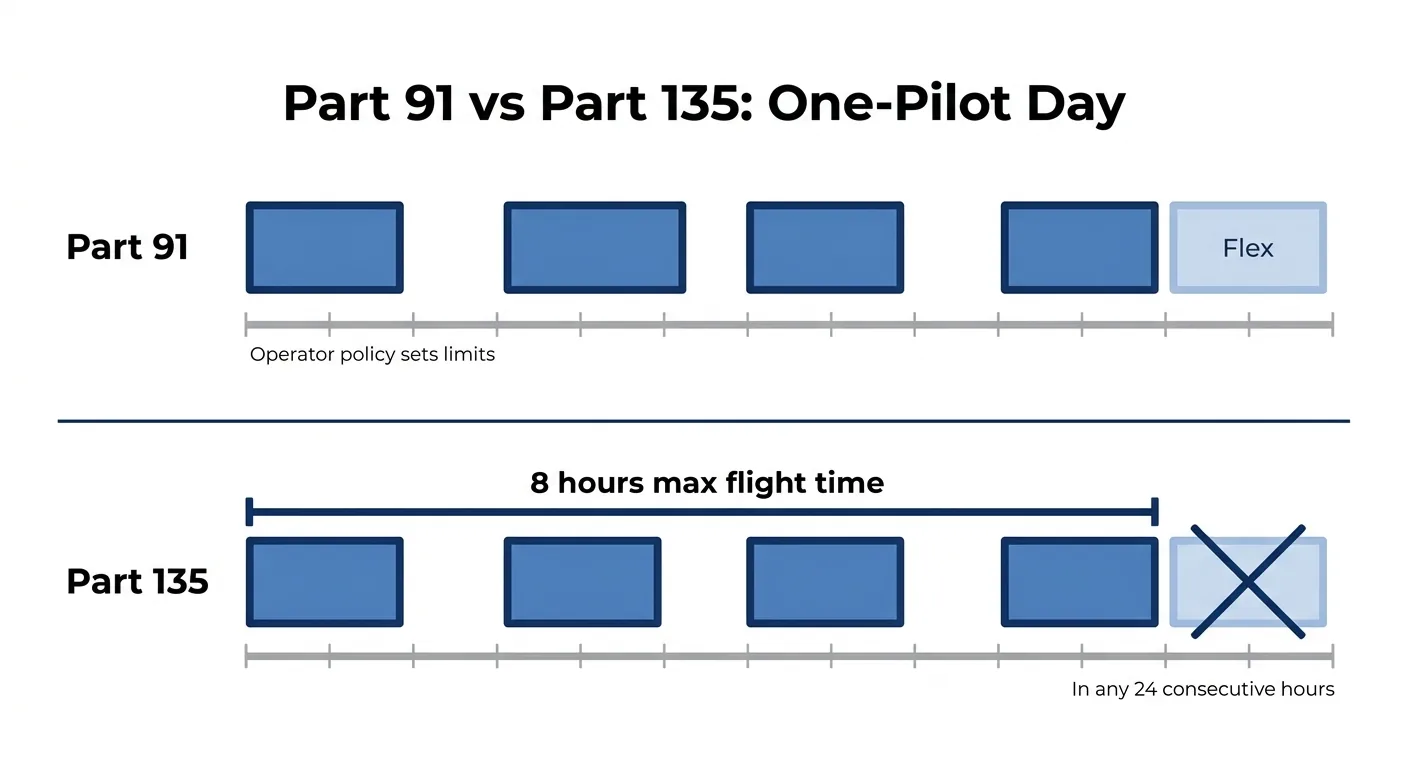
Under Part 135, captains sit for FAA mandated proficiency checks on a six month cycle. Crews fall under a drug and alcohol testing program with a random pool, and duty and rest are numbers instead of judgment calls. Cornell Law School reports that during any 24 consecutive hours, total flight time for a one-pilot crew may not exceed 8 hours. The pilots also have to be employed by the certificate holder that has operational control of the flight.
Those numbers land on the schedule. A single pilot flying four short legs on a busy day reaches the 8 hour ceiling and the day is over, even if the passengers want one more leg. Under Part 91 the same pilot can keep going and the call falls to the operator’s own policy. The six month check cycle pulls each captain off the line twice a year into a training slot booked months ahead, and every crew member has to sit in the random drug and alcohol testing pool before the first revenue leg. Part 91 buys back that flexibility and hands the fatigue call to whoever is tracking the week, which is often the same person flying. Operators close that gap with written duty limits, insurance driven annual training and a scheduler willing to say no.
Airport access and mission flexibility
Part 135 narrows the airport list in two specific ways.
- Landing distance margin. The aircraft has to be able to make a full stop landing within 60 percent of the effective runway length at the destination.
- Weather reporting. Destinations generally need approved weather reporting, which removes a share of the short, unattended fields that made the airplane attractive in the first place.
Part 91 flies the same airplane into those fields on actual performance numbers, contaminated runway data and the day’s weight. For a light jet or turboprop working 4,000 foot strips, that margin is the difference between a 20 minute drive and a 90 minute drive for the passengers.
Schedule changes work the same way. A Part 91 trip can flex a departure by three hours on a phone call. A Part 135 trip flexes inside duty limits, crew legality and the dispatch release. Protective, yes. Slower, also yes. Owners who bought the airplane for exclusive use, privacy and short notice departures feel that difference first.
Maintenance, paperwork, and operating cost
Moves almost always run one direction, from Part 91 onto a Part 135 certificate, and the airframe does not change. The file cabinet changes, and that is where the annual delta lives. For the same light or midsize jet, budget these added lines under Part 135:
- Certificate entry work. A conformity inspection plus an operations specifications amendment before the first revenue leg. Operations specifications are the FAA approved authorizations that state what the certificate holder may fly, where, and under what conditions. The aircraft has to be listed on them.
- Approved inspection program. More frequent inspections and added tasks versus the manufacturer’s recommended program under Part 91, with service bulletin and airworthiness directive compliance tracked to an auditable standard.
- An approved minimum equipment list. Deferrals become documented, time limited and inspector visible.
- Training spend on a calendar. Initial and recurrent ground and flight training, the six month captain check cycle, and the administrative cost of the testing pool.
- Recurring records. Load manifests per leg, passenger identification, flight and duty time records, and training folders per crew member, with retention rules that outlast the crew’s employment.
- Insurance. Lighter oversight and lower utilization keep Part 91 premiums down. A certificate holder carries the operational exposure and roughly double the liability limit, so hull premiums for a large cabin jet commonly run 40 to 50 percent higher under Part 135.
- Tax on revenue. The 7.5 percent federal excise tax on domestic air transportation plus the per-passenger segment fee, priced into the charter rate rather than absorbed.
Charter revenue on an under-utilized aircraft can offset a meaningful slice of fixed cost. But the offset arrives as hours, and hours bring cycles, engine program draw and earlier heavy inspections. Full cost tables for a Part 91 operation sit in the silo hub, “part 91.”
The admin hours are the line owners forget. Somebody has to keep the file current every month. WingLeader carries that office for operators running 1 to 5 aircraft: dispatch, flight following, scheduling, crew coordination, compliance documentation including dry lease records, and expense tracking, with pilot credentials, currency and training records checked before any trip goes on the schedule, so a trip with a crew member out of currency does not get scheduled until it is fixed. The free cost calculator at flywingleader.com/cost-calculator/ returns an estimated annual variable operating cost from jet category, expected annual flight hours and fuel price, with fuel, engine program, parts program and maintenance broken out line by line on request. Abram Finkelstein has flown the trips and filed the paperwork the service handles for clients. If the office work is stacking up between trips, see how back-office support sized for 1 to 5 aircraft works.
Choose Part 91 if, choose Part 135 if
Part 91 applies to the owner, corporate flight department or individual flying privately, with nobody outside paying for transportation. Here is the decision rule.
Choose Part 91 if:
- The aircraft flies the owner, employees and guests, and nobody outside the company pays for transportation.
- Mission value comes from short runways, unreported fields and same-day schedule changes.
- The owner wants direct say over crew selection, training vendor and maintenance timing.
- Exclusive use and privacy come first: passengers are not routinely carded or listed on a manifest for every leg.
- Utilization is already high enough that charter revenue would rarely fill an empty day.
Choose Part 135 if:
- Third parties will pay for seats or flight time.
- You would rather have operational control and primary liability sit with a certificate holder than with you.
- The board, the CFO or the insurer wants an audited safety structure.
- The aircraft sits idle enough that revenue offsets a real share of fixed cost.
- Higher liability limits with a commercial policy in the primary position are worth the higher hull premium.
Key takeaway: Compensation decides whether you have a choice. Liability tolerance and utilization decide which side of the choice you take. Cost is the output, not the input.
Can a flight be Part 91 one leg and Part 135 the next?
Yes, and it happens most weeks. The operating part is set leg by leg by two questions: who holds operational control of that leg, and who is paying for it. Walk a normal charter day and the trigger for each leg is easy to name.
- Deadhead positioning. The certificate holder flies the empty airplane to the pickup airport. Trigger: no passenger and no payment for transportation, so the leg runs under Part 91.
- Empty leg sold to a customer. Trigger: a third party pays to ride that repositioning flight, so it becomes a Part 135 revenue leg with the certificate holder in operational control.
- Owner flight home. Same airplane, same crew, owner and family aboard. Trigger: the owner or the owner’s entity holds control and nobody buys transportation, so the leg is Part 91 (as long as the lease and the records say so).
- Reimbursed guest flight. The owner flies out Part 91 and a company guest rides home while the guest’s employer sends a check. Trigger: a payment for the transportation arrives from outside, and that payment, not the itinerary, is what an examiner reads.
The dollar mechanics decide that last one. Cost sharing under Part 91 is narrow: the pilot may pay no less than a pro rata share of fuel, oil, airport expenses and rental fees, so a $1,200 fuel and fees bill split among a pilot and three passengers leaves the pilot carrying at least $300. A $6,000 check for a trip that burned $1,200 in fuel is charter without a certificate. Private pilots may not act as pilot in command for compensation or hire under Part 91 when carrying persons or property for compensation or hire.
If your operation runs 1 to 5 aircraft and the office work is piling up between trips, see what back-office support for Part 91 operations covers.
Frequently Asked Questions
What is the difference between part 91 and part 121?
Part 91 is the baseline rulebook for private, non-commercial flying. Part 121 is the scheduled airline rulebook, with dispatch systems, approved training centers and the tightest maintenance and duty structure of the three. The practical boundary runs on aircraft size: on-demand Part 135 work tops out around 30 seats or 7,500 pounds of payload capacity, and past that you are into Part 121. The three parts side by side are covered in “Part 91 vs 121 vs 135.”
Is NetJets part 135 or part 91?
Both, depending on the leg. Owner flights run under Part 91 Subpart K and the charter side runs under a Part 135 certificate, with the same airplanes and crews switching operating part from one leg to the next.
Can a pilot over 65 fly part 135?
Yes. The age 65 retirement rule applies to Part 121 airline pilots, not Part 135 on-demand operations. A Part 135 pilot over 65 needs a current medical certificate and the required checks. The practical limit becomes insurance underwriting rather than the regulation.
Can part 135 fly single pilot?
Yes, with single-pilot authorization written into the operator’s operations specifications and, for IFR, an approved autopilot in place of a second in command. Not every aircraft or operation qualifies, and the flight time ceiling for a one-pilot crew is tighter than for a two-pilot crew.
Can I keep some aircraft Part 91 and place one on a Part 135 certificate?
Yes. Mixed fleets are common in operations running 1 to 5 aircraft. Each aircraft needs its own conformity work and operations specifications entry to go on the certificate, and the scheduling side has to keep the two rule sets from bleeding into each other. Crew currency, maintenance tracking and records get harder, which is where most small operations feel the strain.
Who does part 91 apply to?
Part 91 applies to civil flights in US airspace that are not carriage for compensation or hire under a higher part: owner-flown trips, corporate flight departments, fractional owner legs under Subpart K, and the positioning legs of charter operators. It is also the baseline set of flight rules, so a Part 135 flight follows Part 91 too, with the extra Part 135 requirements stacked on top. “What Is Part 91 Operations? The Plain-English Guide” walks through who it covers in detail.