
A contract pilot arrangement almost never fails because the pilot flies badly. It fails because of how the arrangement was structured, documented, and billed. The pilot is typed, current, and sharp on the airplane, and the operation still ends up in front of an FAA inspector trying to explain who actually held operational control.
The mistakes below produce enforcement letters, denied insurance claims, and trips that cancel at the FBO. Each one has a tell. Each one has a fix that takes less time than the cleanup.
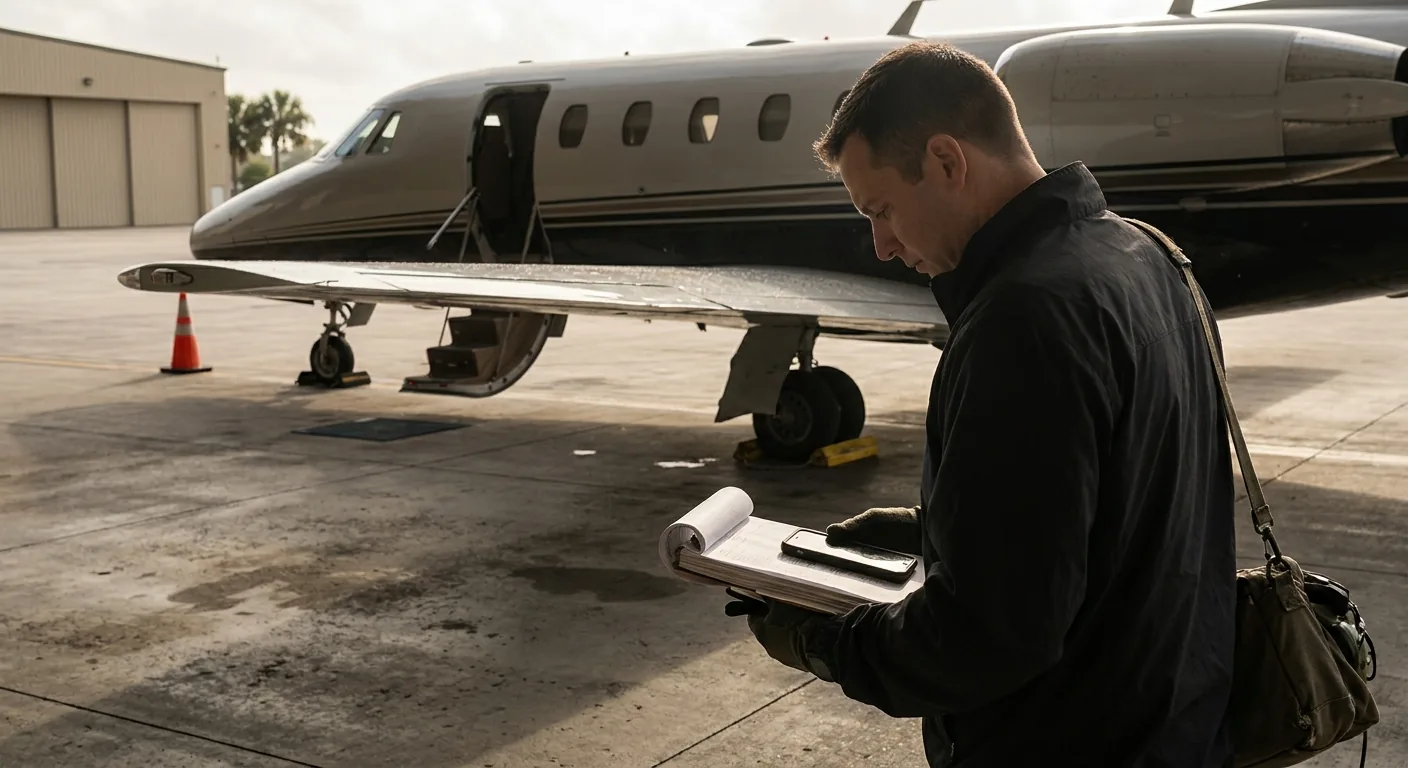
Why Part 91 Contract Pilot Mistakes Happen
A Part 91 contract pilot is a certificated pilot who flies an owner’s or lessee’s aircraft for pay while that owner or lessee keeps operational control and no air carrier certificate is involved. Every mistake below follows one pattern: the facts of the operation stop matching that structure, one trip at a time, and nobody stops to check.
The drift is predictable. Owners want flexibility, pilots want flight time and a day rate, and everybody assumes the paperwork will get cleaned up later. It rarely does. Six months in, the manager is picking the crew, the owner’s business partner is being invoiced per leg, and nobody can point to a signed agreement that says who decides whether a trip goes.
Treating the Job Like Unlimited Freelance Flying
Yes, a pilot flying Part 91 can be paid for flying, provided the pilot holds at least a commercial certificate and is being compensated for pilot services rather than for providing transportation. The line is what the money buys. Pay for flying an owner’s airplane is pilot services. Pay that effectively buys a seat, a route, or a trip from whoever assembled the airplane and the crew is transportation for compensation, and that requires an operating certificate. Becoming a Part 91 contract pilot means holding at least a commercial certificate with instrument privileges, the type rating and aircraft-specific training for the airplane, a current medical, satisfied recent experience and the policy’s open pilot minimums, with the credentials, currency and training records checked before a trip goes on the schedule.
This mistake looks ordinary. A pilot takes open-ended work from a broker or a friend with an airplane. The trips repeat. Somebody starts quoting a price per trip that includes the airplane. Passengers who have no relationship to the owner start showing up on the manifest.
Why it happens: the arrangement grows one trip at a time, and no single trip feels like charter.
What it costs: civil penalties, an insurance carrier that declines the claim because the flight was a commercial operation the policy never covered, and a pilot certificate in jeopardy.
The right move: avoid public-facing offers of transportation. Advertise pilot services and your qualifications, never the airplane, the seat or the trip. Define the passenger universe before the first trip, and keep per-seat pricing and broker trip quotes out of the arrangement. Sell your time, never the lift.
Letting the Paperwork Say One Thing and the Operation Do Another
“Part 91 pilot” means a pilot operating under the FAA’s baseline general operating rules, where the operator is the owner or lessee rather than a certificate holder. The pilot in command carries the airworthiness and operational responsibility for the flight. Everything above that (whether the trip gets scheduled, who approves the maintenance, who the passengers are) belongs to whoever holds operational control. The mistake is never writing that down.
Vague arrangements create two problems at once. The FAA looks at the facts and decides for you who the operator was. Your insurer does the same thing, and with less patience.
Picture the dispute. A trip cancels for weather, the owner’s assistant says the pilot canceled it and wants the day back, and the pilot says the office booked the FBO and the passengers so the trip was never his to hold. A discrepancy from the last leg is still sitting there because nobody agreed who approves the maintenance. The passengers have been sending their schedule changes straight to the pilot’s phone. Four facts settle who the operator was: who cancels, who books, who approves maintenance, and who receives passenger requests. With no document, whoever answers those in practice is the operator.
What a mismatch looks like in practice:
- The agreement says the owner retains operational control, but the pilot routinely accepts trip requests directly from passengers.
- The pilot signs the fuel release, books the FBO, and decides the routing, while the owner’s assistant handles cancellations.
- Nobody can produce a signed pilot services agreement at all, only text messages.
The fix is one document type: a written pilot services agreement, or a crewmember agency agreement where the pilot acts as the operator’s agent for the flight. It names who accepts trip requests, who cancels, who approves maintenance, and who the passengers call. If the document and the habit disagree, change the habit or change the document. Do not leave both running.
Using a Dry Lease Pattern That Still Looks Like Charter
The most common legal trap in Part 91 contract flying is a dry lease that functions like a wet lease. On paper the lessee has the airplane and hires the crew. In fact the lessor is doing the operating. The FAA calls that a sham lease, and it is treated as an unauthorized air carrier operation. The FAA treats the aircraft owner as the operator unless a properly structured dry lease is in place, and enforcement of illegal charters is an active FAA priority, particularly in Florida.
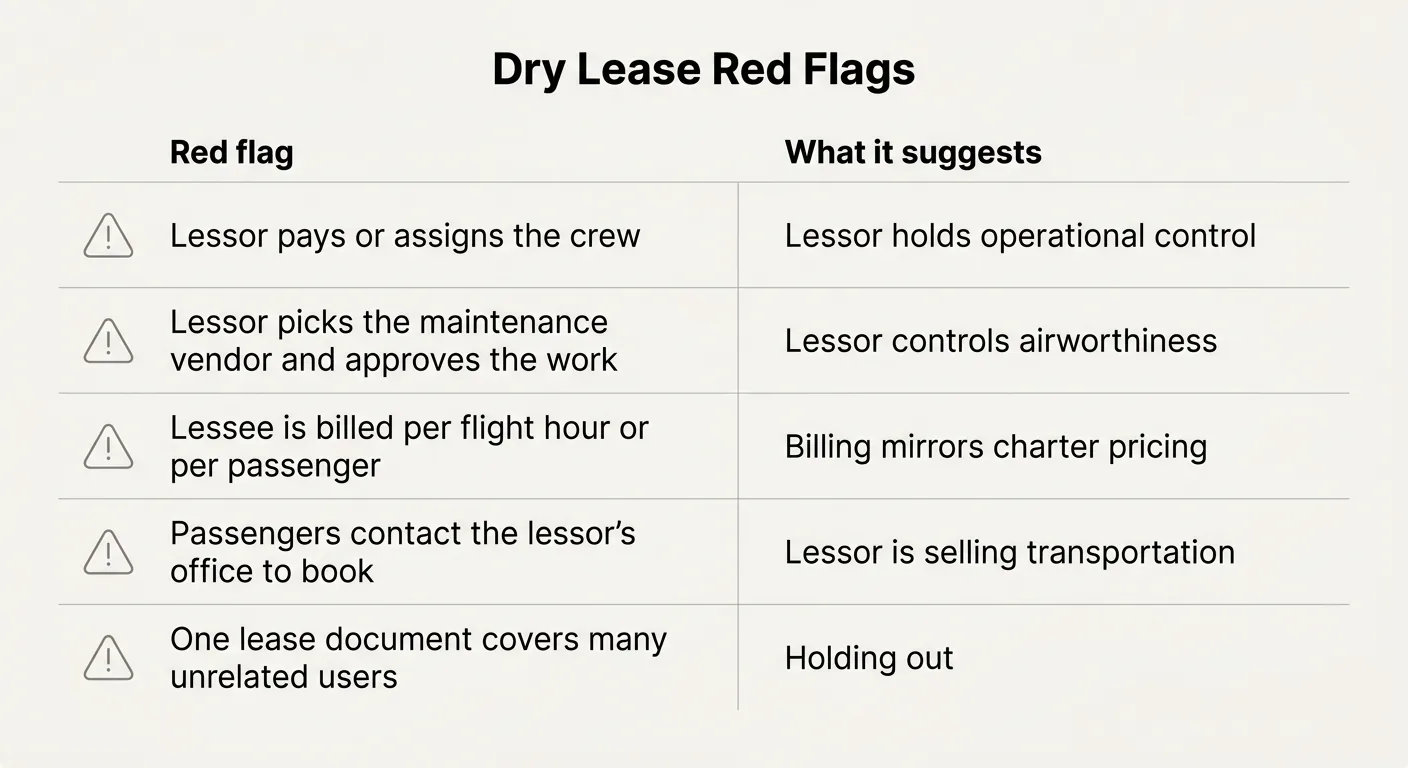
The red flags are specific and easy to self-check:
| Red flag | What it suggests |
|---|---|
| Lessor pays or assigns the crew | Lessor holds operational control |
| Lessor picks the maintenance vendor and approves the work | Lessor controls airworthiness |
| Lessee is billed per flight hour or per passenger | Billing mirrors charter pricing |
| Passengers contact the lessor’s office to book | Lessor is selling transportation |
| One lease document covers many unrelated users | Holding out |
The right move is alignment: the lessee chooses and pays the crew, directs maintenance, holds the airworthiness decision, receives passenger requests, and is billed like a lessee rather than a charter customer.
As one factual example of how that control gets documented: on a dry lease, WingLeader keeps the lease paperwork, the records and the procedures, and acts as the point of contact between lessor and lessee so who holds operational control is documented for every flight. WingLeader does not draft the lease and does not give legal advice.
If you want the office side handled without giving up control of your airplane and crew, see how the back-office support works.
Skipping Qualification, Currency, and Aircraft-Specific Training Checks
A contract pilot for Part 91 operations needs the certificate and rating for the aircraft, a current medical, satisfied recent-experience requirements, aircraft-specific initial or recurrent training, and whatever the insurance policy’s open pilot warranty demands. General experience is not qualification. A 12,000 hour pilot with three type ratings can still be out of currency for the approach the trip requires.
This mistake comes from time pressure. A trip pops up Thursday for Saturday, somebody recommends a pilot, and the records never get checked. Then the flight ends up with an out-of-currency crew member, the insurer finds the gap during a claim, and coverage evaporates. Or the checkride-sharp part goes fine and the trip simply cancels at the ramp when the discrepancy surfaces.
Mission-specific qualifications get their own line. International authorizations, high-altitude or oceanic experience, and terrain or short-field work are where a generally qualified pilot comes up short. Run the check at assignment time, and run it again for every new aircraft and every new mission profile.
Verify before assignment, not before departure:
- Certificate, ratings, and current medical
- Recent experience for the intended operation, including instrument currency
- Aircraft-specific training date and provider
- Insurance open pilot warranty minimums, by make and model
- Mission-specific items: international authorizations, high-altitude or oceanic experience, terrain or short-field profiles
WingLeader tracks pilot credentials, currency, training records, and availability, and checks them before any trip goes on the schedule. A trip with a crew member out of currency does not get scheduled until it is fixed. That is the whole discipline in one sentence, and it is cheap compared to a canceled trip with passengers already at the FBO.
Common mistakes box
- Hiring on reputation instead of records
- Verifying the pilot once and never again
- Treating a type rating as proof of recency
- Ignoring the owner’s policy language on pilot minimums
- Letting the pilot self-certify with no document on file
Assuming the Flight Is Still Part 91 When the Facts Say Otherwise
This is the one that does the most damage: the arrangement starts as a legitimate pilot-for-hire setup, and over time the operational facts start to describe a Part 135 operation. Nothing gets signed to make that happen. It happens through habit, and nobody runs the test that would catch it.
Classify the operation mission by mission against the real control, payment and passenger facts, not against the labels on the lease, the invoice or the trip sheet. As the eCFR notes, an owner is in operational control of a program flight when the owner holds the stated rights and limitations, has directed that the aircraft carry passengers or property that owner designated, and the aircraft is carrying them. That owner is then ultimately responsible for safe operations and for compliance with applicable requirements, including airworthiness. The full boundary between the two parts is covered in “Part 91 vs Part 135: Cost, Risk, Control” and in “What Is Part 91 Operations?
The four-question check, before every new mission profile:
- Control. Who is the operator in fact on this mission, the owner or lessee, or somebody else?
- Passengers. Who are they to the owner, and who did they call to arrange the flight?
- Money. What exactly is being paid for, to whom, and does the invoice describe a lease payment or a trip price?
- Appearance. If an FAA inspector read your last 20 trip records end to end, would the pattern look private or would it look like a small charter operation?
The gray areas are where pilots get caught, so here they are stated plainly:
- Social media advertising. This is fine: a post that advertises your pilot services, your ratings and your time in type. This will get you violated: the same post adding “your airplane or ours” or a price per trip, because that offers transportation to whoever reads it.
- Broker relationships. This is fine: a broker who refers owners to you and then steps out of the deal. This will get you violated: a broker who sources the airplane, quotes the client a trip price and assigns you to the flight, which makes one operation selling lift with your certificate in the middle of it.
- Multiple-client flying. This is fine: flying for six owners in a month, each one hiring you directly for their own airplane. This will get you violated: six trips where the passengers call you first and you arrange the airplane for them.
If any answer points away from the owner or lessee, stop scheduling and fix the structure.
How to Get the Arrangement Right Before the First Flight
Five things in writing before the first flight, and most of the failures above never start.
- Operational control. A plain statement that the owner or lessee is the operator and the pilot acts as the operator’s agent, with trip acceptance and cancellation authority named.
- Qualification. What the pilot is cleared to fly: certificates, medical, recency, aircraft-specific training and open pilot warranty compliance, dated and on file.
- Insurance and indemnity. Named or additional insured status where the carrier allows it, waiver of subrogation where feasible, and indemnity running both directions.
- Cancellation and reposition. What happens when a trip moves, repositions or cancels, plus the internal duty and rest standard that applies, written as a contract term since Part 91 gives you no numeric framework.
- Records. Where the signed agreement, the qualification file and the lease documents live, and who produces the whole set during an inspection.
Day rates, tax structure and the fuller setup walkthrough sit outside this article; the cost side and the case for hiring outside support are covered in “Part 91 Guide: Costs, Options and When to Hire.”
WingLeader was founded by Abram Finkelstein, who flies as a volunteer pilot for Veterans Airlift Command, Challenge Air and Angel Flight SE and has flown the trips and filed the paperwork the service handles for clients. If your operation runs 1 to 5 aircraft, talk with WingLeader about carrying the back office while you keep the airplane and the crew.
Frequently Asked Questions
How to become a Part 91 contract pilot?
Hold at least a commercial certificate with instrument privileges, add the type rating for the aircraft you intend to fly, complete manufacturer or approved aircraft-specific training, and meet the insurance open pilot warranty for that make and model, which usually specifies total time, multi-engine time, and time in type. Then build a paper file: certificates, medical, recency, training dates. Owners who check records hire the pilot who can produce them in an hour.
Do I need my employer’s permission before flying contract trips on my days off?
Read the outside employment clause in your airline or flight department policy before you accept the trip. Many require written approval for any flying for compensation, and some bar it outright on reserve days or during a training footprint. Get the approval in writing and keep it with your qualification file, and remember that a contract leg on a day off still eats the rest you owe your next scheduled trip.
Can a contract pilot be used for Part 91 flights without a Part 135 certificate?
Yes. Paying a pilot for pilot services does not turn a private flight into a commercial operation. The certificate question turns on whether anyone is providing transportation for compensation, which depends on who controls the aircraft, who the passengers are, and what the payment actually buys.
Does Part 91 have duty time limits for contract pilots?
Part 91 imposes no numeric duty and rest framework for most operations, which is exactly why operators write their own. A common internal standard is a 14 hour duty day with a flight time cap around 8 to 10 hours and 10 hours of rest before duty. Put the numbers in the agreement so a late trip request does not become a negotiation at 9 p.m.
Who has operational control in a Part 91 contract pilot setup?
The owner or the lessee, not the pilot and not a management company. Operational control means the authority to initiate, conduct, and terminate a flight. If a manager is choosing crew, directing maintenance vendors, and taking passenger bookings, the facts say the manager is the operator regardless of what the contract claims.
What records should an owner keep for a Part 91 contract pilot?
The signed pilot services agreement, the pilot’s certificates and medical, proof of recent experience and aircraft-specific training, insurance documentation showing the pilot meets policy requirements, and trip records tying each flight to an authorized mission. Keep the lease documents with them when a dry lease is involved. The test is whether you can produce the set during an inspection without hunting through email.
What liabilities should the agreement address in Part 91 flying?
Name who indemnifies whom and for what, who carries the deductible on a hull or liability claim, and whether the owner waives subrogation against the pilot. Add governing law and venue so a dispute does not turn into an argument about where it gets heard. For the pilot, payment timing with a stated remedy for nonpayment belongs in the same section, since a 30 day term with no late clause is the most common way contract pilots get stiffed.
What insurance issues affect Part 91 contract pilot operations?
The open pilot warranty is the first trap, because a pilot who misses a stated minimum by 50 hours in type can void coverage for that flight. The second is status: a contract pilot relying on the owner’s policy without being named has no coverage for personal liability, which is why some pilots carry non-owned aircraft coverage. Ask the broker in writing whether the pilot is covered and get the response on file before the first trip.